5 min read
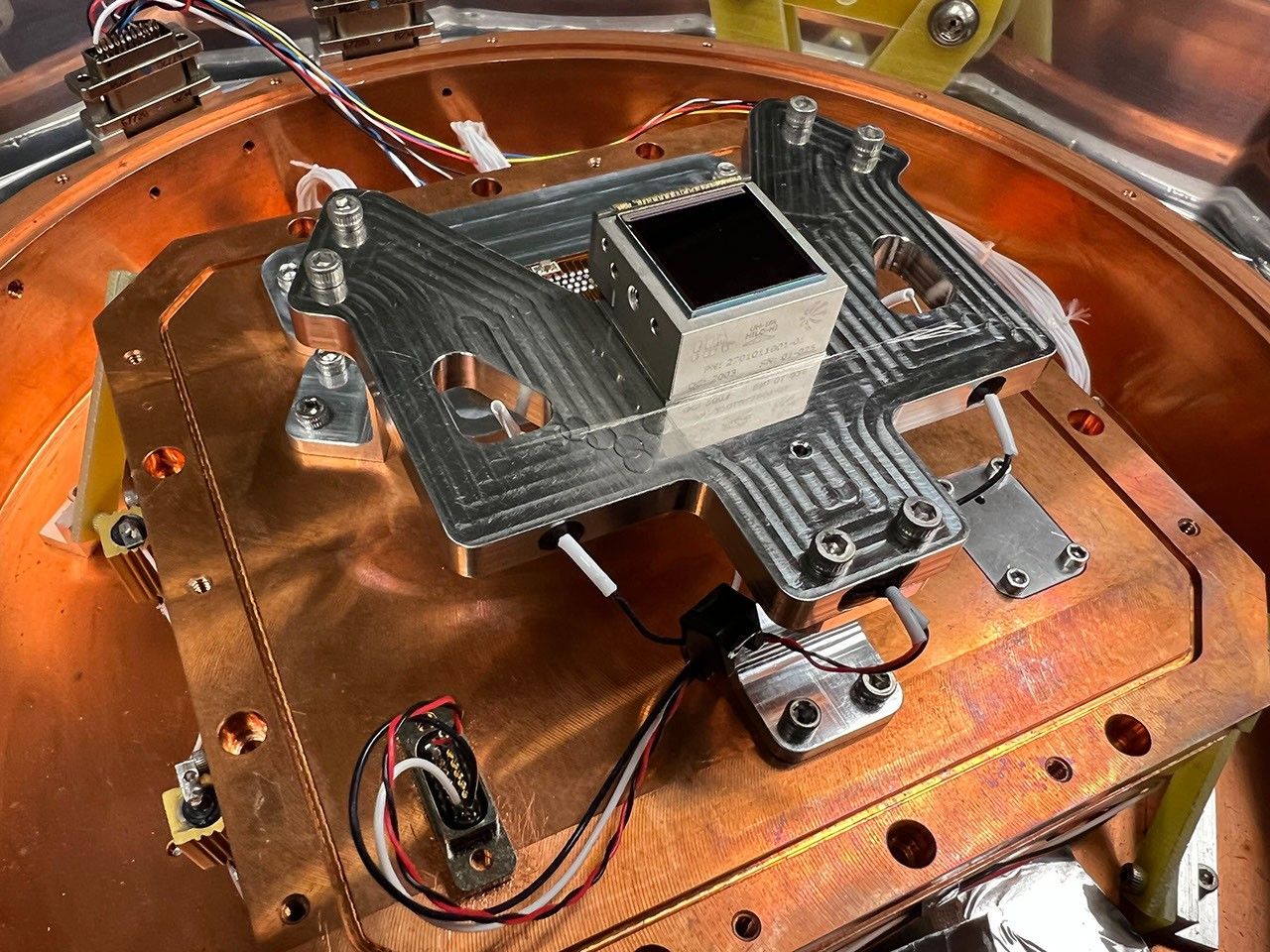
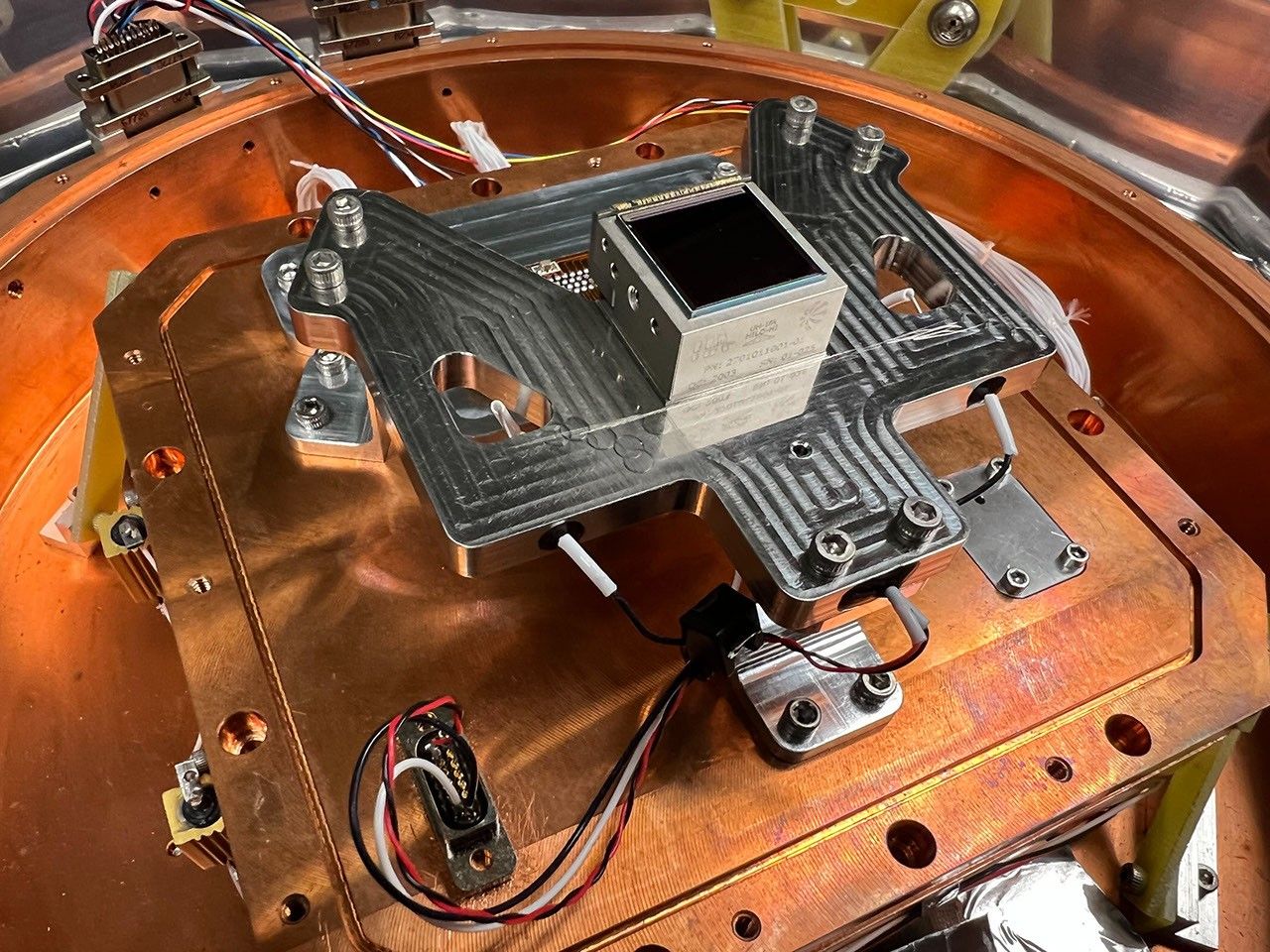
Ultra-low-noise Infrared Detectors for Exoplanet Imaging 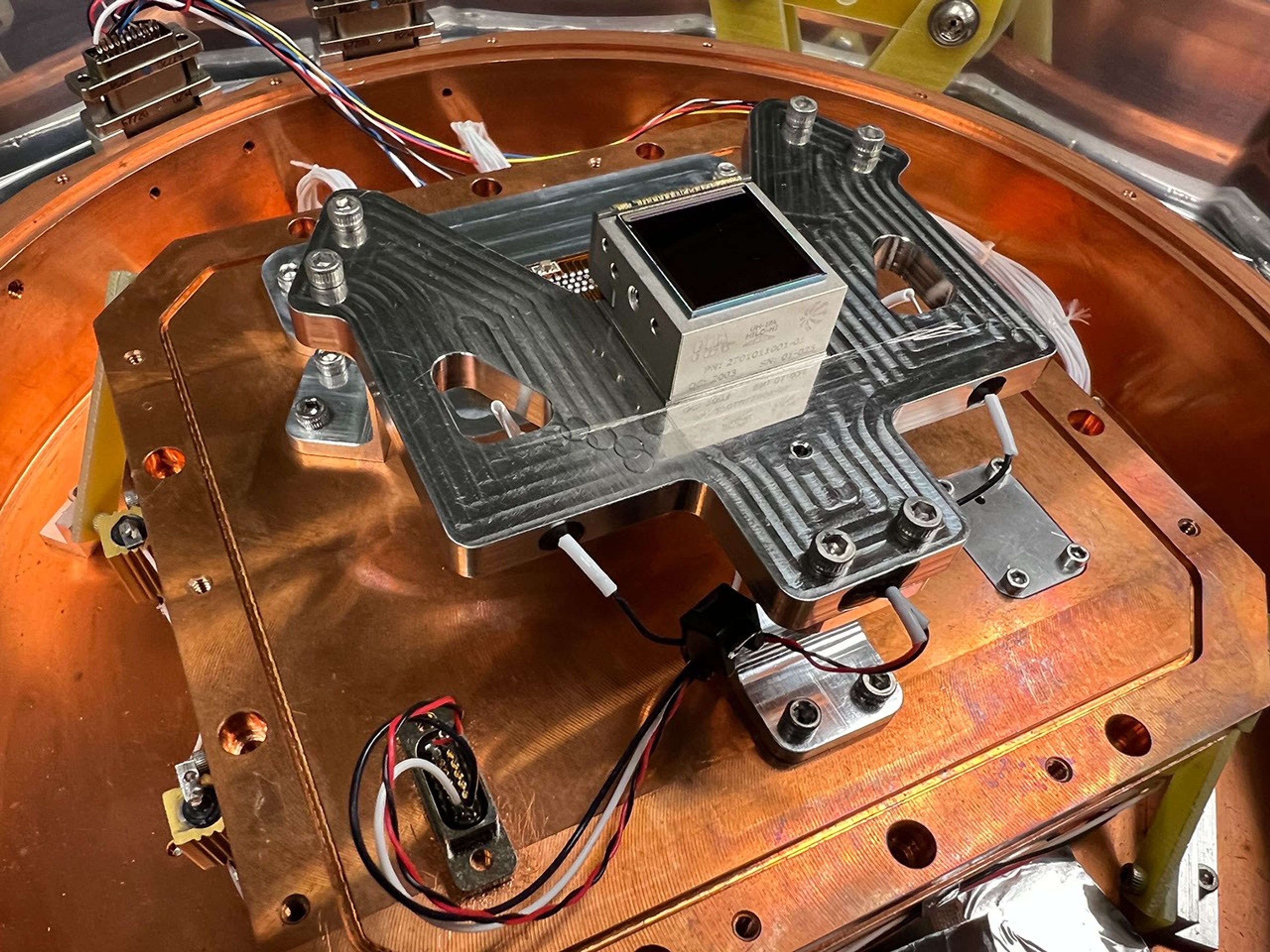 A linear-mode avalanche photodiode array in the test dewar. The detector is the dark square in the center. Michael Bottom, University of Hawai’i One of the ultimate goals in astrophysics is the discovery of Earth-like planets that are capable of hosting life. While thousands of planets have been discovered around other stars, the vast majority of these detections have been made via indirect methods, that is, by detecting the effect of the planet on the star’s light, rather than detecting the planet’s light directly. For example, when a planet passes in front of its host star, the brightness of the star decreases slightly.
However, indirect methods do not allow for characterization of the planet itself, including its temperature, pressure, gravity, and atmospheric composition. Planetary atmospheres may include “biosignature” gases like oxygen, water vapor, carbon dioxide, etc., which are known to be key ingredients needed to support life as we know it. As such, direct imaging of a planet and characterization of its atmosphere are key to understanding its potential habitability.
But the technical challenges involved in imaging Earth-like extrasolar planets are extreme. First such planets are detected only by observing light they reflect from their parent star, and so they typically appear fainter than the stars they orbit by factors of about 10 billion. Furthermore, at the cosmic distances involved, the planets appear right next to the stars. A popular expression is that exoplanet imaging is like trying to detect a firefly three feet from a searchlight from a distance of 300 miles.
Tremendous effort has gone into developing starlight suppression technologies to block the bright glare of the star, but detecting the light of the planet is challenging in its own right, as planets are incredibly faint. One way to quantify the faintness of planetary light is to understand the photon flux rate. A photon is an indivisible particle of light, that is, the minimum detectable amount of light. On a sunny day, approximately 10 thousand trillion photons enter your eye every second. The rate of photons entering your eye from an Earth-like exoplanet around a nearby star would be around 10 to 100 per year. Telescopes with large mirrors can help collect as much of this light as possible, but ultra-sensitive detectors are also needed, particularly for infrared light, where the biosignature gases have their strongest effects. Unfortunately, state-of-the-art infrared detectors are far too noisy to detect the low level of light emitted from exoplanets.
With support from NASA’s Astrophysics Division and industrial partners, researchers at the University of Hawai’i are developing a promising detector technology to meet these stringent sensitivity requirements. These detectors, known as avalanche photodiode arrays, are constructed out of the same semiconductor material as conventional infrared sensors. However, these new sensors employ an extra “avalanche” layer that takes the signal from a single photon and multiplies it, much like an avalanche can start with a single snowball and quickly grow it to the size of a boulder. This signal amplification occurs before any noise from the detector is introduced, so the effective noise is proportionally reduced. However, at high avalanche levels, photodiodes start to behave badly, with noise exponentially increasing, which negates any benefits of the signal amplification. Late University of Hawai’i faculty member Donald Hall, who was a key figure in driving technology for infrared astronomy, realized the potential use of avalanche photodiodes for ultra-low-noise infrared astronomy with some modifications to the material properties.
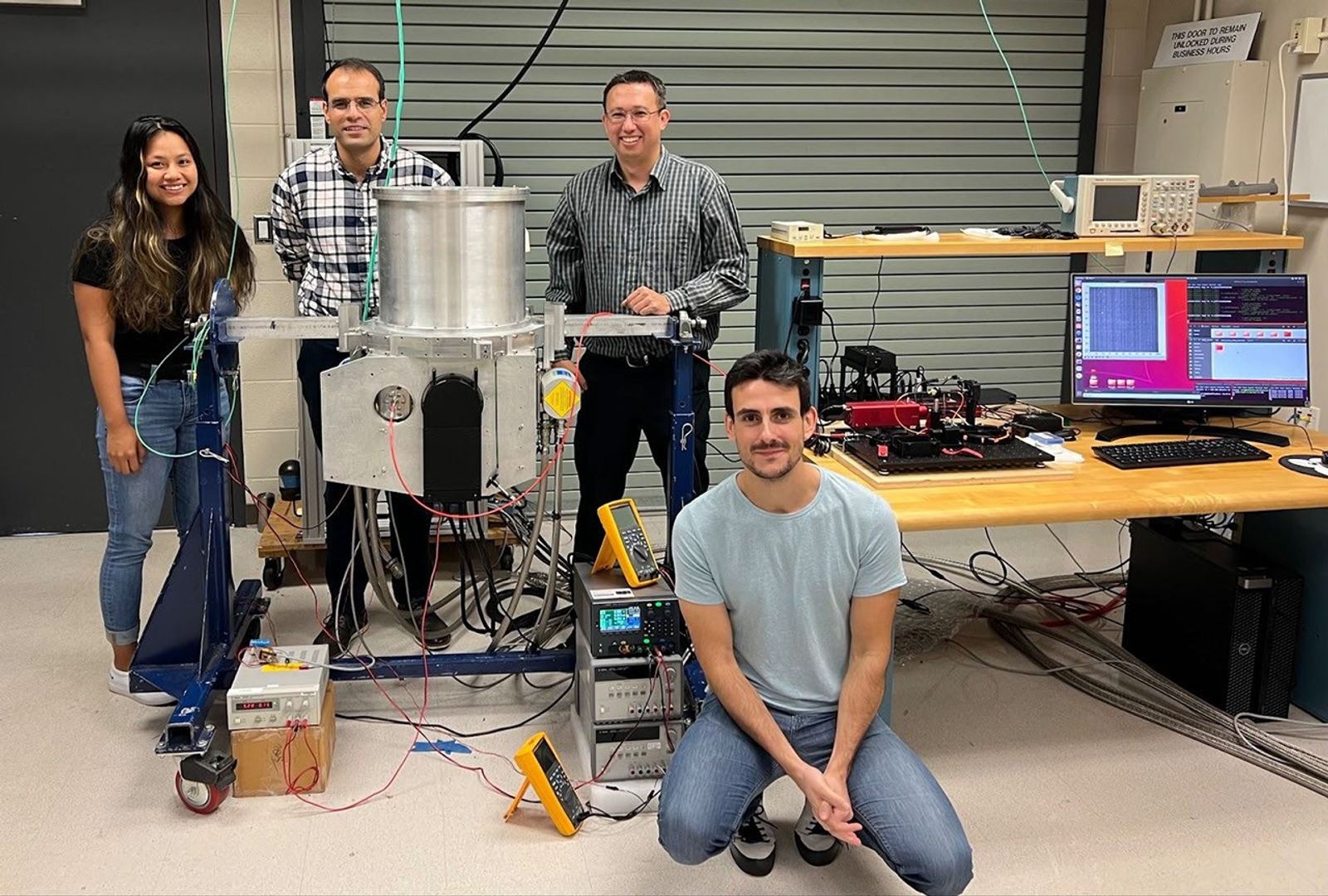 University of Hawai’i team members with cryogenic dewar used to test the sensors. From left to right, Angelu Ramos, Michael Bottom, Shane Jacobson, Charles-Antoine Claveau. Michael Bottom, University of Hawai’i The most recent sensors benefit from a new design including a graded semiconductor bandgap that allows for excellent noise performance at moderate amplification, a mesa pixel geometry to reduce electronic crosstalk, and a read-out integrated circuit to allow for short readout times. “It was actually challenging figuring out just how sensitive these detectors are,” said Michael Bottom, associate professor at the University of Hawai’i and lead of development effort. “Our ‘light-tight’ test chamber, which was designed to evaluate the infrared sensors on the James Webb Space Telescope, was supposed to be completely dark. But when we put these avalanche photodiodes in the chamber, we started seeing light leaks at the level of a photon an hour, which you would never be able to detect using the previous generation of sensors.”
The new designs have a format of one megapixel, more than ten times larger than the previous iteration of sensors, and circuitry that allows for tracking and subtracting any electronic drifts. Additionally, the pixel size and control electronics are such that these new sensors could be drop-in replacements for the most common infrared sensors used on the ground, which would give new capabilities to existing instruments.
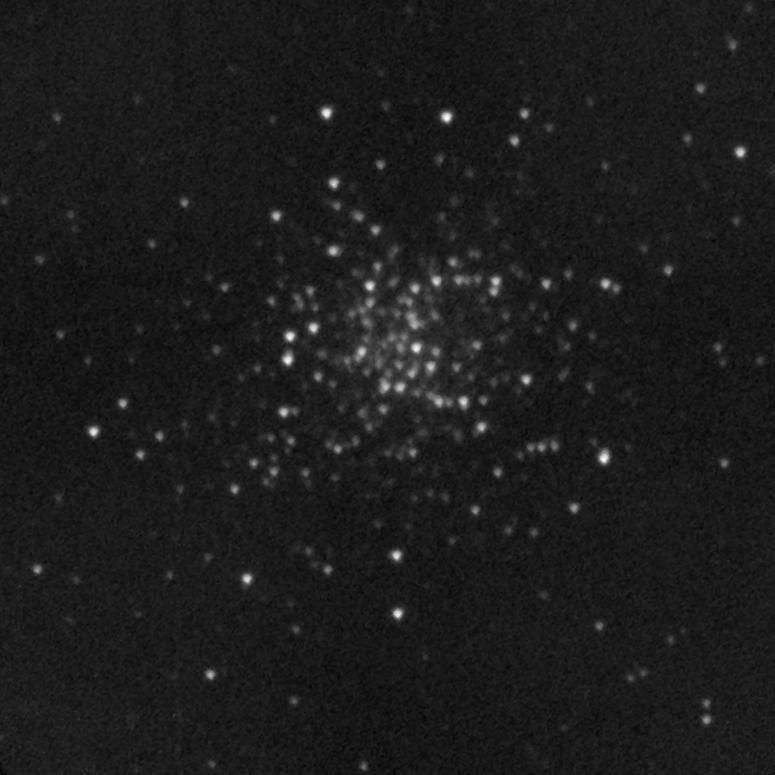 Image of the Palomar-2 globular cluster located in the constellation of Auriga, taken with the linear-mode avalanche photodiode arrays, taken from the first on-sky testing of the sensors using the University of Hawai’i’s 2.2 meter telescope. Michael Bottom, University of Hawai’i Last year, the team took the first on-sky images from the detectors, using the University of Hawai’i’s 2.2-meter telescope. “It was impressive to see the avalanche process on sky. When we turned up the gain, we could see more stars appear,” said Guillaume Huber, a graduate student working on the project. “The on-sky demonstration was important to prove the detectors could perform well in an operational environment,” added Michael Bottom.
According to the research team, while the current sensors are a major step forward, the megapixel format is still too small for many science applications, particularly those involving spectroscopy. Further tasks include improving detector uniformity and decreasing persistence. The next generation of sensors will be four times larger, meeting the size requirements for the Habitable Worlds Observatory, NASA’s next envisioned flagship mission, with the goals of imaging and characterizing Earth-like exoplanets.
Project Lead: Dr. Michael Bottom, University of Hawai’i
Sponsoring Organization: NASA Strategic Astrophysics Technology (SAT) Program
Details Last Updated Feb 18, 2025 Related Terms Technology Highlights Astrophysics Astrophysics Division Science-enabling Technology
 6 min read Webb Reveals Rapid-Fire Light Show From Milky Way’s Central Black Hole
Article
5 mins ago
 2 min read Hubble Captures a Cosmic Cloudscape
Article
4 days ago
 5 min read Webb Maps Full Picture of How Phoenix Galaxy Cluster Forms Stars
Article
5 days ago