
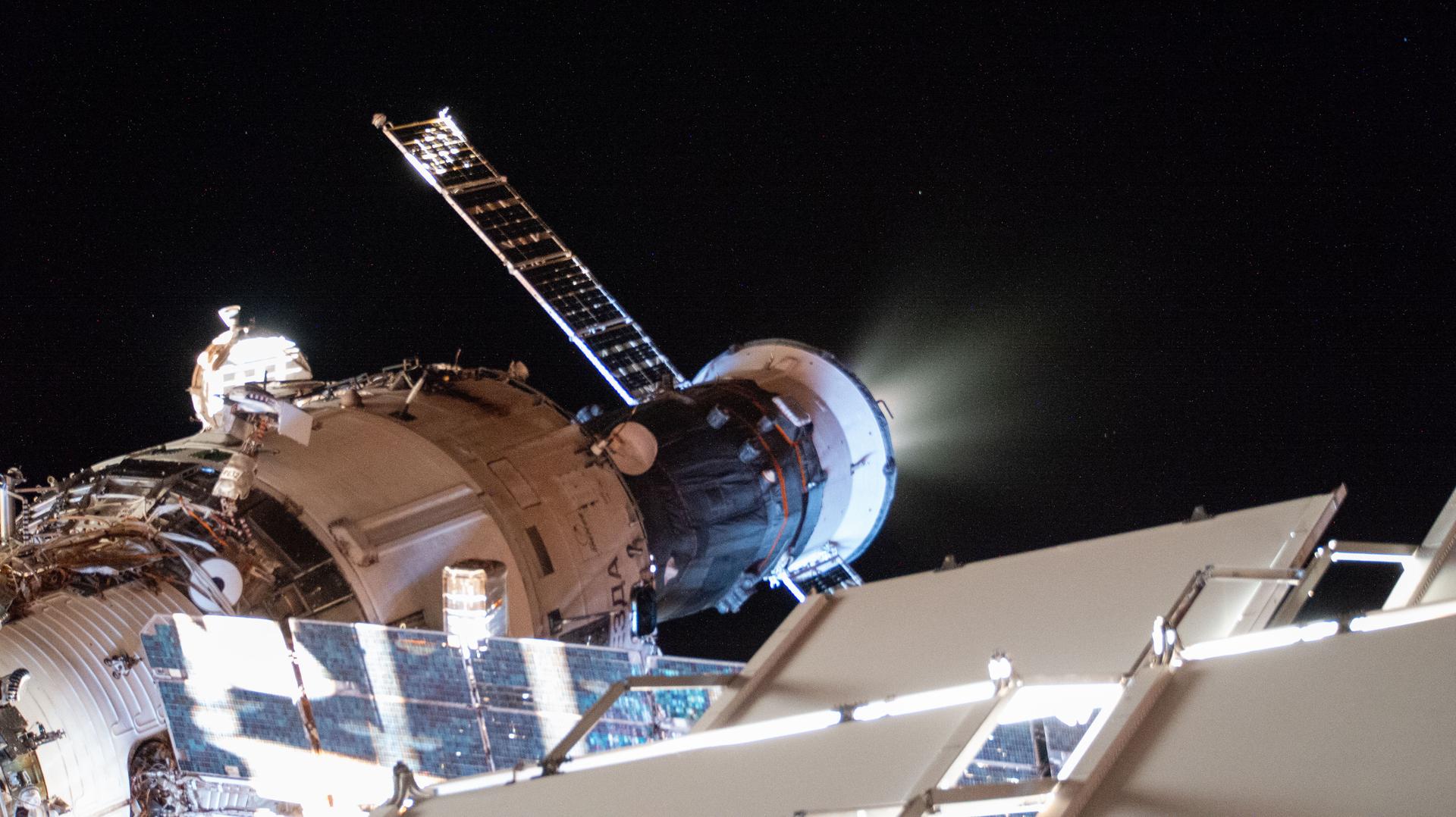

The International Space Station is orbiting higher today after the Progress 93 resupply ship, docked to the Zvezda service module, fired its engines for just over five minutes Wednesday night. The orbital reboost places the space station at the correct altitude for the upcoming Progress 95 cargo mission scheduled to resupply the Expedition 74 crew at the end of April.
Meanwhile, brand new science experiments are underway and advanced lab hardware is being installed on the orbital outpost following the arrival of the Cygnus XL cargo spacecraft on Monday. The crew has been unpacking several tons of scientific gear, research samples, crew supplies, and more since the hatches were opened on Cygnus on Tuesday.
NASA flight engineers Jack Hathaway, Jessica Meir, and Chris Williams took turns on Thursday learning how to manage cardiovascular health and infectious diseases in space. Hathaway started first setting up a portable glovebag in the Harmony module and configuring the Multi-use Variable-g Platform (MVP) that can generate artificial gravity for a wide range of biology and physics investigations. Meir and Williams then installed sample hardware housing bacteria and heart tissue samples inside the MVP. Researchers will observe how bacteria affects heart tissue in the microgravity environment to learn how to treat heart and infectious diseases.
Later in his shift, Hathway installed light hardware inside the Columbus laboratory module’s Veggie facility and collected light measurements for the upcoming Veg-06 study to learn how to grow plants for food on future space missions. Meir swapped blood stem cell samples inside the Destiny laboratory module’s fluorescent microscope providing researchers with insights into cancerous diseases and blood disorders. Finally, Williams installed the new European Enhanced Exploration Exercise Device, or E4D, inside Columbus. The E4D is being evaluated for its ability to support crew workouts on missions to the Moon, Mars, and beyond.
At the beginning of her shift on Thursday, flight engineer Sophie Adenot from ESA (European Space Agency) assisted her crewmates with the scientific work and the E4D installations. She later finalized the installation of a new quantum physics module inside the Destiny laboratory module’s EXPRESS rack. The new module expands the Cold Atom Lab’s (CAL) quantum science capabilities for improved insights into general relativity and aid the search for dark matter.
Roscosmos cosmonauts Sergey Kud-Sverchkov and Sergei Mikaev began their day conducting maintenance and inspections inside the Zvezda service module. The duo later split up as Kud-Sverchkov studied ways to use artificial intelligence tools to improve crew operations while Mikaev continued inspections inside Zvezda. Cosmonaut Andrey Fedyaev spent his shift on lab maintenance disinfecting water tanks, checking the battery levels of tablet computers, and replacing orbital plumbing gear.
Learn more about station activities by following the space station blog, @space_stationon X, as well as the ISS Facebookand ISS Instagram accounts.
Get the latest from NASA delivered every week. Subscribe here.