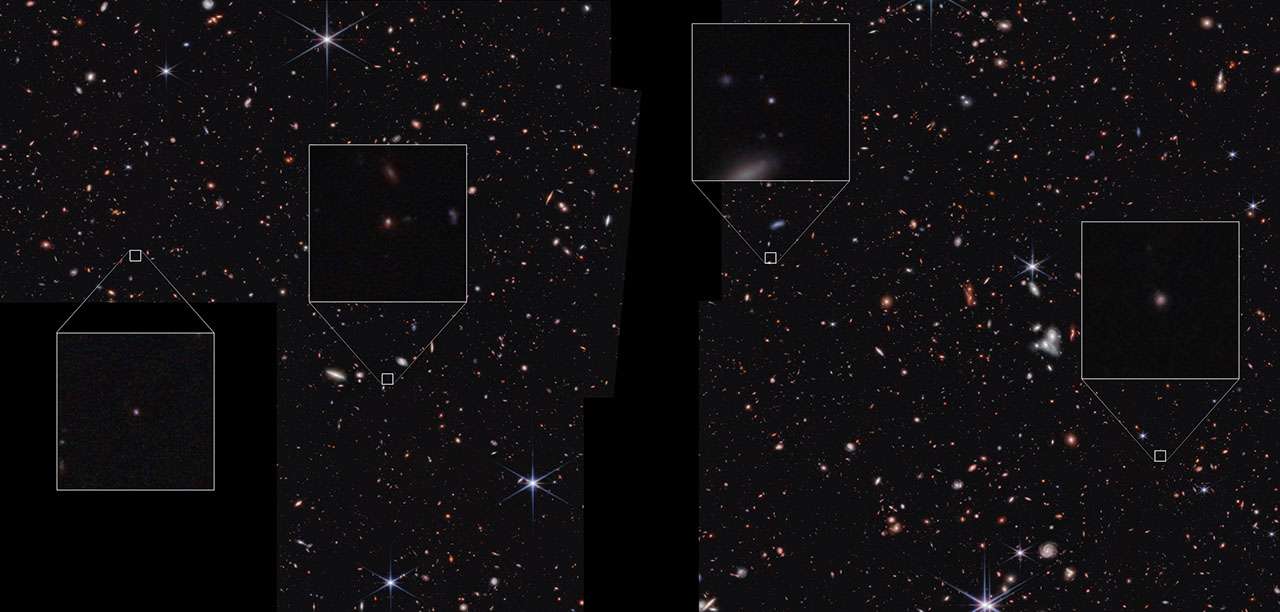
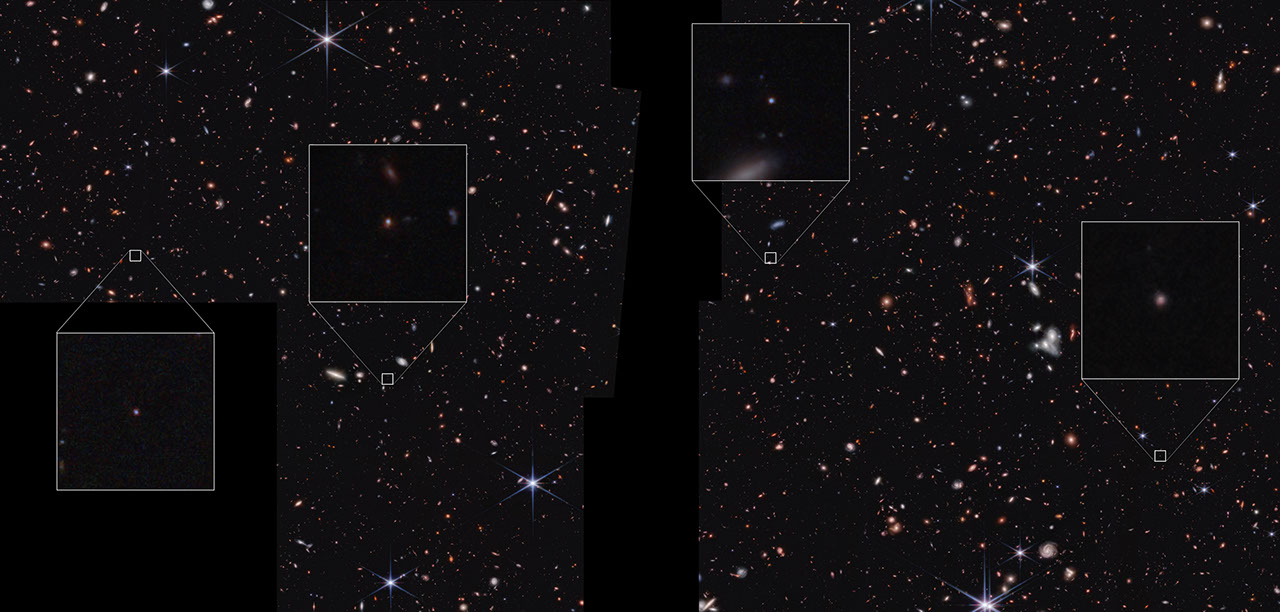
Explore Webb Science James Webb Space Telescope (JWST) Scientists Identify… Webb News Latest News Latest Images Webb’s Blog Awards X (offsite – login reqd) Instagram (offsite – login reqd) Facebook (offsite- login reqd) Youtube (offsite) Overview About Who is James Webb? Fact Sheet Impacts+Benefits FAQ Webb Timeline Science Overview and Goals Early Universe Galaxies Over Time Star Lifecycle Other Worlds Science/Engineering Explainers Observatory Overview Launch Deployment Orbit Mirrors Sunshield Instruments & ISIM Module Instrument: NIRCam Instrument: MIRI Instrument: NIRSpec Instrument: FGS/NIRISS Optical Telescope Element Backplane Spacecraft Bus Multimedia About Webb Images Images Videos What is Webb Observing? 3d Webb in 3d Solar System Podcasts Webb Image Sonifications Webb’s First Images Team International Team People Of Webb More For the Media For Scientists For Educators For Fun/Learning 5 Min Read Scientists Identify ‘Astronomy’s Platypus’ with NASA’s Webb Telescope 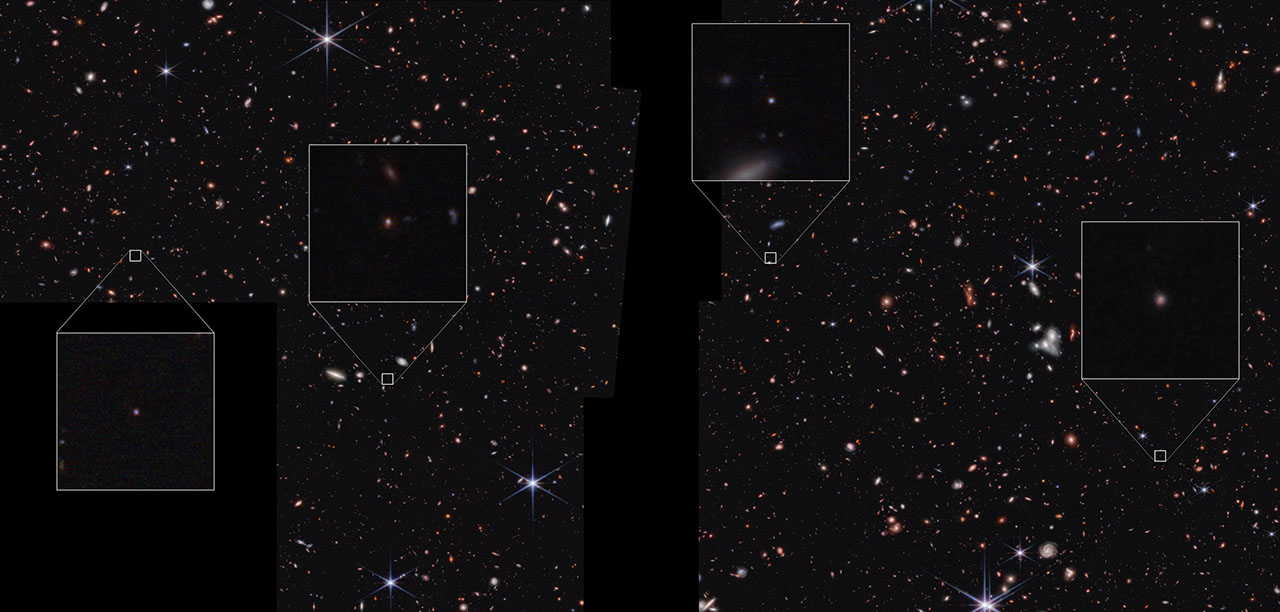 Four of the nine galaxies in the newly identified “platypus” sample were discovered in NASA’s James Webb Space Telescope’s Cosmic Evolution Early Release Science Survey (CEERS). One key feature that makes them distinct is their point-like appearance. Credits:
Image: NASA, ESA, CSA, Steve Finkelstein (UT Austin); Image Processing: Alyssa Pagan (STScI) After combing through NASA’s James Webb Space Telescope’s archive of sweeping extragalactic cosmic fields, a small team of astronomers at the University of Missouri says they have identified a sample of galaxies that have a previously unseen combination of features. Principal investigator Haojing Yan compares the discovery to an infamous oddball in another branch of science: biology’s taxonomy-defying platypus.
“It seems that we’ve identified a population of galaxies that we can’t categorize, they are so odd. On the one hand they are extremely tiny and compact, like a point source, yet we do not see the characteristics of a quasar, an active supermassive black hole, which is what most distant point sources are,” said Yan.
The research was presented in a press conference at the 247th meeting of the American Astronomical Society in Phoenix.
Image A: Galaxies in CEERS Field (NIRCam image) Four of the nine galaxies in the newly identified “platypus” sample were discovered in NASA’s James Webb Space Telescope’s Cosmic Evolution Early Release Science Survey (CEERS). One key feature that makes them distinct is their point-like appearance, even to a telescope that can capture as much detail as Webb. Image: NASA, ESA, CSA, Steve Finkelstein (UT Austin); Image Processing: Alyssa Pagan (STScI) “I looked at these characteristics and thought, this is like looking at a platypus. You think that these things should not exist together, but there it is right in front of you, and it’s undeniable,” Yan said.
The team whittled down a sample of 2,000 sources across several Webb surveys to identify nine point-like sources that existed 12 to 12.6 billion years ago (compared to the universe’s age of 13.8 billion years). Spectral data gives astronomers more information than they can get from an image alone, and for these nine sources it doesn’t fit existing definitions. They are too far away to be stars in our own galaxy, and too faint to be quasars, which are so brilliant that they outshine their host galaxies. Though the spectra resemble the less distant “green pea” galaxies discovered in 2009, the galaxies in this sample are much more compact.
“Like spectra, the detailed genetic code of a platypus provides additional information that shows just how unusual the animal is, sharing genetic features with birds, reptiles, and mammals,” said Yan. “Together, Webb’s imaging and spectra are telling us that these galaxies have an unexpected combination of features.”
Yan explained that for typical quasars, the peaks in their characteristic spectral emission lines look like hills, with a broad base, indicating the high velocity of gas swirling around their supermassive black hole. Instead, the peaks for the “platypus population” are narrow and sharp, indicating slower gas movement.
While there are narrow-line galaxies that host active supermassive black holes, they do not have the point-like feature of the sample Yan’s team has identified.
Image B: Galaxy CEERS 4233-42232: Comparison With Quasar Spectrum 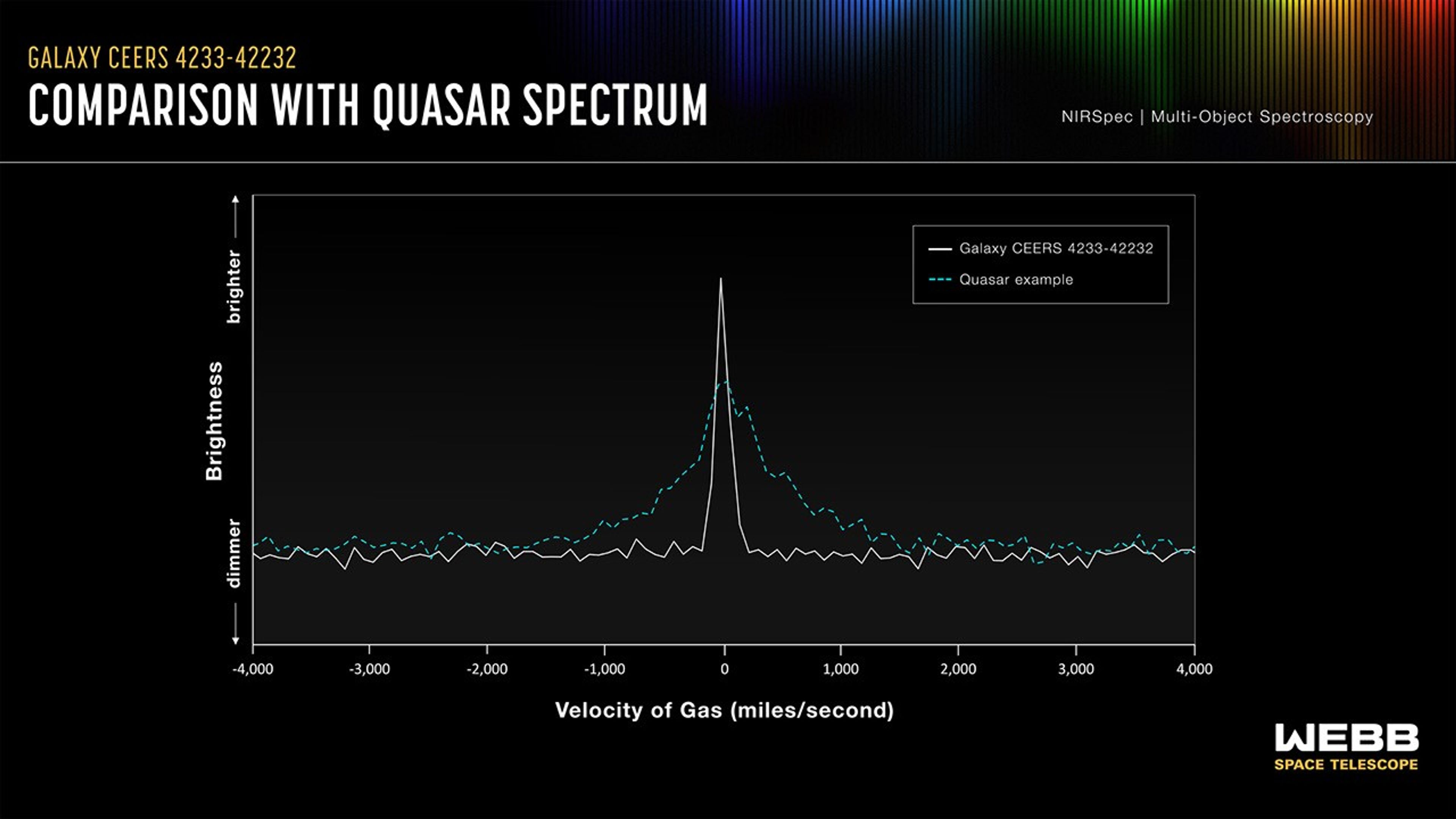 This graphic illustrates the pronounced narrow peak of the spectra that caught researchers’ attention in a small sample of galaxies, represented here by galaxy CEERS 4233-42232. Typically, distant point-like light sources are quasars, but quasar spectra have a much broader shape. Illustration: NASA, ESA, CSA, Joseph Olmsted (STScI) Has Yan’s team discovered a missing link in the cosmos? Once the team determined that the objects didn’t fit the definition of a quasar, graduate student researcher Bangzheng Sun analyzed the data to see if there were signatures of star-forming galaxies.
“From the low-resolution spectra we have, we can’t rule out the possibility that these nine objects are star-forming galaxies. That data fits,” said Sun. “The strange thing in that case is that the galaxies are so tiny and compact, even though Webb has the resolving power to show us a lot of detail at this distance.”
One proposal the team suggests is that Webb, as promised, is revealing earlier stages of galaxy formation and evolution than we have ever been able to see before. It is generally accepted across the astronomy community that large, massive galaxies like our own Milky Way grew by many smaller galaxies merging together. But, Yan asks, what comes before small galaxies?
“I think this new research is presenting us with the question, how does the process of galaxy formation first begin? Can such small, building-block galaxies be formed in a quiet way, before chaotic mergers begin, as their point-like appearance suggests?” Yan said.
To begin answering that question, as well as to determine more about the nature of their odd platypuses, the team says they need a much larger sample than nine to analyze, and with higher-resolution spectra.
“We cast a wide net, and we found a few examples of something incredible. These nine objects weren’t the focus; they were just in the background of broad Webb surveys,” said Yan. “Now it’s time to think about the implications of that, and how we can use Webb’s capabilities to learn more.”
The James Webb Space Telescope is the world’s premier space science observatory. Webb is solving mysteries in our solar system, looking beyond to distant worlds around other stars, and probing the mysterious structures and origins of our universe and our place in it. Webb is an international program led by NASA with its partners, ESA (European Space Agency) and CSA (Canadian Space Agency).
To learn more about Webb, visit:
Downloads & Related Information The following sections contain links to download this article’s images and videos in all available resolutions followed by related information links, media contacts, and if available, research paper and spanish translation links.
Related Images & Videos Galaxies in CEERS Field (NIRCam image) Four of the nine galaxies in the newly identified “platypus” sample were discovered in NASA’s James Webb Space Telescope’s Cosmic Evolution Early Release Science Survey” (CEERS). One key feature that makes them distinct is their point-like appearance.
Galaxy CEERS 4233-42232: Comparison With Quasar Spectrum This graphic illustrates the pronounced narrow peak of the spectra that caught researchers’ attention in a small sample of galaxies, represented here by galaxy CEERS 4233-42232. Typically, distant point-like light sources are quasars, but quasar spectra have a much broader shape.
Related Links Read more: Webb Science: Galaxies Through Time
Explore more: ViewSpace Seeing Farther: Hubble Ultra Deep Field
Explore more: JWST’s Tiny Red Sources and the Big Questions They Raise
Read more: Webb Shows Many Early Galaxies Looked Like Pool Noodles, Surfboards
Related for Kids What is the Webb Telescope?
Details Last Updated Jan 06, 2026 Location NASA Goddard Space Flight Center
Contact Media Laura Betz
NASA’s Goddard Space Flight Center
Greenbelt, Maryland
laura.e.betz@nasa.gov
Leah Ramsay
Space Telescope Science Institute
Baltimore, Maryland
Christine Pulliam
Space Telescope Science Institute
Baltimore, Maryland
Related Terms James Webb Space Telescope (JWST) Astrophysics Galaxies Goddard Space Flight Center Science & Research The Universe
Keep Exploring Related Topics James Webb Space Telescope
Webb is the premier observatory of the next decade, serving thousands of astronomers worldwide. It studies every phase in the…