
3 min read
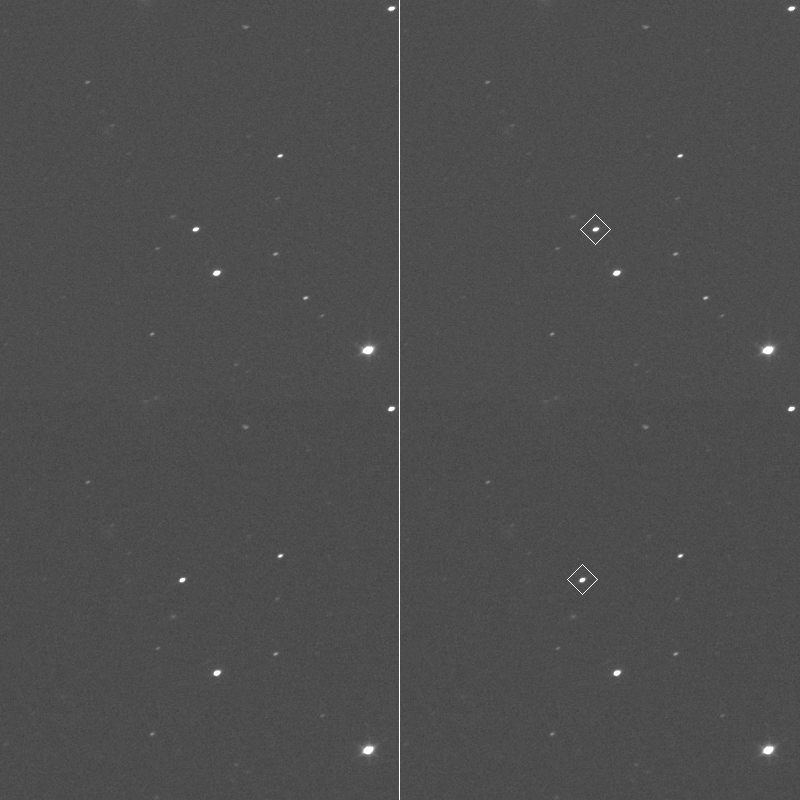
Preparations for Next Moonwalk Simulations Underway (and Underwater) NASA’s Lucy spacecraft has its next flyby target, the small main belt asteroid Donaldjohanson, in its sights. By blinking between images captured by Lucy on Feb. 20 and 22, this animation shows the perceived motion of Donaldjohanson relative to the background stars as the spacecraft rapidly approaches the asteroid.
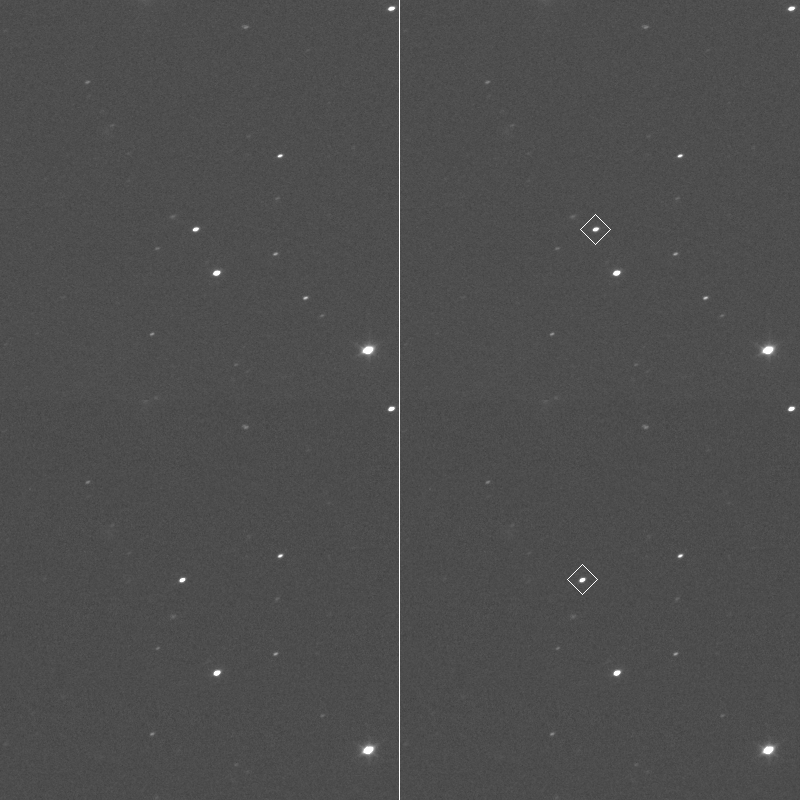 NASA’s Lucy spacecraft’s first views of the asteroid Donaldjohanson. The asteroid is outlined with a square in the right image to guide the eye.NASA/Goddard/SwRI/Johns Hopkins APL Lucy will pass within 596 miles (960 km) of the 2-mile-wide asteroid on April 20. This second asteroid encounter for the Lucy spacecraft will serve as a dress-rehearsal for the spacecraft’s main targets, the never-before-explored Jupiter Trojan asteroids. Lucy already successfully observed the tiny main belt asteroid Dinkinesh and its contact-binary moon, Selam, in November 2023. Lucy will continue to image Donaldjohanson over the next two months as part of its optical navigation program, which uses the asteroid’s apparent position against the star background to ensure an accurate flyby.
Donaldjohanson will remain an unresolved point of light during the spacecraft’s long approach and won’t start to show surface detail until the day of the encounter.
From a distance of 45 million miles (70 million km), Donaldjohanson is still dim, though it stands out clearly in this field of relatively faint stars in the constellation of Sextans. Celestial north is to the right of the frame, and the 0.11-degree field of view would correspond to 85,500 miles (140,000 km) at the distance of the asteroid. In the first of the two images, another dim asteroid can be seen photobombing in the lower right quadrant of the image. However, just as the headlights of an approaching car often appear relatively stationary, Donaldjohanson’s apparent motion between these two images is much smaller than that of this interloper, which has moved out of the field of view in the second image.
These observations were made by Lucy’s high-resolution camera, the L’LORRI instrument — short for Lucy LOng Range Reconnaissance Imager — provided by the Johns Hopkins Applied Physics Laboratory in Laurel, Maryland.
Asteroid Donaldjohanson is named for anthropologist Donald Johanson, who discovered the fossilized skeleton — called “Lucy” — of a human ancestor. NASA’s Lucy mission is named for the fossil.
Lucy’s principal investigator, Hal Levison, is based out of the Boulder, Colorado, branch of Southwest Research Institute, headquartered in San Antonio. NASA’s Goddard Space Flight Center in Greenbelt, Maryland, provides overall mission management, systems engineering, and safety and mission assurance. Lockheed Martin Space in Littleton, Colorado, built the spacecraft. Lucy is the 13th mission in NASA’s Discovery Program. NASA’s Marshall Space Flight Center in Huntsville, Alabama, manages the Discovery Program for the Science Mission Directorate at NASA Headquarters in Washington.
For more information about NASA’s Lucy mission, visit:
By Katherine Kretke
Southwest Research Institute
Media Contact:
Nancy N. Jones
NASA’s Goddard Space Flight Center, Greenbelt, Md.