Explore Hubble Hubble Home Overview About Hubble The History of Hubble Hubble Timeline Why Have a Telescope in Space? Hubble by the Numbers At the Museum FAQs Impact & Benefits Hubble’s Impact & Benefits Science Impacts Cultural Impact Technology Benefits Impact on Human Spaceflight Astro Community Impacts Science Hubble Science Science Themes Science Highlights Science Behind Discoveries Universe Uncovered Hubble’s Partners in Science Hubble & Citizen Science AI & Hubble Science Explore the Night Sky Observatory Hubble Observatory Hubble Design Mission Operations Science Operations Astronaut Missions to Hubble Hubble vs Webb Team Hubble Team Career Aspirations Hubble Astronauts Multimedia Images Videos Online Activities e-Books Sonifications Podcasts 3D Hubble Models Lithographs Fact Sheets Posters Hubble on the NASA App Glossary News Hubble News Social Media Media Resources 35th Anniversary More Online Activities 3 min read
NASA’s Hubble Captures Crimson Cloud Sparkling with White, Blue Stars 
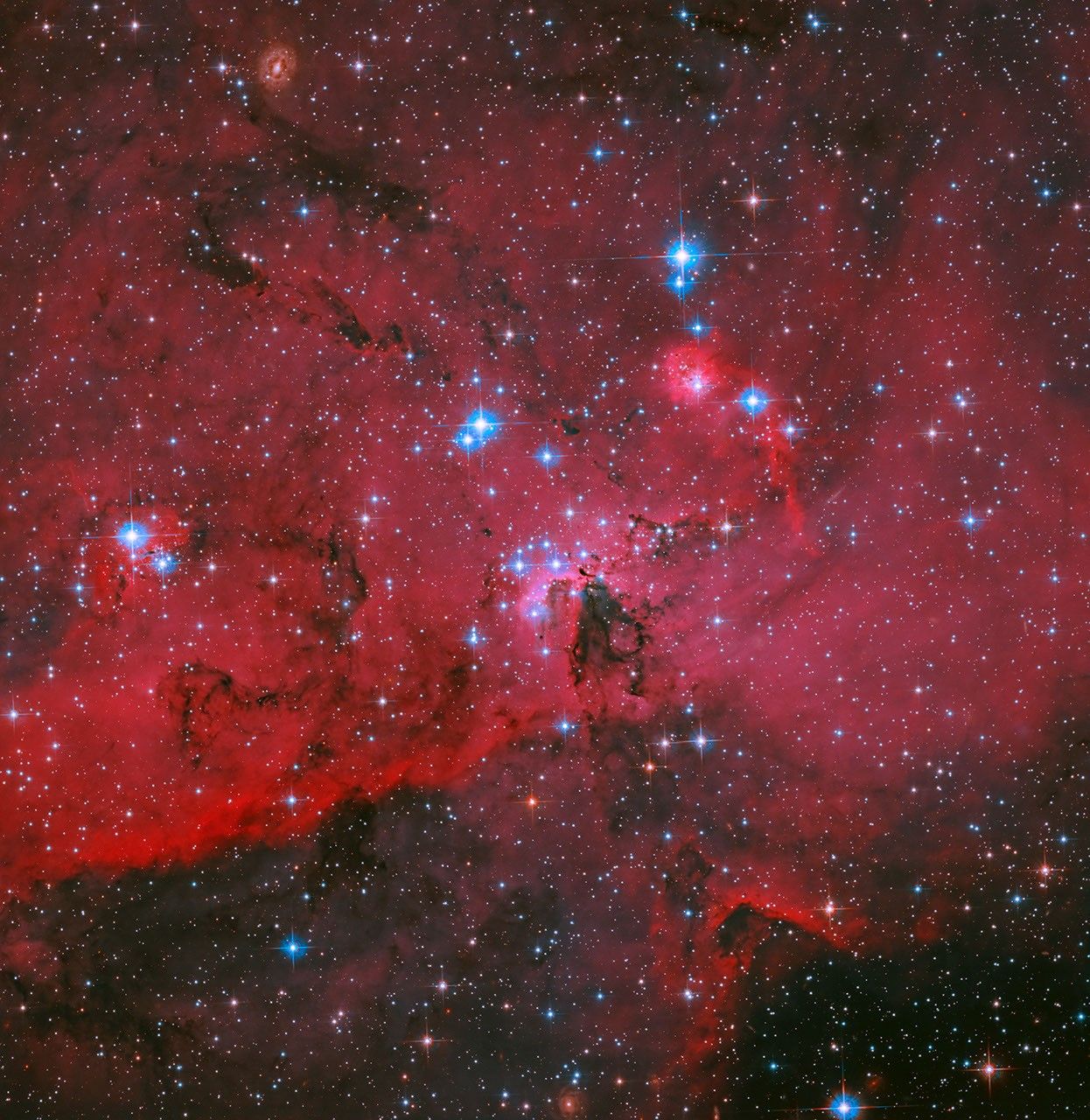
LH 95 is a region in the Large Magellanic Cloud, a dwarf galaxy that orbits the Milky Way. Low-mass infant stars live alongside massive blue giant stars in what is known as a stellar association, one of many in the Large Magellanic Cloud.
The LH 95 region’s most massive stars, possessing at least three times the mass of the Sun and visible here as the largest and brightest blue stars, expel ultraviolet radiation and stellar winds that both heat and shape the surrounding hydrogen gas. Dark filaments stand out in sharp contrast against the glowing hydrogen where denser dust lanes resist erosion.
In this image, blue indicates the shorter wavelengths that are visible light, while red depicts the longer wavelengths of visible light, as well as some near-infrared light. Colors in Hubble images are chosen based on standard image processing techniques to best represent the wavelengths of light that pass through the filters used in the observation. The gas of the nebula glows crimson due to hydrogen-alpha emissions.
Hydrogen-alpha is an excellent indicator of star formation, allowing astronomers to identify very young stars embedded in this glowing gas. Researchers found developing stars still gathering material from the disks of gas and dust around them. In fact, LH 95 is home to an extraordinary 2,500 stars that have accumulated almost all of their critical mass but have not yet “turned on” by beginning fusion reactions. These stars, called “pre-main-sequence stars,” have formed from collapsing clouds of gas and are still contracting. They will soon begin burning hydrogen in their cores to become full stars.
By studying these forming stars, researchers confirmed that the stars’ accretion rate ― the rate at which they accumulate matter ― decreased with age, as expected. However, they also learned that accretion can persist for several million years, longer than sometimes assumed. This information helps refine our understanding of how young stars keep growing and how their disks evolve.
Researchers noted that distinct generations of stars in LH 95 exist side-by-side, indicating that rather than forming stars in a single event, the region produces multiple stellar generations over an extended period.
The most massive star in LH 95 (above center, slightly left) has about 60-70 times the mass of the Sun and is about a million years younger than the rest of stars in the system, which appear to be around 4 million years old. Massive stars like these burn through their fuel quickly and die in supernova explosions.
With its rich stellar population, LH 95 is valued by astronomers for providing a way to observe forming stars at relatively close range in an environment with less obscuring dust than similar regions of the Milky Way.
As one of NASA’s flagship observatories, Hubble has produced a wealth of scientific discoveries over more than 30 years in orbit. Its observations are expanded upon and enhanced by observations with other NASA missions, including the infrared-detecting Webb Space Telescope and the upcoming Nancy Grace Roman Space Telescope, which is scheduled to launch in late summer.
Facebook logo @NASAHubble @NASAHubble Instagram logo @NASAHubble Explore More
Hubble’s Nebulae
Media Contact:
Claire Andreoli
NASA’s Goddard Space Flight Center, Greenbelt, MD
claire.andreoli@nasa.gov
Details Last Updated Jul 03, 2026 Editor Andrea Gianopoulos Location NASA Goddard Space Flight Center Related Terms Hubble Space Telescope Astrophysics Astrophysics Division Goddard Space Flight Center Magellanic Clouds Nebulae Stars The Universe
Keep Exploring Discover More Topics From Hubble Hubble Space Telescope
Since its 1990 launch, the Hubble Space Telescope has changed our fundamental understanding of the universe.
Hubble Celebrates Nation’s 250th Birthday
NASA’s Hubble celebrates the nation’s 250th birthday with new images and more!
What Did Hubble See on Your Birthday?
Take a look at what cosmic wonders Hubble observed on your special day!
Fourth of July Through Hubble’s Eyes
To commemorate the nation’s 250th birthday, Hubble shares 13 images for the nation’s 13 original colonies.