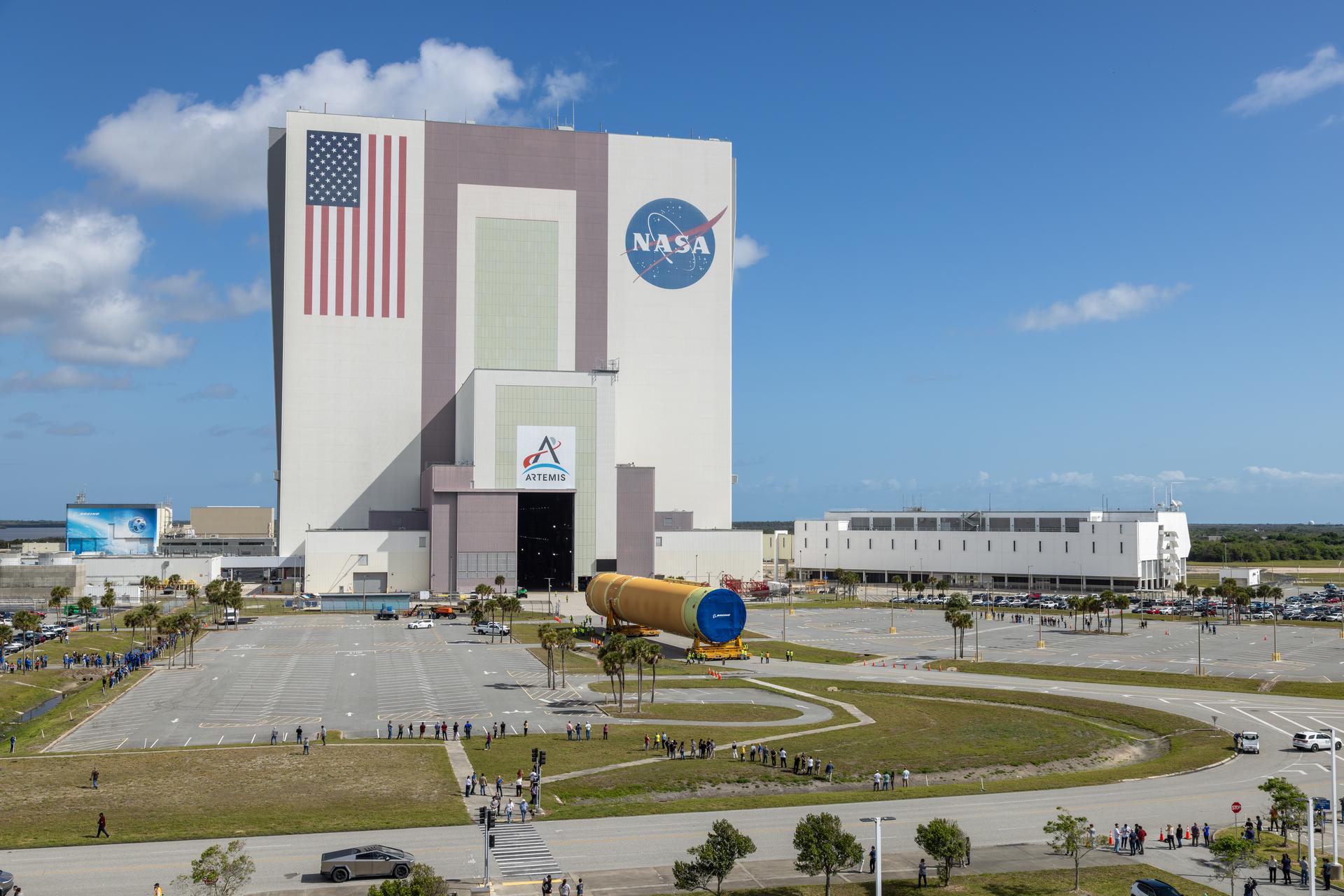
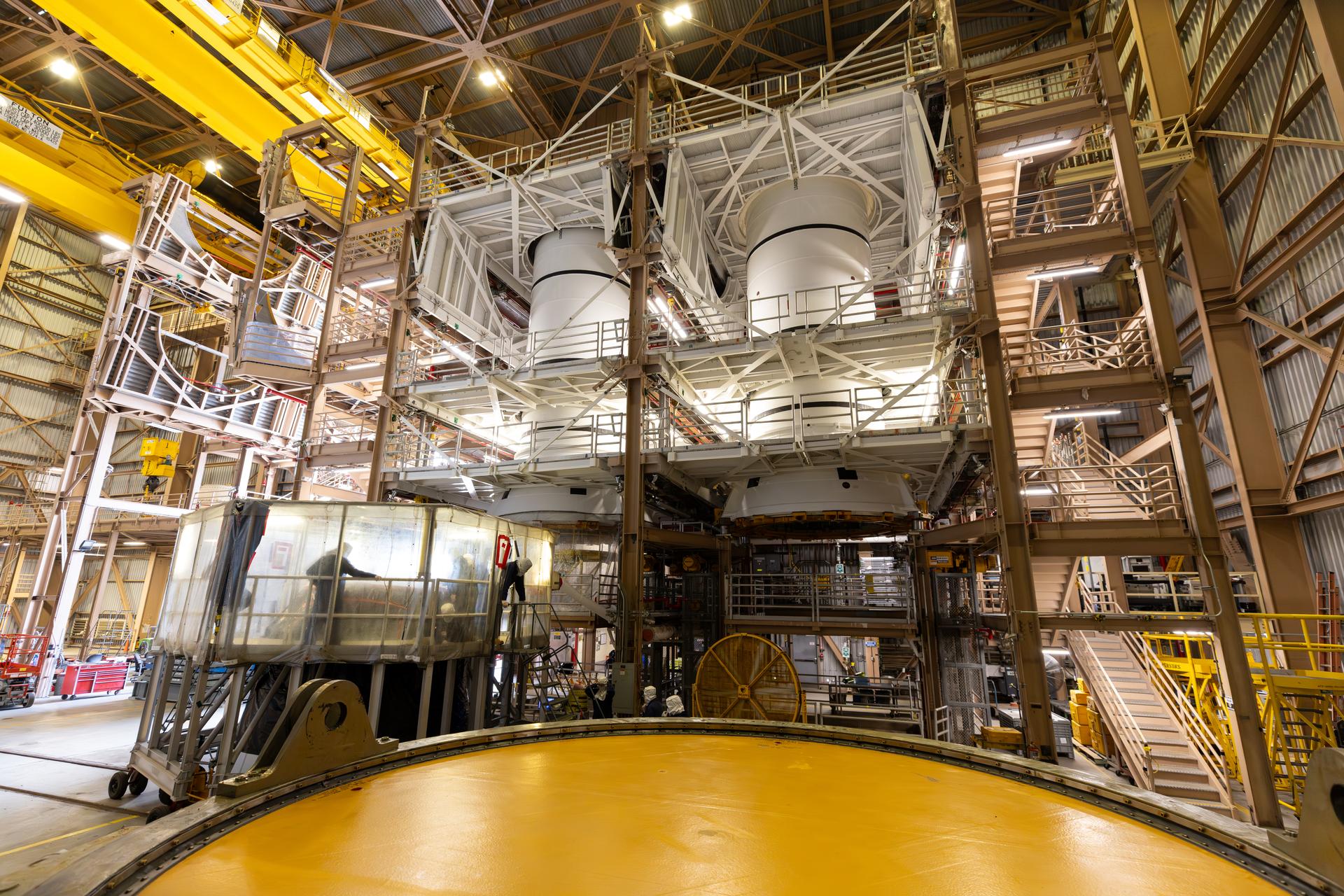
On the heels of a successful Artemis II test flight, teams at NASA’s Kennedy Space Center in Florida are pressing forward for the next Artemis mission. Technicians maneuvered NASA’s massive core stage of the SLS (Space Launch System) rocket inside the agency’s Vehicle Assembly Building (VAB) at NASA Kennedy on April 28 in preparation for Artemis III, as the Artemis II crew module arrived back at Kennedy for post-flight analysis.
The Artemis III core stage will be placed horizontally in the transfer aisle of the VAB before being lifted into High Bay 2, where it will be connected to the engine section and its boat-tail, which were integrated in August 2025. At 212 feet tall when fully assembled, the core stage houses two propellant tanks that collectively hold more than 733,000 gallons of super-chilled liquid propellant to fuel four RS-25 engines, as well as the flight computers, or avionics, that act as the brains of the rocket to control flight during ascent. This marks the first time core stage assembly operations are taking place at NASA Kennedy.
Booster Motor Segments for Artemis III Processing
Other SLS hardware for Artemis III is arriving in Florida. The first shipment of booster motor segments for the flight arrived at Kennedy on April 13. These components will form the twin solid rocket boosters for SLS, which generate more than 75% of the rocket’s thrust at liftoff. A second shipment of booster motor segments is expected this summer.
Shipped by rail across eight states in specialized transporters, the segments were manufactured by Northrop Grumman in Utah before making their journey to the spaceport. Teams are now processing the hardware inside Kennedy’s Rotation, Processing and Surge Facility, where each segment will be inspected and prepared for integration.
Once ready, the motor segments will be moved to the VAB and stacked with forward and aft assemblies to form the towering, 17-story-tall boosters. Working together with the SLS core stage and its four RS-25 engines, the boosters will help produce 8.8 million pounds of thrust—powering Artemis III and future missions as NASA continues its campaign of lunar exploration.
Artemis II Orion Arrives at Kennedy
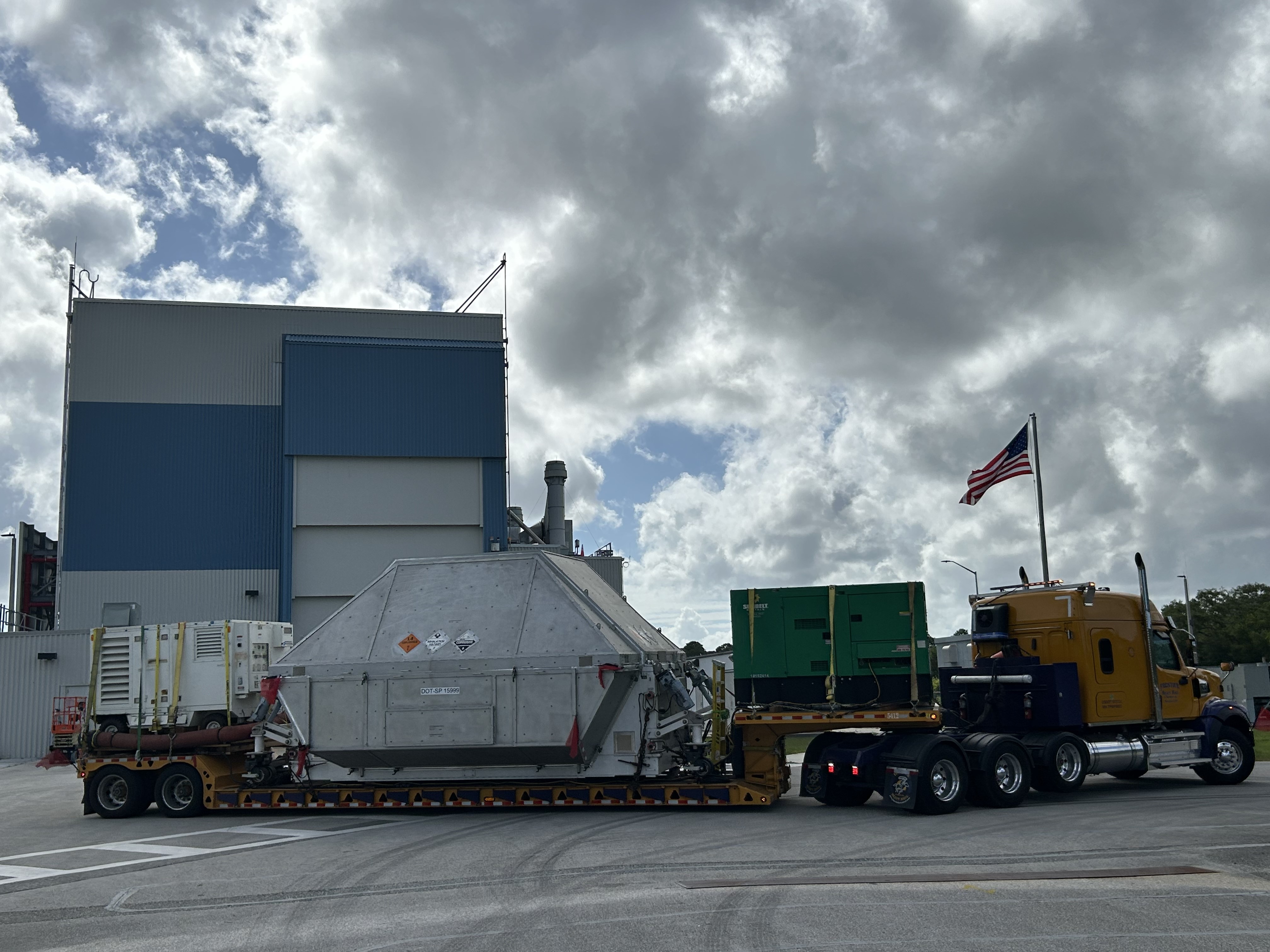
Arriving on the opposite side of the spaceport after carrying NASA astronauts Reid Wiseman, Victor Glover, and Christina Koch, and CSA (Canadian Space Agency) astronaut Jeremy Hansen around the Moon and returning them safely to Earth, the Artemis II Orion spacecraft arrived back at NASA Kennedy’s Multi-Processing Payload Facility.
Now at Kennedy, technicians will begin de-servicing operations on the spacecraft. This includes removing payloads from the crew module, removing avionics boxes for reuse, and retrieving data on the spacecraft to better understand how it performed to inform procedures and plans for future Artemis missions. Orion’s heat shield and other elements will be removed for extensive analysis, and remaining hazards such as excess propellant will be offloaded.
While detailed Artemis II post-flight assessments are underway, engineers are completing major functional testing of the Artemis III Orion crew module at NASA Kennedy before joining it with its service module later this summer. All 186 Avcoat blocks for its upgraded heat shield have been installed, cured, and inspected. Teams also completed thermal cycle testing and ultrasonic inspections of the heat shield. The Artemis III Orion service module has successfully undergone thermal cycle testing, deployment checks of all four solar array wings, and installation of the adapter cone that connects Orion to the SLS rocket. NASA plans to integrate the crew and service modules with the launch abort system later this year.
Next year’s Artemis III mission will launch astronauts to Earth’s orbit aboard the Orion spacecraft on top of SLS to test rendezvous and docking capabilities between Orion and commercial spacecraft needed to land Artemis IV astronauts on the Moon in 2028.