3 min read
NASA, Partners Advance LISA Prototype Hardware Engineers and scientists at NASA’s Goddard Space Flight Center in Greenbelt, Maryland, completed tests this month on a second early version of a key element of the upcoming LISA (Laser Interferometer Space Antenna) mission.
The LISA mission, a collaboration between ESA (the European Space Agency) and NASA, will use infrared lasers to detect gravitational waves, or ripples in the fabric of space-time. The tests involved the frequency reference system, delivered by BAE Systems, that will help control the lasers connecting LISA’s three spacecraft. The lasers must be finely tuned to make precise measurements — to within a trillionth of a meter, called a picometer.
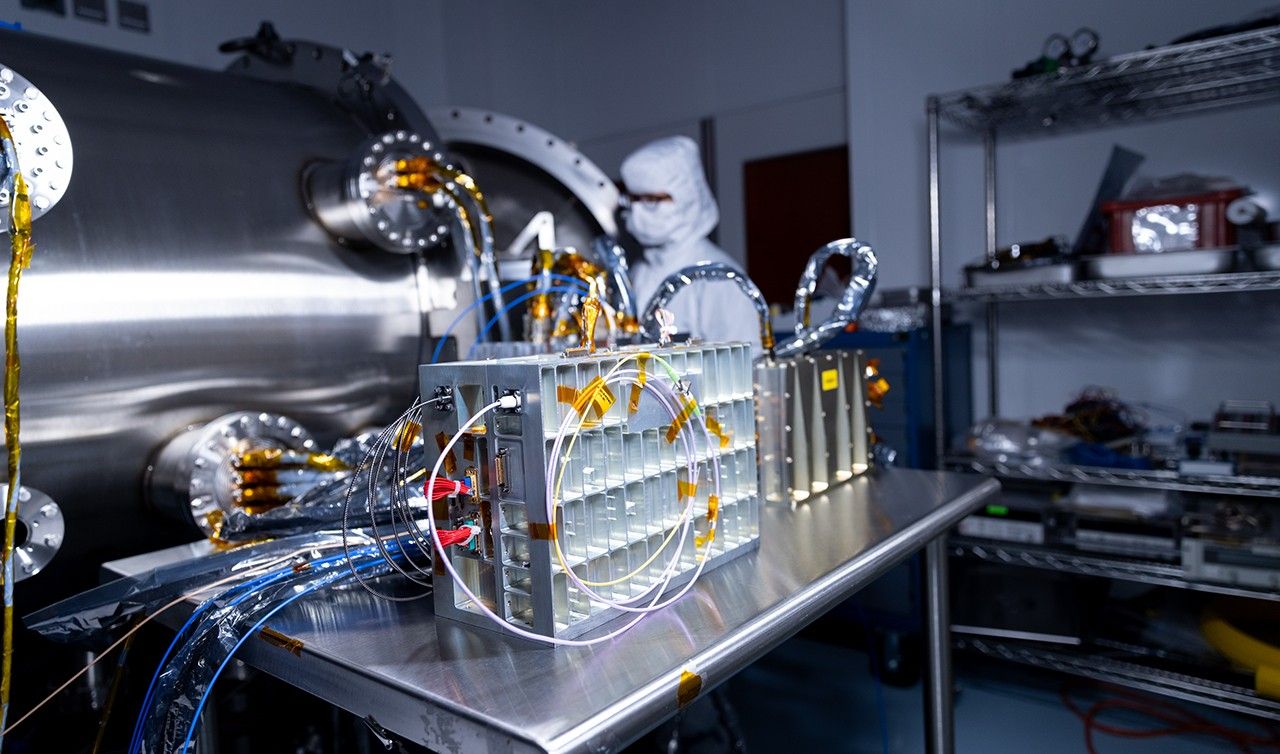
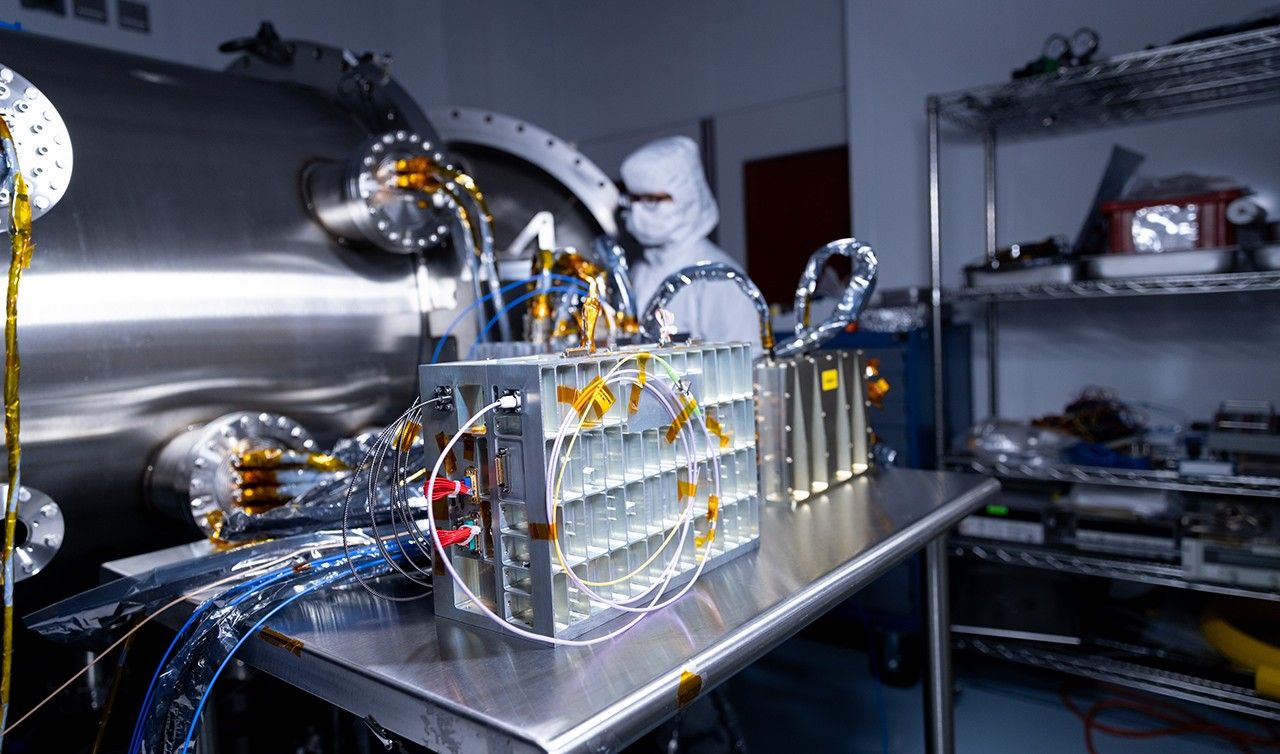
 A prototype laser optical module for LISA (Laser Interferometer Space Antenna) rests on a table after testing at NASA’s Goddard Space Flight Center in Greenbelt, Maryland, in May 2025. Xiaozhen Xu, an engineer with Miller Engineering and Research Corp., works in the background. The smaller box to the right is the laser electronics module. Each of the three LISA spacecraft will have a laser system with a frequency reference component and six laser heads. NASA/Sophia Roberts
Download high-resolution images from NASA’s Scientific Visualization Studio
The team tested the first version of the system in May 2025.
“The extensive round of checkouts on the frequency reference system last year were very successful,” said Ira Thorpe, the project scientist for LISA at NASA Goddard. “This second unit is identical, so our assessments this time around were less intense and preface a future cross-check of the two, which is the gold-standard for checking the stability of the system overall.”
In addition to the laser system, NASA is contributing the telescopes, devices to manage the buildup of onboard electrical charge, and the framework scientists will need to process the data the mission will generate.
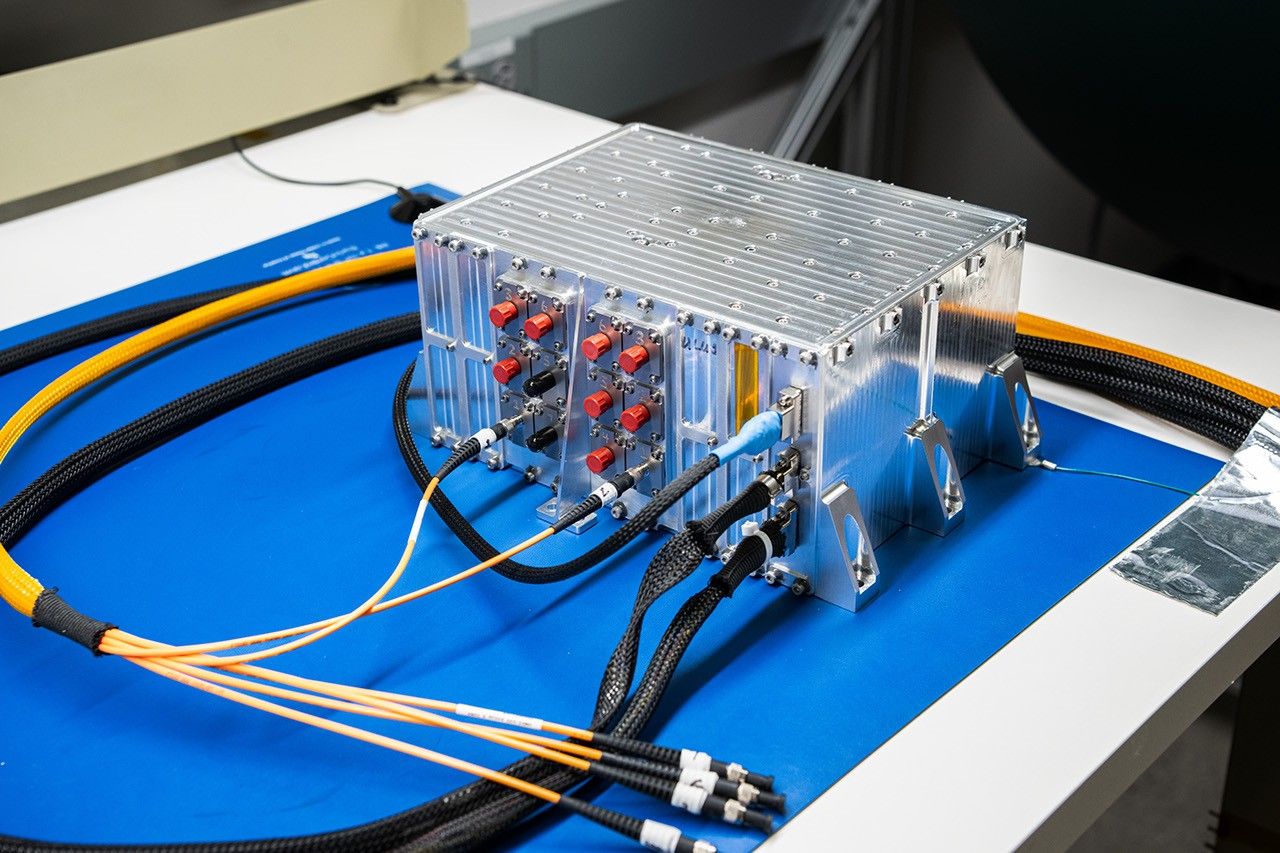 A prototype charge management device for LISA sits on a lab bench at NASA Goddard in May 2025. Each of the three LISA spacecraft will have a charge management device to reduce the buildup of electric charge on the gold-platinum proof masses that fly freely inside the spacecraft. The University of Florida in Gainesville and Fibertek Inc. in McNair, Va., are developing the devices. NASA/Dennis Henry NASA’s contributions are part of the agency’s efforts to innovate on ambitious science missions that will help us better understand how the universe works. LISA will also offer a major advancement in multimessenger astronomy, which is how scientists explore cosmic signals other than light.
The three LISA spacecraft will fly in a vast triangular formation that follows Earth as it orbits the Sun. Each arm of the triangle will stretch 1.6 million miles (2.5 million kilometers).
Each spacecraft will contain two free-floating cubes inside called proof masses. Arriving gravitational waves from throughout the universe will minutely change the lengths of the triangle’s arms. The lasers connecting the cubes will measure changes in their separation to within a distance smaller than a helium atom.
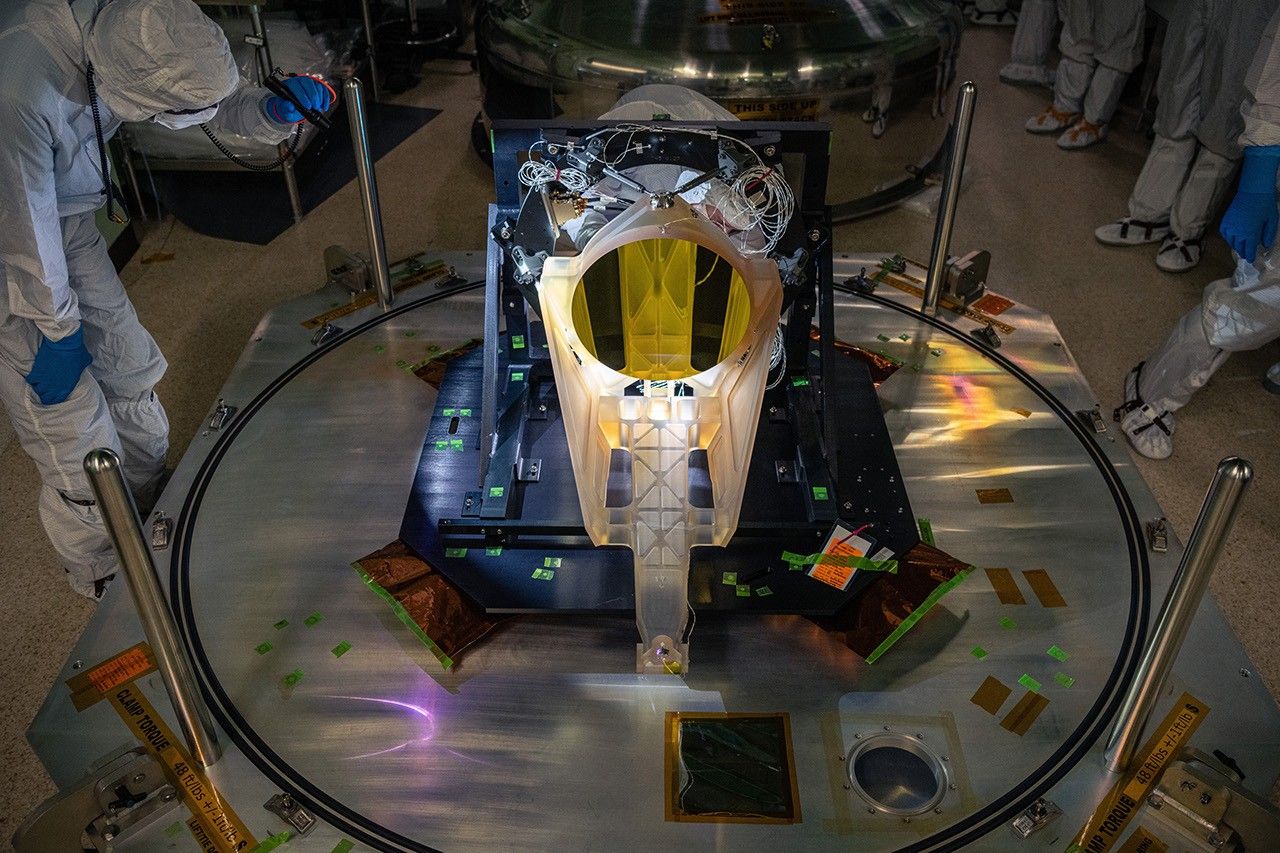 In May 2024, technicians inspected the prototype LISA telescope in a darkened clean room at NASA Goddard. Illuminated by a flashlight, the telescope’s structure glows. The prototype is made from a translucent, amber-colored, glass-ceramic material called Zerodur, which is often used in high-precision applications because it resists changes in shape over a wide temperature range. The mirror, near center and coated in gold, reflects a magnified image of part of the telescope. NASA/Dennis Henry The enormous scale of the triangle will enable LISA to detect gravitational waves that cannot be found with ground-based facilities, such as those generated when massive black holes in the centers of galaxies merge. Scientists can use the data to learn about a source’s distance and physical properties.
The LISA mission is slated to launch in the mid-2030s.
By Jeanette Kazmierczak
NASA’s Goddard Space Flight Center, Greenbelt, Md.
Media Contact:
Claire Andreoli
301-286-1940
NASA’s Goddard Space Flight Center, Greenbelt, Md.
Facebook logo @NASAUniverse @NASAUniverse Instagram logo @NASAUniverse
Details Last Updated Jan 27, 2026 Editor Jeanette Kazmierczak Related Terms LISA (Laser Interferometer Space Antenna) Astrophysics Black Holes Galaxies Galaxy Mergers Goddard Space Flight Center Gravitational Waves Supermassive Black Holes The Universe