6 min read
Preparations for Next Moonwalk Simulations Underway (and Underwater) 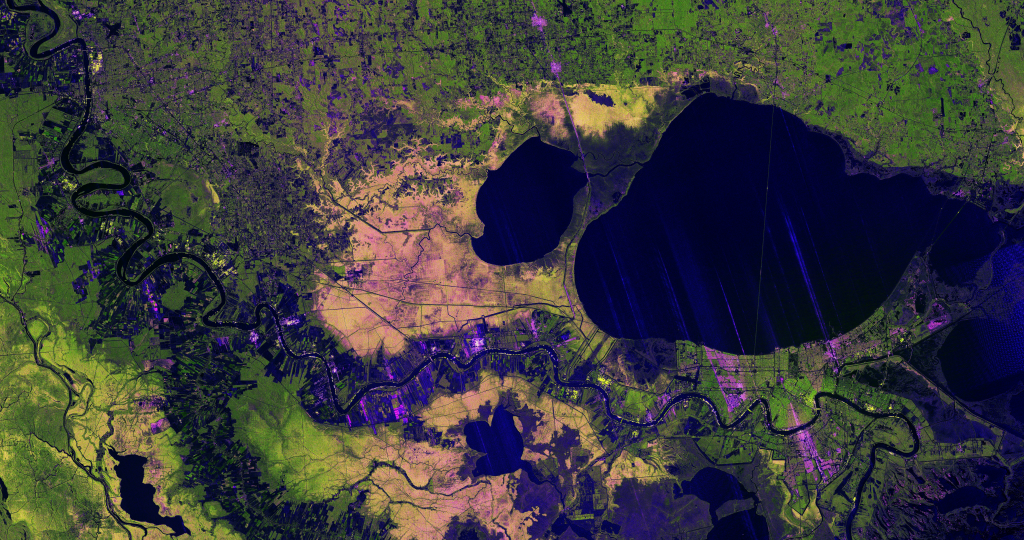 This image captured by NISAR’s L-band SAR instrument on Nov. 29, 2025, shows the cities of New Orleans and Baton Rouge, the Mississippi River, Lake Pontchartrain, and a range of wetlands, farmlands, and populated areas. The colors indicate different types of land cover.NASA/JPL-Caltech
 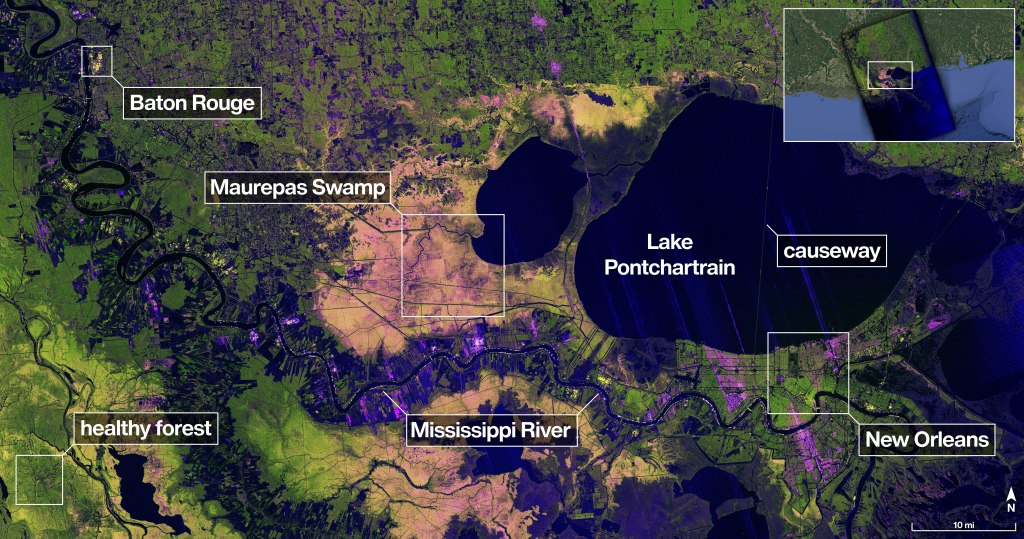 This same Nov. 29, 2025, image from NISAR’s L-band SAR instrument features labels noting cities and geographic features of the Mississippi River Delta region. Colors indicate types of land cover, such as healthy forests (bright green), thinned tree populations (yellow-and-magenta hues), and tall crops (bright magenta).NASA/JPL-Caltech A new image from the NISAR mission shows off the satellite’s ability to reveal details of Earth’s surfaces. The science team also released new sample data.
A U.S.-Indian Earth satellite’s ability to see through clouds, revealing insights and characteristics of our planet’s surface, is on display in a colorful, newly released image showing the Mississippi River Delta region in southeastern Louisiana.
Created with data collected by the NISAR (NASA-ISRO Synthetic Aperture Radar) satellite in late fall, the image shows the cities of New Orleans and Baton Rouge, the Mississippi River, Lake Pontchartrain, and a diversity of wetlands, farmland, forests, and communities. It also highlights the key difference between radar, which scans surfaces with microwaves, and technologies that sense visible light: Optical imagery from other instruments taken the same day showed the region largely obscured by clouds.
This image comes as the NISAR project prepares to make thousands of mission data files available for download in late February. The mission also recently released a smaller set of sample files to help data users prepare to utilize the broader dataset.
While the Earth-observing satellite went through checks to verify the health of all its systems after launching in July, the mission’s NASA science team — researchers and data scientists from a range of disciplines spread around the U.S. — pulled preliminary measurements from its L-band synthetic aperture radar (SAR) instrument to generate maps such as this one that demonstrate the instrument’s capabilities.
Built by NASA’s Jet Propulsion Laboratory in Southern California, the L-band radar employs microwaves that, due to their 9-inch (24-centimeter) wavelength, can pass uninterrupted through clouds and image the surface below clearly.
What’s revealed Captured Nov. 29, the image demonstrates how the L-band SAR can discern what type of land cover — low-lying vegetation, trees, and human structures — is present in each area. This capability is vital both for monitoring the gain and loss of forest and wetland ecosystems, as well as for tracking the progress of crops through growing seasons around the world.
The colors seen here represent varying types of cover, which tend to reflect microwaves back to the satellite differently. Portions of New Orleans appear green, a sign that the radar’s signals may be scattering from buildings that are oriented at different angles relative to the satellite’s orbit. Parts of the city appear magenta where streets that run parallel to the satellite’s flight track cause the signals to bounce strongly and brightly off buildings and back to the instrument.
The resolution of the image is fine enough to make clear, right of center, the Lake Pontchartrain Causeway — twin bridges that, at nearly 24 miles (39 kilometers) in length, make up the world’s longest continuous bridge over water.
The bright green areas to the west of the Mississippi River, which snakes from Baton Rouge in the upper left to New Orleans in the lower right, are healthy forests. There, tree canopies and other vegetation caused NISAR’s microwaves to bounce in many directions before returning to the satellite. Meanwhile, the yellow-and-magenta-speckled hues of Maurepas Swamp, directly west of Lake Pontchartrain and the smaller Lake Maurepas, indicate that the tree populations in that wetland forest ecosystem have thinned.
On either bank of the Mississippi, the image shows parcels of varying shapes, sizes, and cover. Darker areas suggest fallow farm plots, while bright magenta indicates that tall plants, such as crops, may be present.
The data products created with NISAR’s L-band measurements will be downloadable at the website of the Alaska Satellite Facility Distributed Active Archive Center. The Fairbanks-based facility stores and distributes NASA’s SAR data.
Insights from NISAR can protect communities by providing unique, actionable information to decision-makers in a diverse range of areas, including disaster response, infrastructure monitoring, and agricultural management.
More about NISAR A joint mission developed by NASA and the Indian Space Research Organisation (ISRO), NISAR launched on July 30 from Satish Dhawan Space Centre on India’s southeastern coast. Managed by Caltech, JPL leads the U.S. component of the project and provided the satellite’s L-band SAR and antenna reflector. ISRO provided NISAR’s spacecraft bus and its S-band SAR, which operates at a wavelength of 4 inches (10 centimeters.)
The NISAR satellite is the first to carry two SAR instruments at different wavelengths and will monitor Earth’s land and ice surfaces twice every 12 days, collecting data using the spacecraft’s giant drum-shaped reflector, which measures 39 feet (12 meters) wide — the largest radar antenna reflector NASA has ever sent into space.
To learn more about NISAR, visit:
https://science.nasa.gov/mission/nisar/
News Media Contacts Andrew Wang / Andrew Good
Jet Propulsion Laboratory, Pasadena, Calif.
626-379-6874 / 818-393-2433
andrew.wang@jpl.nasa.gov / andrew.c.good@jpl.nasa.gov
2026-007
 4 min read March 2026 Total Lunar Eclipse: Your Questions Answered A total lunar eclipse will redden the Moon on March 3, 2026. Here’s what you…
Article 4 hours ago
 4 min read NASA Analysis Shows La Niña Limited Sea Level Rise in 2025 Article 4 hours ago
  4 min read The West Faces Snow Drought Very wet—but very warm—weather in the western U.S. has left many mountainous regions looking at…
Article 16 hours ago
Keep Exploring Discover Related Topics NISAR NISAR (NASA-ISRO Synthetic Aperture Radar) systematically maps Earth, measuring changes of our planet’s surface as small as a centimeter.