
NASA’s Nancy Grace Roman Space Telescope team has released detailed plans for a major survey that will reveal our home galaxy, the Milky Way, in unprecedented detail. In one month of observations spread across two years, the survey will unveil tens of billions of stars and explore previously uncharted structures.
This video begins with a view of the Carina Nebula — a giant, relatively nearby star-forming region in the southern sky. Roman will view the entire nebula as well as its surroundings, including a 10,000 light-year-long swath of the spiral arm it resides in. The observation will offer an unparalleled opportunity to watch how stars grow, interact, and sculpt their environments, and it’s just one of many thousands of highlights astronomers are looking forward to from the Galactic Plane Survey NASA’s Nancy Grace Roman Space Telescope will conduct.
Credit: NASA’s Goddard Space Flight Center “The Galactic Plane Survey will revolutionize our understanding of the Milky Way,” said Julie McEnery, Roman’s senior project scientist at NASA’s Goddard Space Flight Center in Greenbelt, Maryland. “We’ll be able to explore the mysterious far side of our galaxy and its star-studded heart. Because of the survey’s breadth and depth, it will be a scientific mother lode.”
The Galactic Plane Survey is Roman’s first selected general astrophysics survey — one of many observation programs Roman will do in addition to its three core surveys and Coronagraph technology demonstration. At least 25% of Roman’s five-year primary mission is reserved for astronomers worldwide to propose more surveys beyond the core programs, fully leveraging Roman’s capabilities to conduct groundbreaking science. Roman is slated to launch by May 2027, but the team is on track for launch as early as fall 2026.
While ESA’s (European Space Agency’s) retired Gaia spacecraft mapped around 2 billion Milky Way stars in visible light, many parts of the galaxy remain hidden by dust. By surveying in infrared light, Roman will use powerful heat vision that can pierce this veil to see what lies beyond.
“It blows my mind that we will be able to see through the densest part of our galaxy and explore it properly for the first time,” said Rachel Street, a senior scientist at Las Cumbres Observatory in Santa Barbara, California, and a co-chair of the committee that selected the Galactic Plane Survey design.
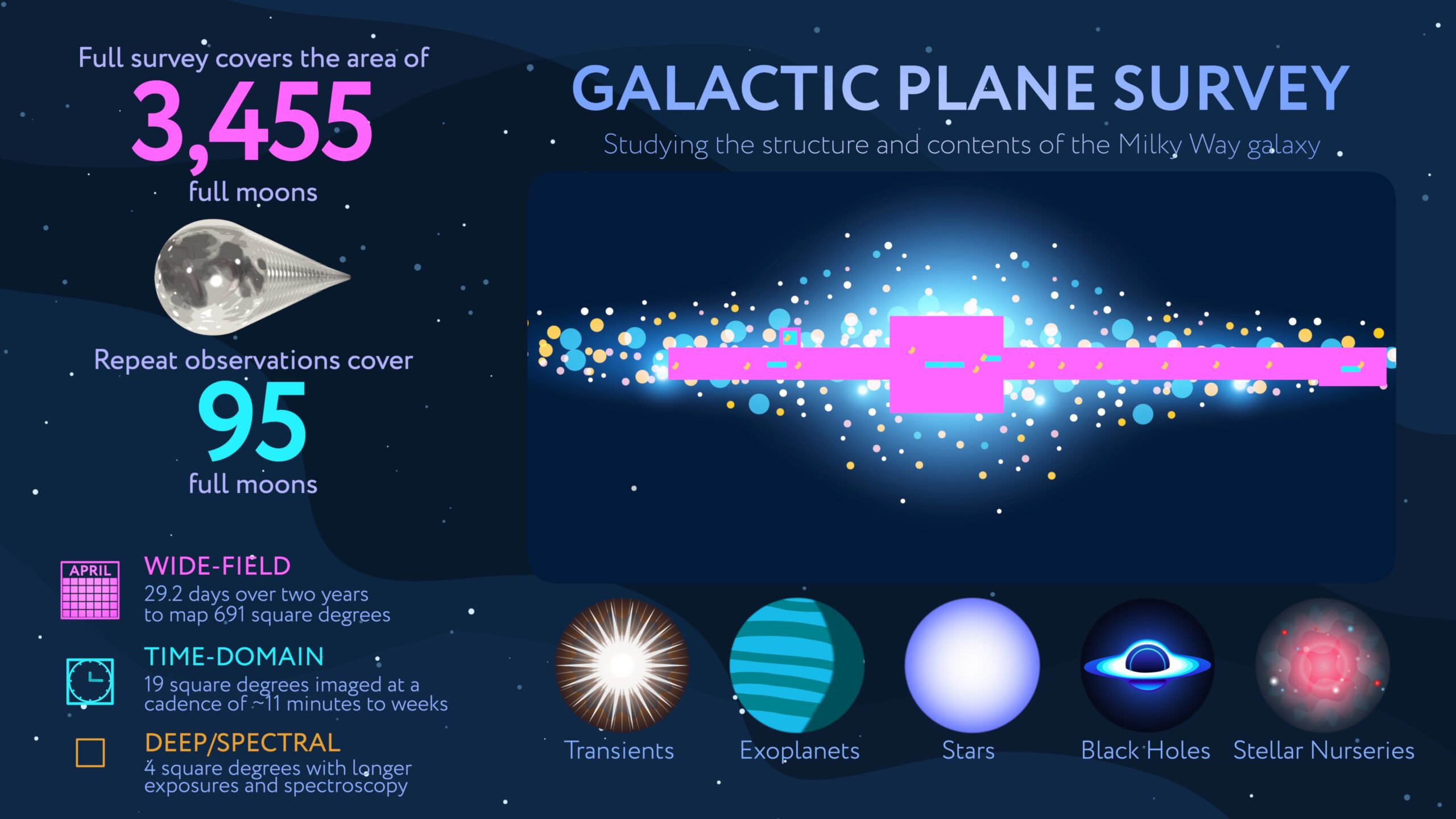
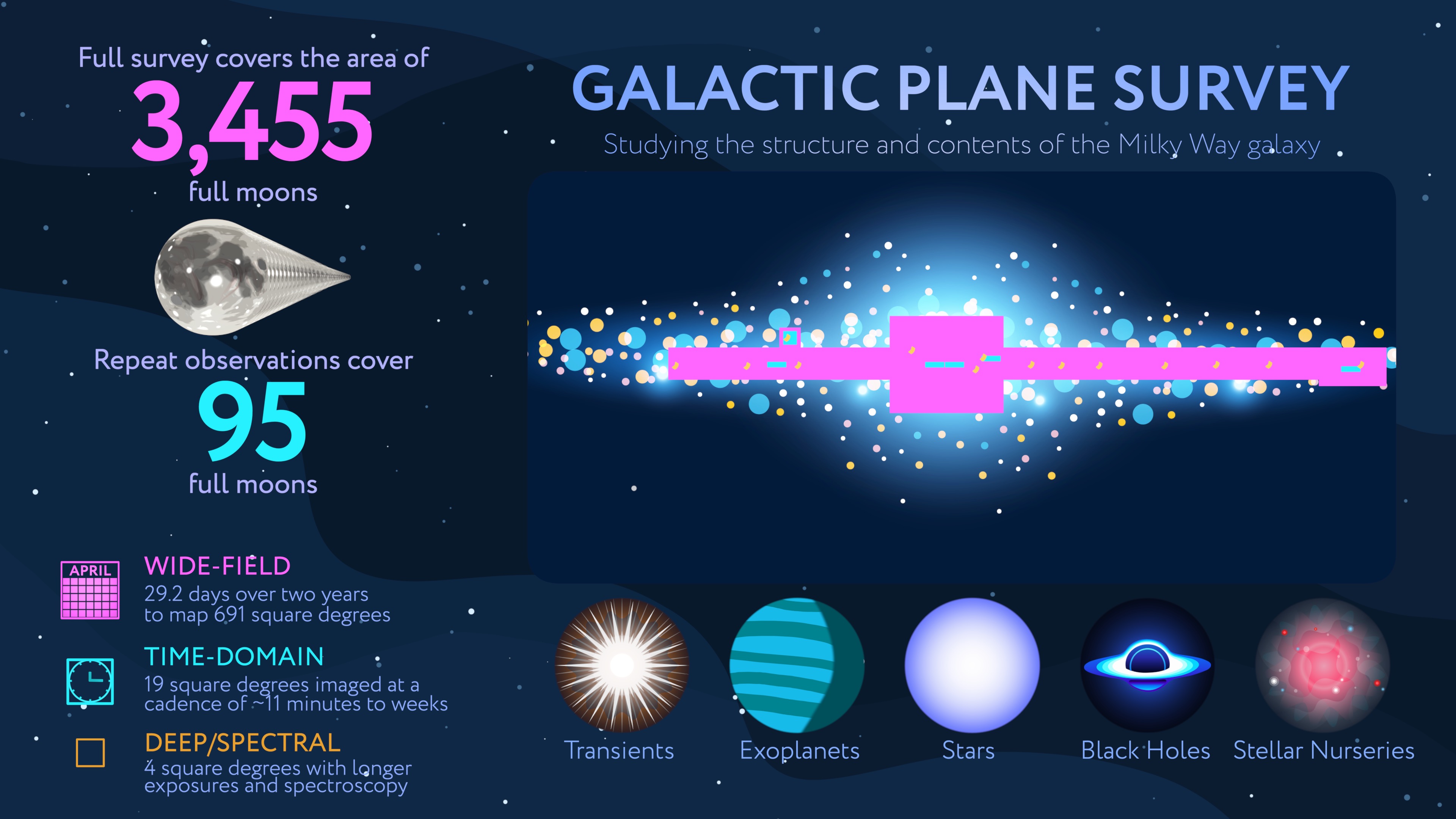 This infographic describes the 29-day Galactic Plane Survey that will be conducted by NASA’s Nancy Grace Roman Space Telescope. The survey’s main component will cover 691 square degrees — a region of sky as large as around 3,500 full moons — in 22.5 days. Roman will also view a smaller area — 19 square degrees, the area of 95 full moons — repeatedly for about 5.5 days total to capture things that change over time. The survey’s final component will image a smattering of even smaller areas, adding up to about 4 square degrees (the area of 20 full moons) and 31 total hours, with Roman’s full suite of filters and spectroscopic tools. The survey will reveal our home galaxy in unprecedented detail including many in regions we’ve never been able to see before because they’re blocked by dust, unveiling tens of billions of stars and other objects.Credit: NASA’s Goddard Space Flight Center The survey will cover nearly 700 square degrees (a region of sky as large as about 3,500 full moons) along the glowing band of the Milky Way — our edge-on view of the disk-shaped structure containing most of our galaxy’s stars, gas, and dust. Scientists expect the survey to map up to 20 billion stars and detect tiny shifts in their positions with repeated high-resolution observations. And it will only take 29 days spread over the course of the mission’s first two years.
Cosmic Cradles Stars are born from parent clouds of gas and dust. Roman will peer through the haze of these nesting grounds to see millions of stellar embryos, newborn stars still swaddled in shrouds of dust, tantrumming toddler stars that flare unpredictably, and young stars that may have planetary systems forming around them. Astronomers will study stellar birth rates across a wide range of masses and stitch together videos that show how stars change over time.
“This survey will study such a huge number of stars in so many different stellar environments that we’ll be sampling every phase of a star’s evolution,” Street said.
Observing so many stars in various stages of early development will shed light on the forces that shape them. Star formation is like a four way tug-of-war between gravity, radiation, magnetism, and turbulence. Roman will help us study how these forces influence whether gas clouds collapse into full-fledged stars, smaller brown dwarfs — in-between objects that are much heavier than planets but not massive enough to ignite like stars — or new worlds.
The Galactic Plane Survey by NASA’s Nancy Grace Roman Space Telescope will scan the densest part of our galaxy, where most of its stars, gas, and dust reside — the most difficult region to study from our place inside the Milky Way since we have to look through so much light-blocking material. Roman’s wide field of view, crisp resolution, and infrared vision will help astronomers peer through thick bands of dust to chart new galactic territory.
Credit: NASA’s Goddard Space Flight Center Some stars are born in enormous litters called clusters. Roman will study nearly 2,000 young, loosely bound open clusters to see how the galaxy’s spiral arms trigger star formation. The survey will also map dozens of ancient, densely packed globular clusters near the center of the galaxy that could help astronomers reconstruct the Milky Way’s early history.
Comparing Roman’s snapshots of clusters scattered throughout the galaxy will enable scientists to study nature versus nurture on a cosmic scale. Because a cluster’s stars generally share the same age, origin, and chemical makeup, analyzing them allows astronomers to isolate environmental effects very precisely.
Pulse Check When they run out of fuel, Sun-like stars leave behind cores called white dwarfs and heavier stars collapse to form neutron stars and black holes. Roman will find these stellar embers even when they’re alone thanks to wrinkles in space-time.
Anything that has mass warps the underlying fabric of the universe. When light from a background star passes through the gravitational well around an intervening object on its journey toward Earth, its path slightly curves around the object. This phenomenon, called microlensing, can temporarily brighten the star. By studying these signals, astronomers can learn the mass and size of otherwise invisible foreground objects.
A separate survey — Roman’s Galactic Bulge Time-Domain Survey — will conduct deep microlensing observations over a smaller area in the heart of the Milky Way. The Galactic Plane Survey will conduct repeated observations over a shorter interval but across the whole center of the galaxy, giving us the first complete view of this complex galactic environment. An unobscured view of the galaxy’s central bar will help astronomers answer the question of its origin, and Roman’s videos of stars in this region will enable us to study some ultratight binary objects at the very ends of their lives thanks to their interactions with close companions.
“Compact binaries are particularly interesting because they’re precursors to gravitational-wave sources,” said Robert Benjamin, a visiting professor at the University of Wisconsin-Whitewater, and a co-chair of the committee that selected the Galactic Plane Survey design. When neutron stars and black holes merge, the collision is so powerful that it sends ripples through the fabric of space-time. “Scientists want to know more about the pathways that lead to those mergers.”
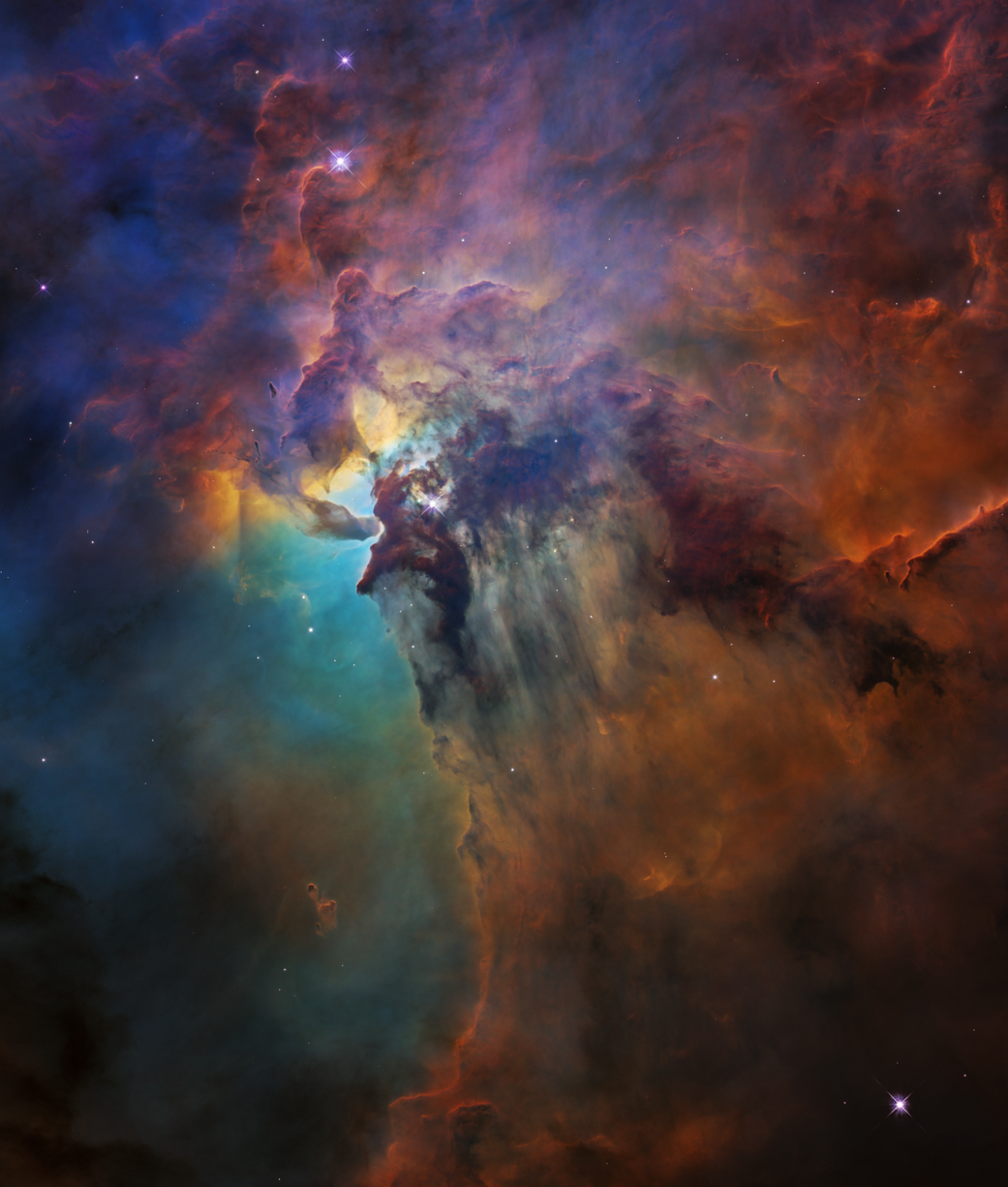
 optical infrared
 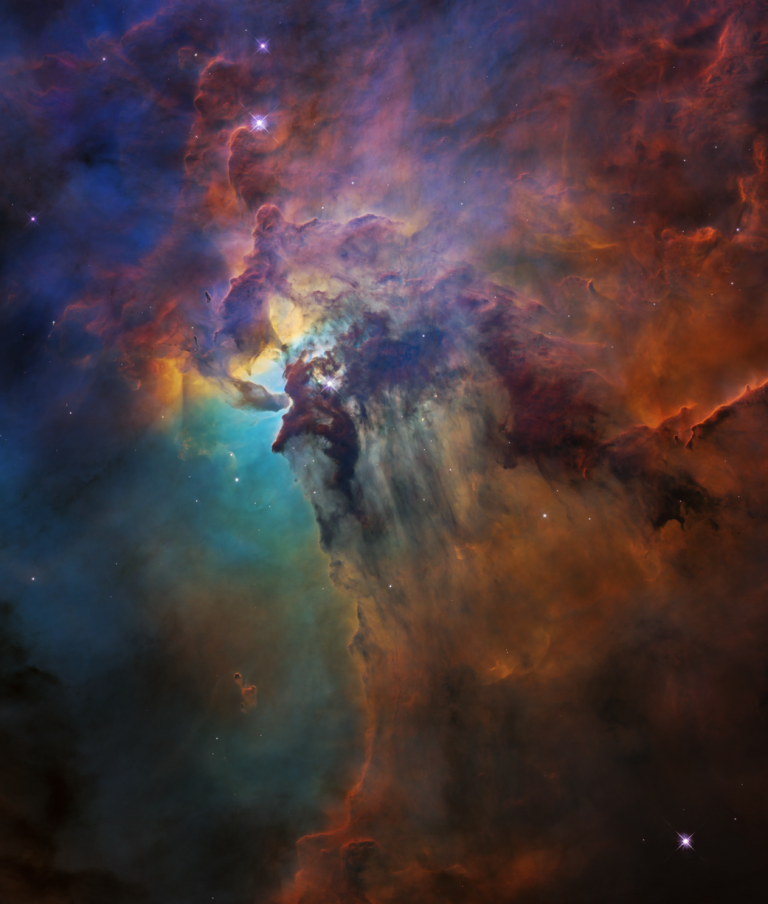 This colorful image, taken by the Hubble Space Telescope and published in 2018, celebrated the observatory’s 28th anniversary of viewing the heavens.
 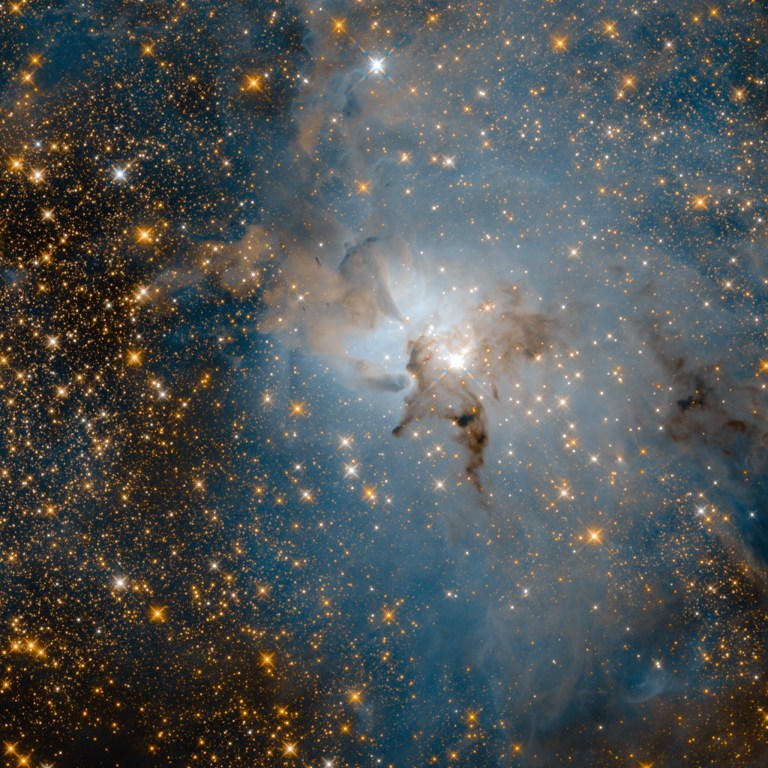 opticalinfrared This colorful image, taken by the Hubble Space Telescope and published in 2018, celebrated the observatory’s 28th anniversary of viewing the heavens. optical infrared Optical vs infrared
Two Views CurtainToggle2-Up Image Details The Galactic Plane Survey by NASA’s Nancy Grace Roman Space Telescope will scan the densest part of our galaxy, where most of its stars, gas, and dust reside — the most difficult region to study from our place inside the Milky Way since we have to look through so much light-blocking material. Roman’s wide field of view, crisp resolution, and infrared vision will help astronomers peer through thick bands of dust to chart new galactic territory. Credit: NASA, ESA, and STScI Roman’s repeated observations will also monitor stars that flicker. Ground-based surveys detect thousands of bright stellar outbursts, but often can’t see the faint, dust-obscured stars that produce them. Roman will pinpoint the culprits plus take high-resolution snapshots of the aftermath.
Some stars throb rhythmically, and the speed of their pulsing is directly linked to their intrinsic brightness. By comparing their true brightness to how bright they appear from Earth, astronomers can measure distances across the galaxy. Roman will find these blinking stars farther away than ever before and track them over time, helping astronomers improve their cosmic measuring sticks.
“Pairing Roman’s Galactic Plane Survey with other Milky Way observations will create the best portrait of the galaxy we’ve ever had,” Benjamin said.
Download additional images and video from NASA’s Scientific Visualization Studio.
For more information about the Roman Space Telescope, visit:
By Ashley Balzer
NASA’s Goddard Space Flight Center, Greenbelt, Md.
Media contact:
Claire Andreoli
NASA’s Goddard Space Flight Center, Greenbelt, Md.
301-286-1940
 6 min read NASA’s Roman Mission Shares Detailed Plans to Scour Skies Article 8 months ago
  8 min read NASA Completes Nancy Grace Roman Space Telescope Construction Article 1 week ago
  7 min read One Survey by NASA’s Roman Could Unveil 100,000 Cosmic Explosions Article 5 months ago