Explore Hubble Hubble Home Overview About Hubble The History of Hubble Hubble Timeline Why Have a Telescope in Space? Hubble by the Numbers At the Museum FAQs Impact & Benefits Hubble’s Impact & Benefits Science Impacts Cultural Impact Technology Benefits Impact on Human Spaceflight Astro Community Impacts Science Hubble Science Science Themes Science Highlights Science Behind Discoveries Universe Uncovered Hubble’s Partners in Science AI and Hubble Science Explore the Night Sky Observatory Hubble Observatory Hubble Design Mission Operations Science Operations Astronaut Missions to Hubble Hubble vs Webb Team Hubble Team Career Aspirations Hubble Astronauts Multimedia Images Videos Sonifications Podcasts e-Books Online Activities 3D Hubble Models Lithographs Fact Sheets Posters Hubble on the NASA App Glossary News Hubble News Social Media Media Resources More 35th Anniversary Online Activities 2 min read
Hubble Studies Star Ages in Colorful Galaxy 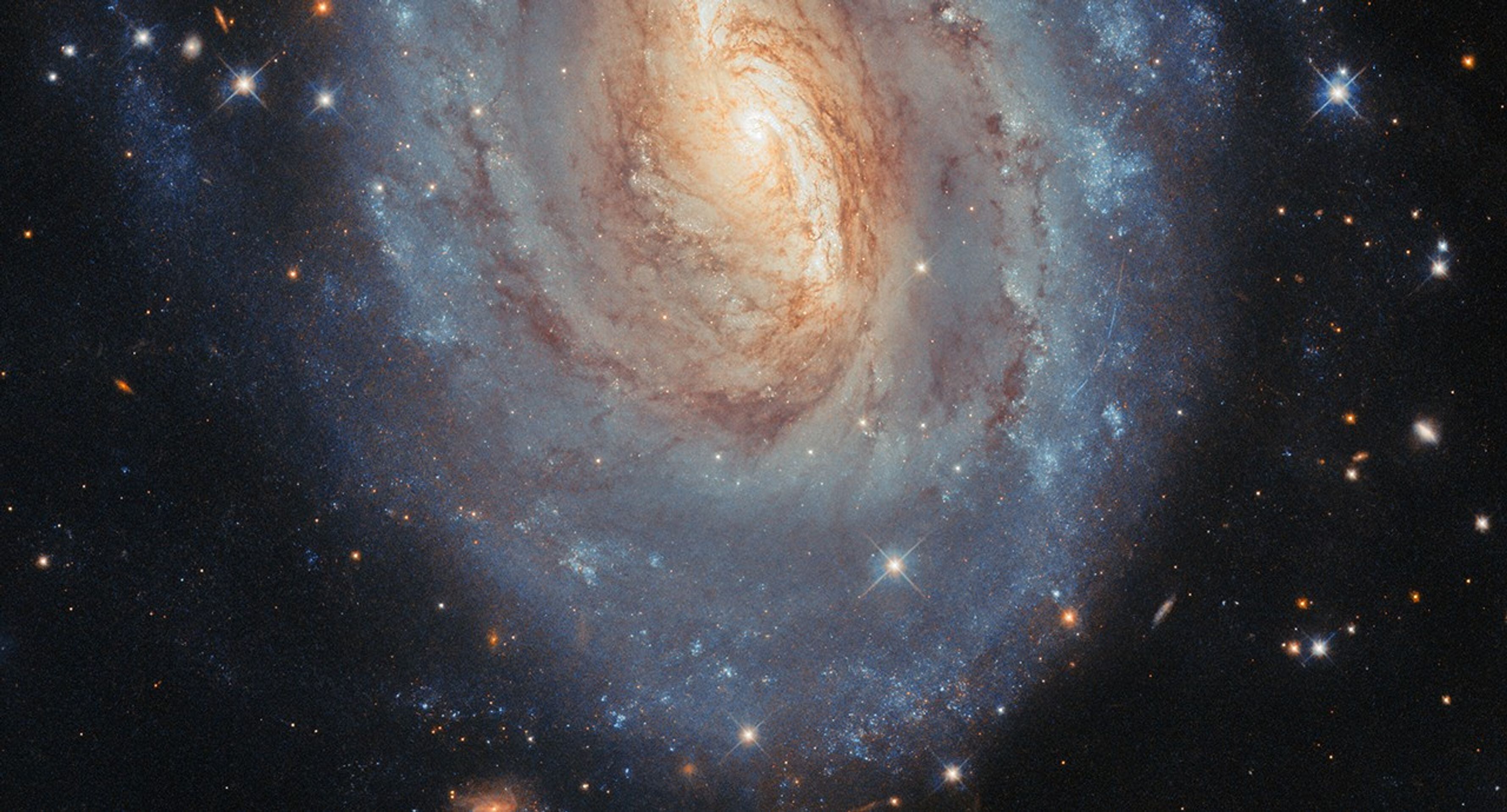 This NASA/ESA Hubble Space Telescope image features the spiral galaxy called NGC 6000. ESA/Hubble & NASA, A. Filippenko; Acknowledgment: M. H. Özsaraç Stars of all ages are on display in this NASA/ESA Hubble Space Telescope image of the sparkling spiral galaxy called NGC 6000, located 102 million light-years away in the constellation Scorpius.
NGC 6000 has a glowing yellow center and glittering blue outskirts. These colors reflect differences in the average ages, masses, and temperatures of the galaxy’s stars. At the heart of the galaxy, the stars tend to be older and smaller. Less massive stars are cooler than more massive stars, and somewhat counterintuitively, cooler stars are redder, while hotter stars are bluer. Farther out along NGC 6000’s spiral arms, brilliant star clusters host young, massive stars that appear distinctly blue.
Hubble collected the data for this image while surveying the sites of recent supernova explosions in nearby galaxies. NGC 6000 hosted two recent supernovae: SN 2007ch in 2007 and SN 2010as in 2010. Using Hubble’s sensitive detectors, researchers can discern the faint glow of supernovae years after the initial explosion. These observations help constrain the masses of supernovae progenitor stars and can indicate if they had any stellar companions.
By zooming in to the right side of the galaxy’s disk in this image, you can see a set of four thin yellow and blue lines. These lines are an asteroid in our solar system that was drifting across Hubble’s field of view as it gazed at NGC 6000. The four lines are due to four different exposures recorded one after another with slight pauses in between. Image processors combined these four exposures to create the final image. The lines appear dashed with alternating colors because each exposure used a filter to collect very specific wavelengths of light, in this case around red and blue. Having these separate exposures of particular wavelengths is important to study and compare stars by their colors — but it also makes asteroid interlopers very obvious!
Facebook logo @NASAHubble @NASAHubble Instagram logo @NASAHubble Media Contact:
Claire Andreoli (claire.andreoli@nasa.gov)
NASA’s Goddard Space Flight Center, Greenbelt, MD
Details Last Updated Nov 14, 2025 Editor Andrea Gianopoulos Location NASA Goddard Space Flight Center Related Terms Hubble Space Telescope Astrophysics Astrophysics Division Galaxies Goddard Space Flight Center Spiral Galaxies Stars The Universe
Keep Exploring Discover More Topics From Hubble Hubble Space Telescope
Since its 1990 launch, the Hubble Space Telescope has changed our fundamental understanding of the universe.