
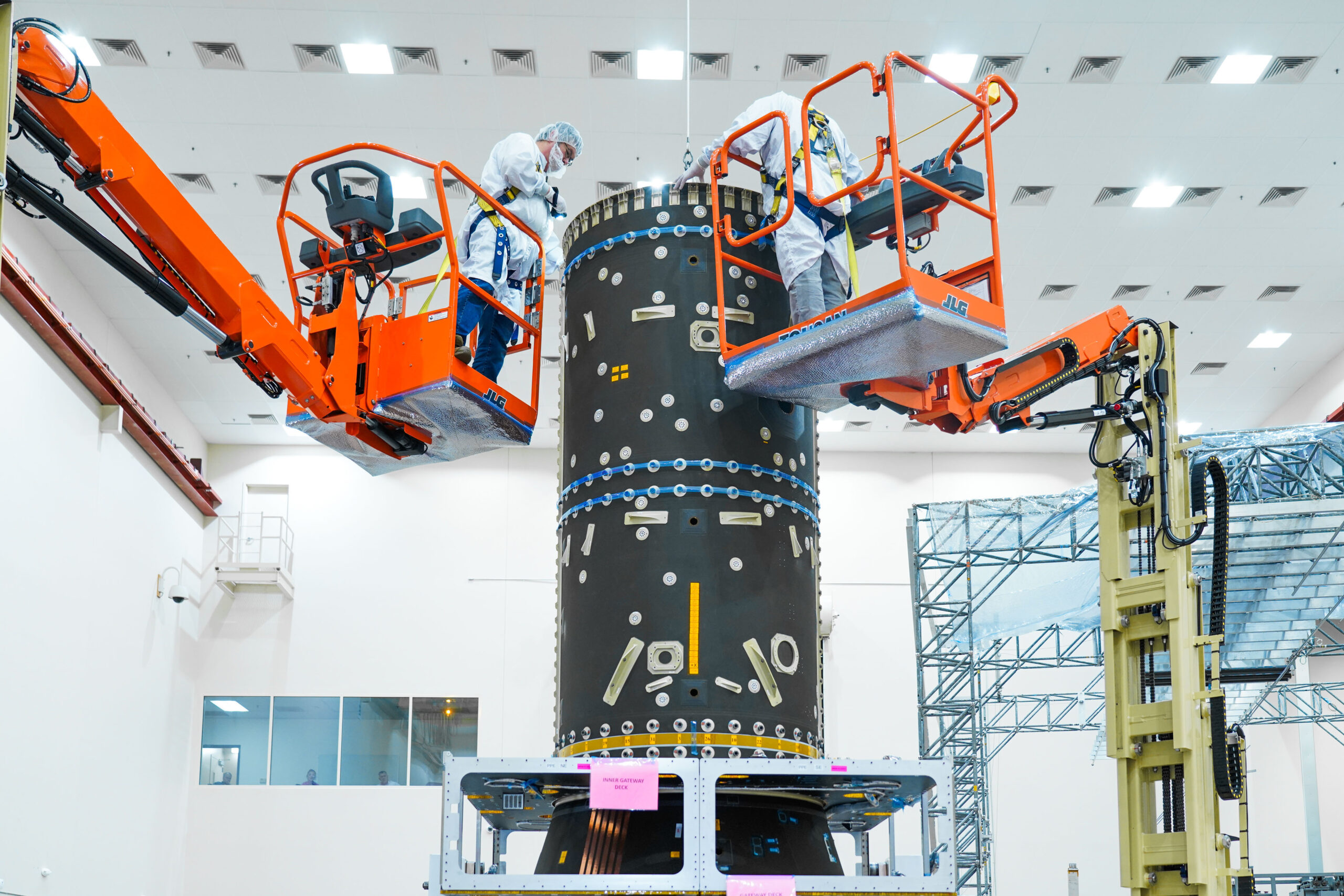
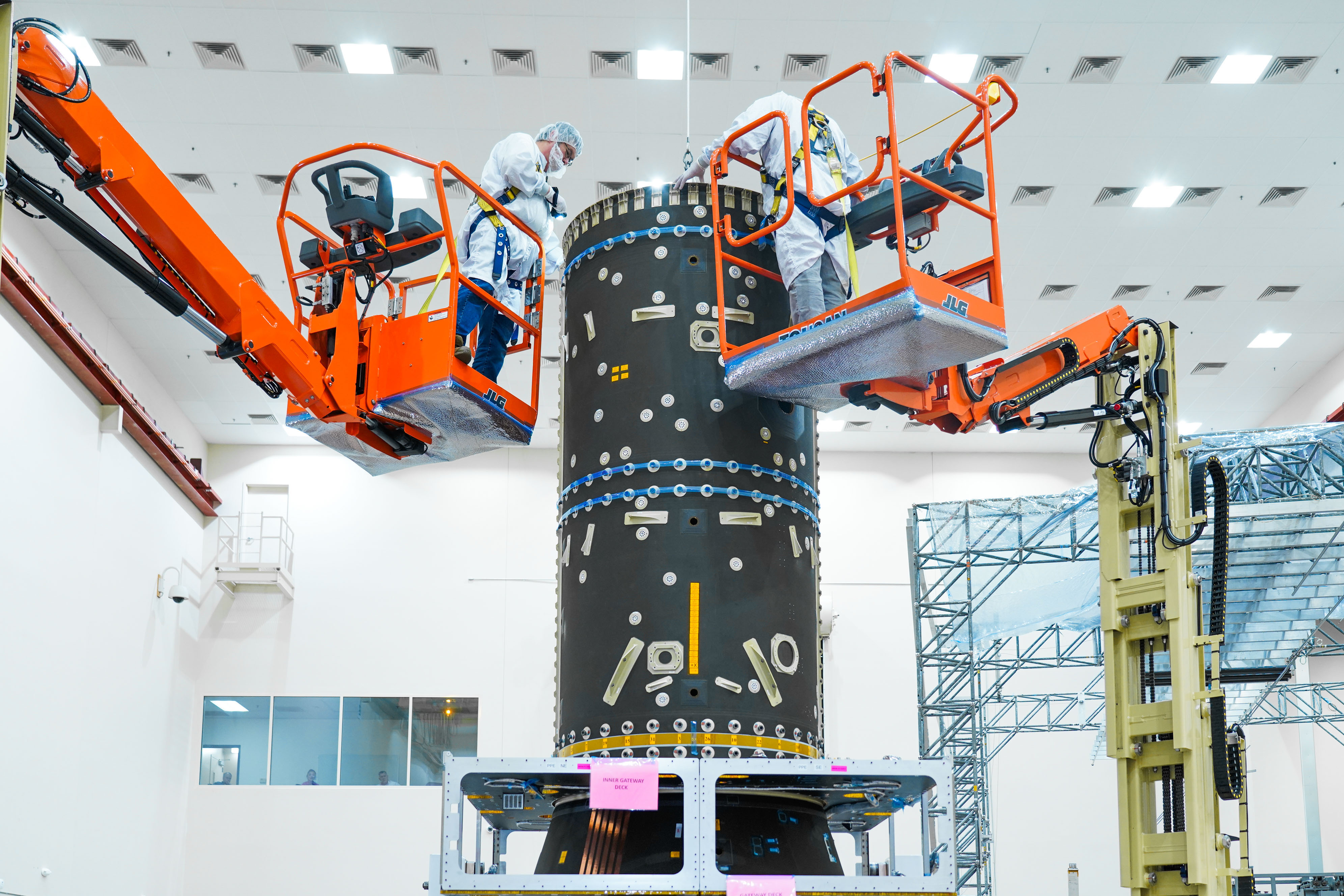
 Two engineers in cleanroom suits work on the Power and Propulsion Element at Maxar Space Systems in Palo Alto, California.Maxar Space Systems Technicians work diligently to assemble a key power element of Gateway, the lunar space station that will become the most powerful solar electric spacecraft ever flown.
Gateway’s Power and Propulsion Element will use the largest roll-out solar arrays ever built – together about the size of an American football field endzone – to harness the Sun’s energy for deep space exploration. The module is built by Maxar Space Systems in Palo Alto, California, and managed at NASA’s Glenn Research Center in Cleveland. That includes energizing xenon gas to produce the thrust needed to send Gateway from Earth to lunar orbit and keep it there for the Artemis IV, V, and VI missions. On those missions and beyond, international teams of astronauts will expand Gateway with additional living and working space, and will journey to the lunar South Pole region from Gateway.
The Power and Propulsion Element will power Gateway’s subsystems and enable telecommunications between the lunar surface, the space station, Earth, and back again. Building on technology advancements from past successful electric propulsion missions like Psyche and DART (Double Asteroid Redirection Test), the module will help NASA expand the boundaries of what’s possible in deep space.
NASA and its international partners will explore the scientific mysteries of deep space with Gateway, humanity’s first space station around the Moon. The international teams of astronauts living and conducting science on Gateway will be the first humans to make their home in deep space.
 A type of advanced electric propulsion system thruster that will be used on Gateway glows blue as it emits ionized xenon gas during testing at NASA’s Glenn Research Center.NASA
  An artist’s rendering of the Gateway space station, which will be humanity’s first space station around the Moon as a vital component of the Artemis missions to return humans to the lunar surface for scientific discovery and chart the path for the first human missions to Mars. NASA/Alberto Bertolin
 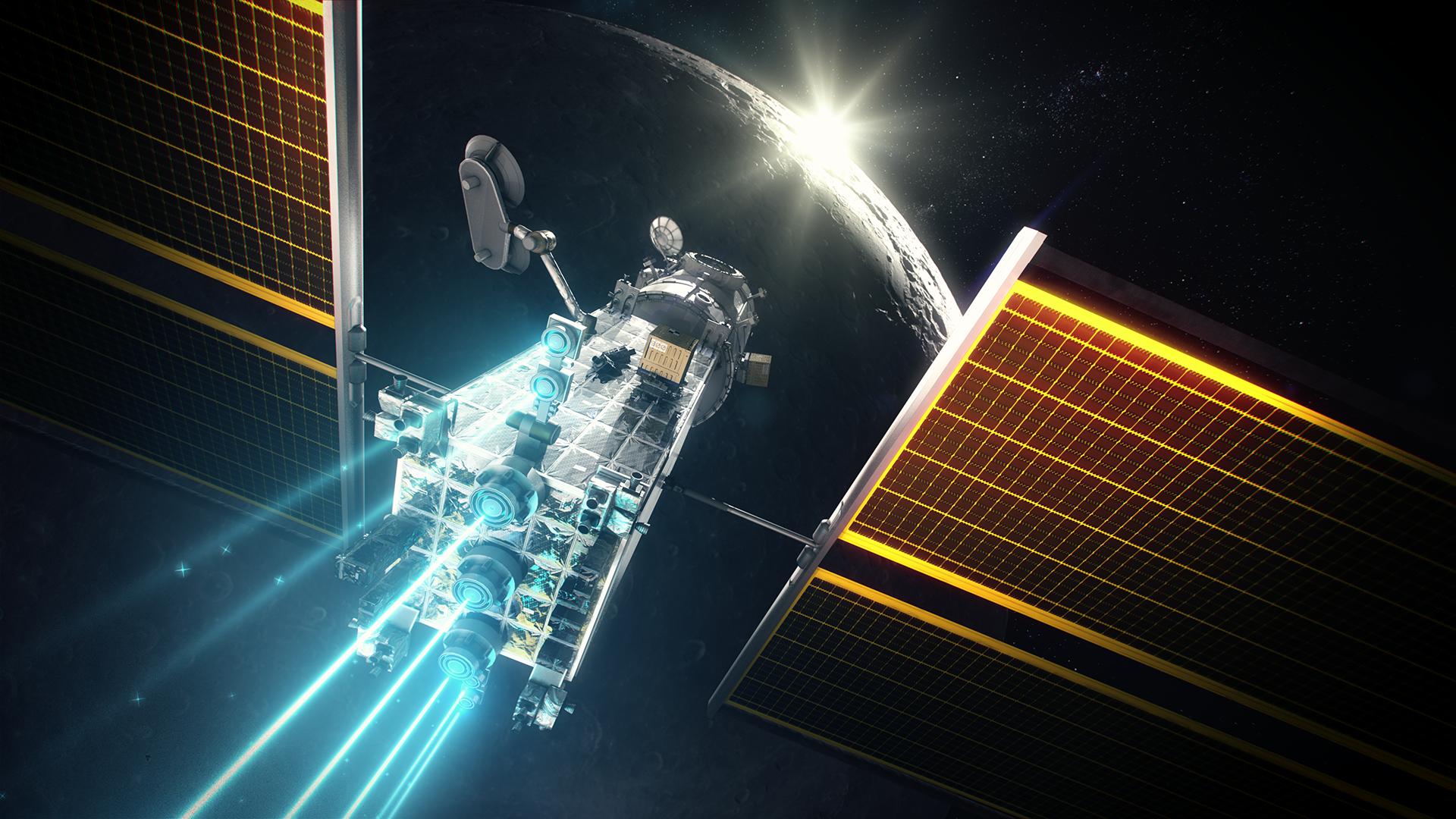 Artist’s rendering of Gateway in its initial configuration, featuring the Habitation and Logistics Outpost (HALO) connected to the Power and Propulsion Element.NASA Learn More About Gateway Facebook logo @NASAGateway @NASA_Gateway Instagram logo @nasaartemis
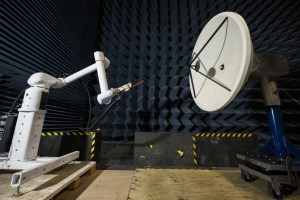 2 min read Earth to Gateway: Electric Field Tests Enhance Lunar Communication Learn how engineers at NASA’s Johnson Space Center are using electric field testing to optimize…
Article 3 weeks ago
 3 min read Gateway: Up Close in Stunning Detail Witness Gateway in stunning detail with this video that brings the future of lunar exploration…
Article 2 months ago
 2 min read Through Astronaut Eyes, Virtual Reality Propels Gateway Forward NASA astronauts are using virtual reality to explore Gateway. When they slip on their headsets,…
Article 4 months ago