
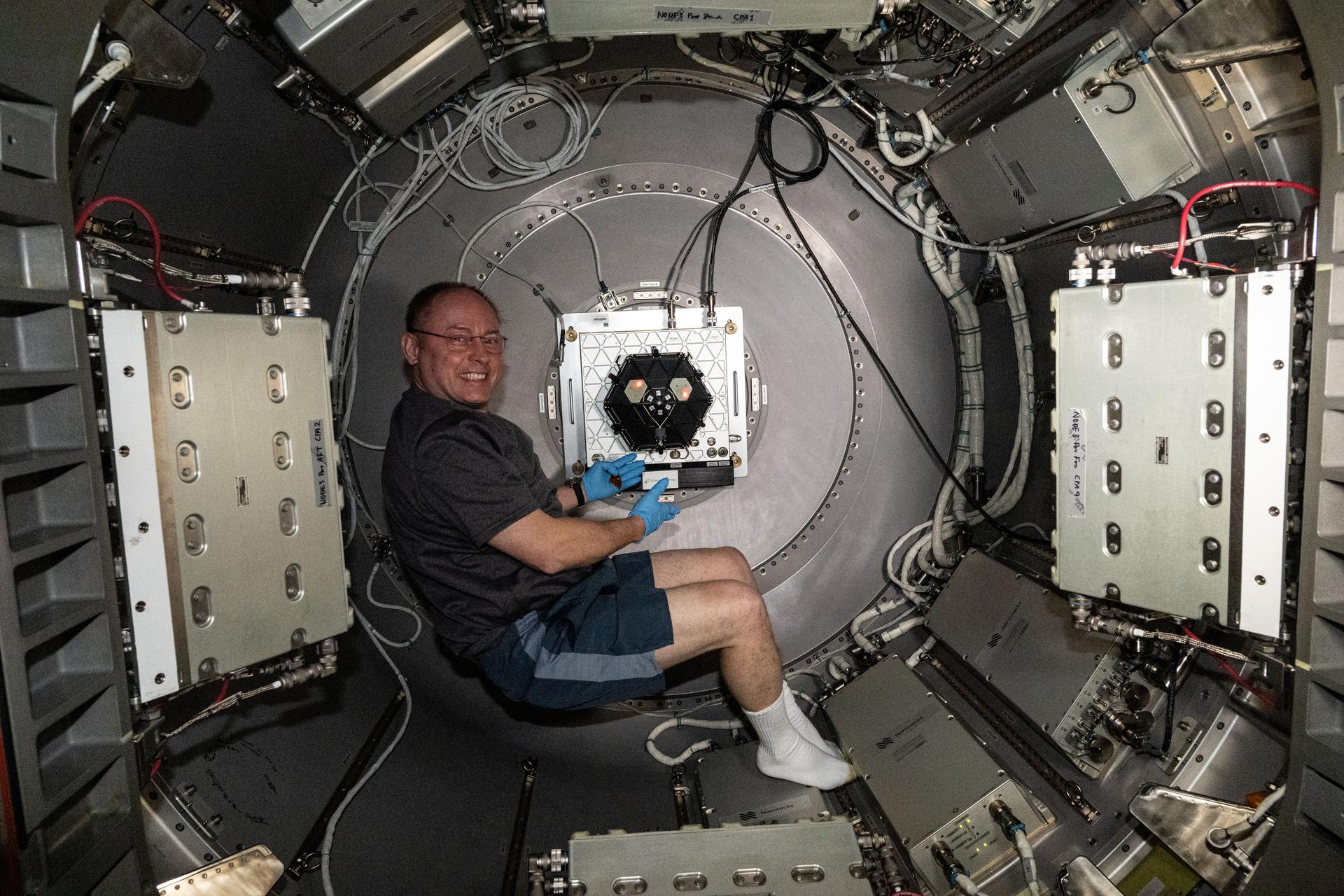

The Expedition 74 crew’s research schedule was filled with biomedical duties and artificial intelligence on Thursday to promote crew health and spark innovation on and off the Earth. Spacesuit tailoring and advanced science hardware maintenance rounded out the day for the seven residents aboard the International Space Station.
Flight Engineer Chris Williams of NASA began his day collecting his blood and urine samples, processing them, then stowing them in a science freezer for later analysis. He also swapped out a sensor-packed Bio-Monitor vest and headband for a dry set and began a second day of health monitoring for the long-running CIPHER human research study. Doctors will examine his biomedical samples after they are returned to Earth and analyze his downlinked heart and lung activity to understand how microgravity is affecting his body.
Roscosmos Flight Engineers Sergey Kud-Sverchkov and Sergei Mikaev took turns testing a voice-based artificial intelligence system that records crew members vocally documenting their activities for more efficient reporting. The cosmonauts also each spent an hour in a quiet portion of the station wearing noise-reducing headphones for a computerized hearing test and responding to pre-programmed tones.
Flight Engineer Kimiya Yui of JAXA (Japan Aerospace Exploration Agency) spent his shift working on a pair of scientific instruments supporting a variety of experiments ranging from biology to physics. He started inside the Kibo laboratory module and set up a biology research imaging system that uses luminescence to observe tissues and genes in microgravity for deeper insights into disease mechanisms. Next, he moved into the Destiny laboratory module and powered on the KERMIT fluorescence microscope to image flat liquid crystal films to help engineers design advanced screen displays for touchpads and instrumentation panels.
Station Commander Mike Fincke of NASA spent most of his day working on spacesuits in the Quest airlock. Fincke began his shift adjusting the length of the arms and legs on one spacesuit. Next, Fincke practiced installing emergency jet packs on the spacesuits with assistance from Williams and Yui. The jet pack, officially called Simplified Aid For EVA Rescue, or SAFER, is attached to the back of the spacesuit and enables a spacewalker to safely maneuver back to the station in the unlikely event they become untethered from the orbital outpost.
NASA Flight Engineer Zena Cardman worked primarily on computer and life support maintenance throughout Thursday. Cardman first worked in the Columbus laboratory module setting up a laptop computer and adjusting its settings so it can run specialized science experiment software. Afterward, she worked in the Tranquility module replacing atmospheric cleaning components that remove harmful contaminants from the air, such as ammonia, that can cause eye, skin, or respiratory irritation.
Flight Engineer Oleg Platonov worked throughout Thursday inside the station’s Roscosmos segment servicing a variety of life support equipment ensuring the orbital outpost operates in tip-tip shape. Platonov spent the first half of his shift replacing atmospheric monitoring hardware in the Zvezda service module and filling a water processing assembly tank. After lunchtime, the first-time space flyer cleaned the ventilation system inside the Nauka science module.
Learn more about station activities by following the space station blog, @space_station on X, as well as the ISS Facebook and ISS Instagram accounts.
Get the latest from NASA delivered every week. Subscribe here.