

3 Min Read Celestial Wonders in Leo  Showing a large portion of M66, this Hubble photo is a composite of images obtained at visible and infrared wavelengths. The images have been combined to represent the real colors of the galaxy. Credits:
NASA, ESA and the Hubble Heritage (STScI/AURA)-ESA/Hubble Collaboration; Acknowledgment: Davide De Martin and Robert Gendler Leo is a prominent sight for stargazers in April. Its famous sickle, punctuated by the bright star Regulus, draws many a beginning stargazer’s eyes, inviting deeper looks into some of Leo’s celestial delights, including a great double star and a famous galactic trio.
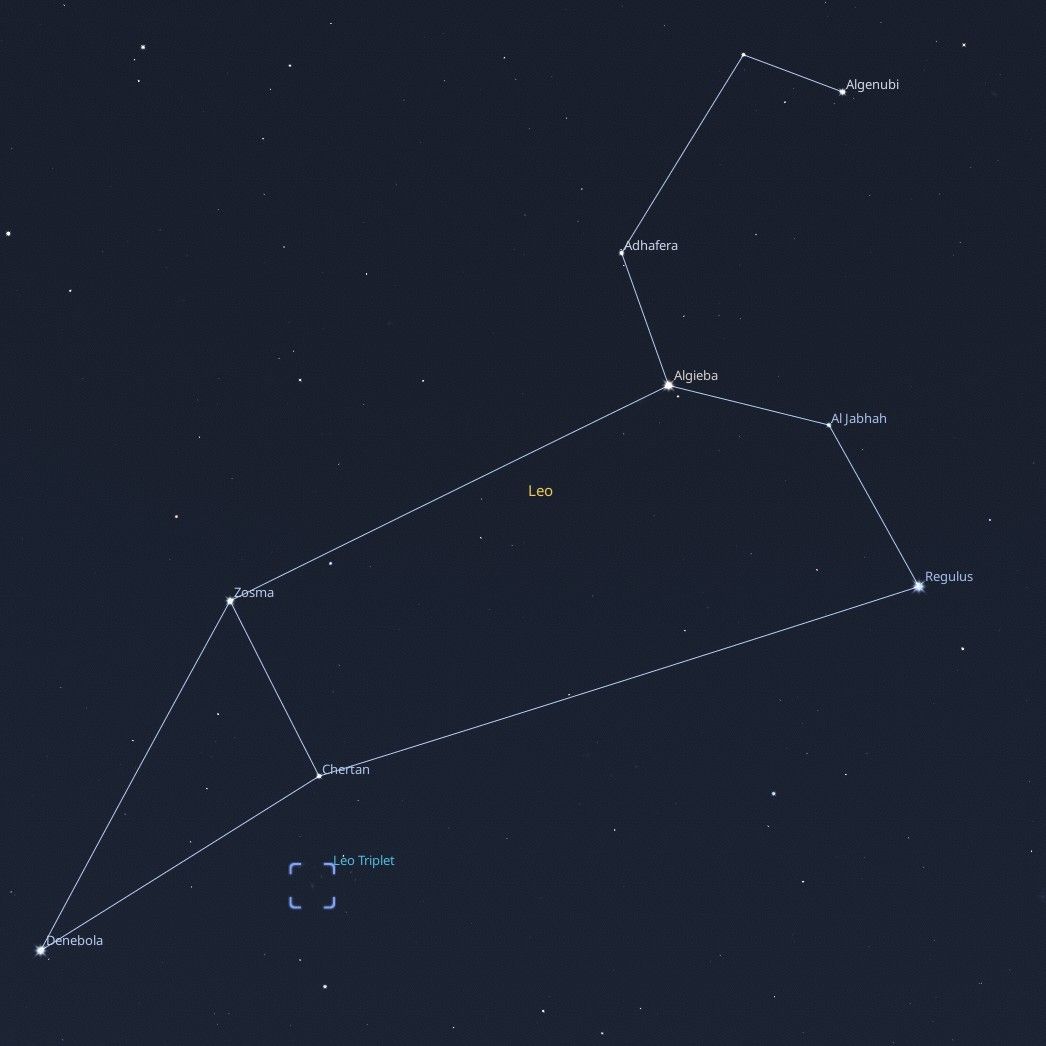 The constellation, Leo. You can find this constellation in the springtime skies. Stellarium Leo’s distinctive forward sickle, or “reverse question mark,” is easy to spot as it climbs the skies in the southeast after sunset. If you are having a difficult time spotting the sickle, look for bright Sirius and Procyon in Canis Major and Canis Minor. Complete a triangle by drawing two lines to the east, joining at the bright star Regulus, the “period” in the reverse question mark. Trailing them is a trio of bright stars forming an isosceles triangle, the brightest star in that formation named Denebola. Connecting these two patterns together forms the constellation of Leo the Lion, with the forward-facing sickle being the lion’s head and mane, and the rear triangle its hindquarters. Can you see this mighty feline? It might help to imagine Leo proudly sitting up and staring straight ahead, like a celestial Sphinx. To help find these objects, you can use online tools like Stellarium Web.
If you peer deeper into Leo with a small telescope or binoculars, you’ll find a notable double star! Look in the sickle of Leo for its second-brightest star, Algieba, also called Gamma Leonis. This star splits into two bright yellow stars even with a small magnification. You can make this “split” with binoculars, but it’s more apparent with a telescope. Compare the color and intensity of these two stars: do you notice any differences? There are other multiple-star systems in Leo; spend a few minutes scanning with your instrument of choice, and see what you discover.
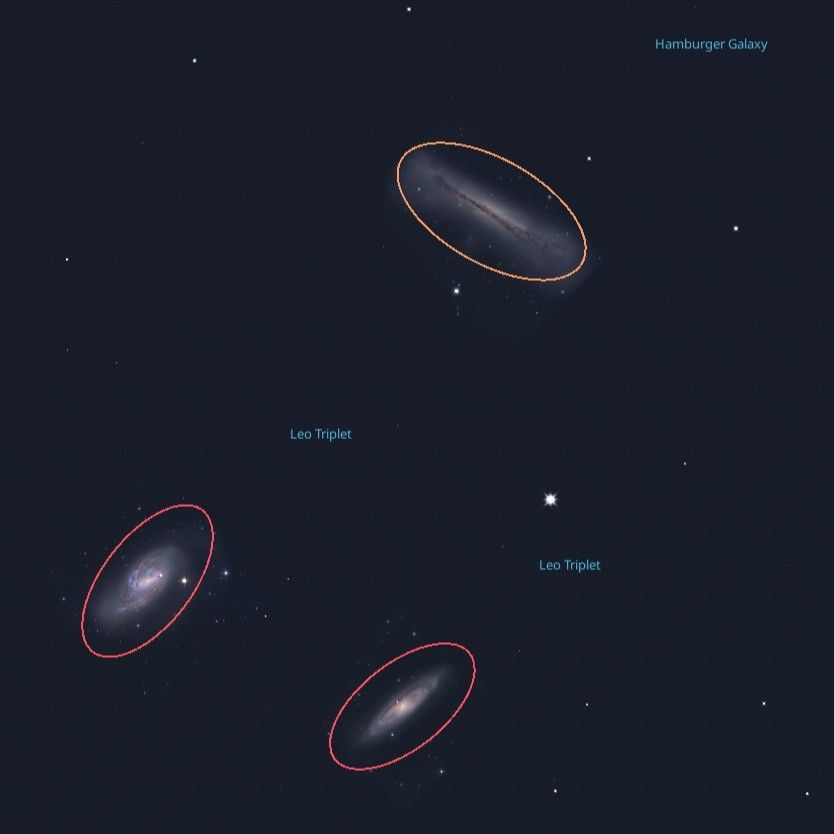 The Leo Triplet – three galaxies that appear to be close together under the star Chertan in the Leo constellation. Stellarium One of the most famous sights in Leo is the “Leo Triplet”: three galaxies that appear to be close together. They are indeed gravitationally bound to one another, around 30 million light-years away! You’ll need a telescope to spot them, and use an eyepiece with a wide field of view to see all three galaxies at once! Look below the star Chertan to find galaxies M65, M66, and NGC 3628 – The Hamburger Galaxy. Compare and contrast the appearance of each galaxy – while they are all spiral galaxies, each one is tilted at different angles to our point of view! Do they all look like spiral galaxies to you?
April is Citizen Science Month, and there are some fun Leo-related activities you can participate in! If you enjoy
comparing the Triplets, the Galaxy Zoo project could use your eyes to help classify different galaxies from sky survey data! Looking at Leo itself can even help measure light pollution: the Globe at Night project uses Leo as their target constellation for sky quality observations from the Northern Hemisphere. Find and participate in many more NASA community science programs at NASA Citizen Science. Happy observing!
Originally posted by Dave Prosper: April 2021
Last Updated by Kat Troche: April 2026