
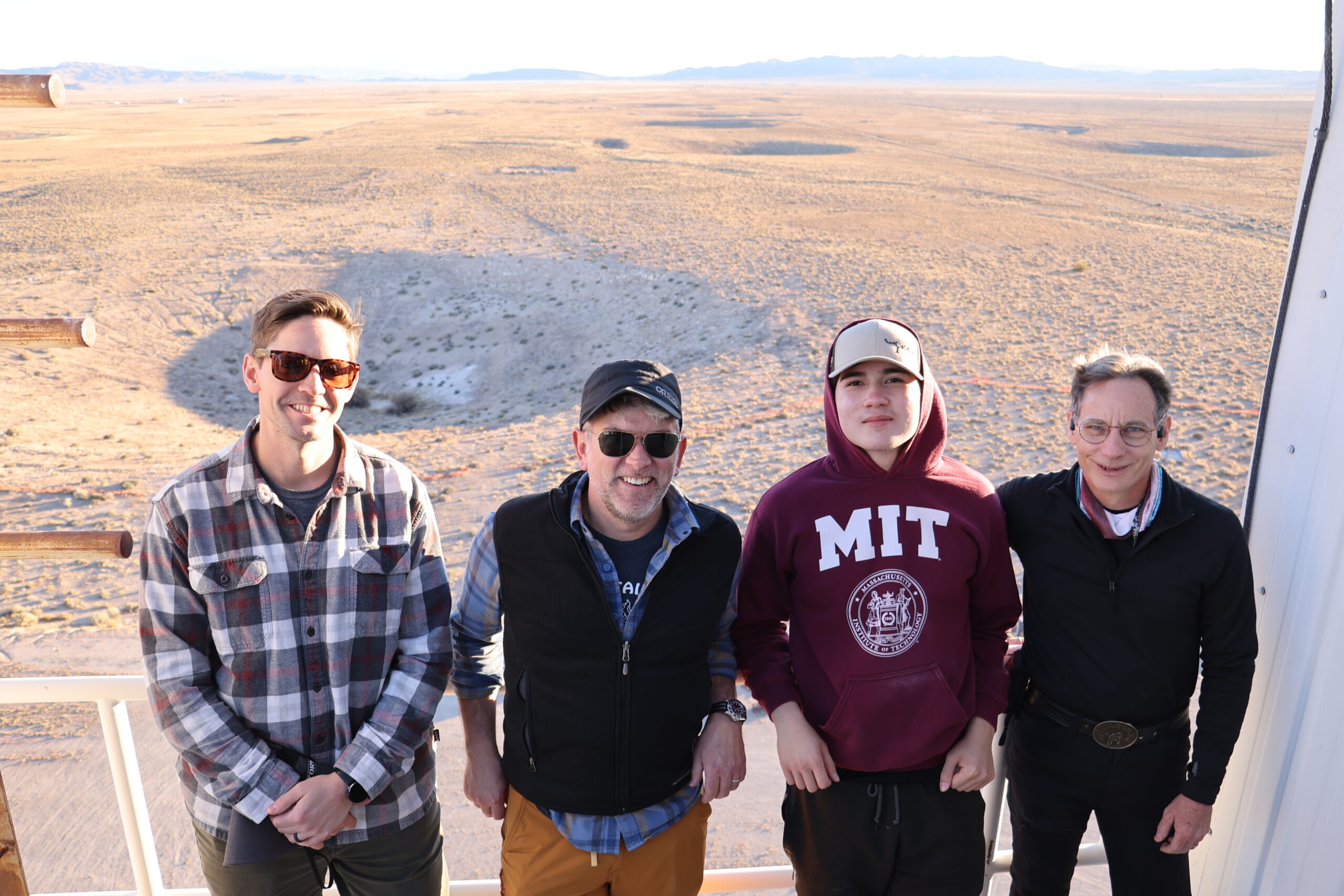
2 Min Read Building a Lunar Network: Johnson Tests Wireless Technologies for the Moon  From left, Johnson Exploration Wireless Laboratory (JEWL) Software Lead William Dell; Lunar 3GPP Principal Investigator Raymond Wagner; JEWL intern Harlan Phillips; and JEWL Lab Manager Chatwin Lansdowne. Credits: Nevada Space Proving Grounds (NSPG) NASA engineers are strapping on backpacks loaded with radios, cameras, and antennas to test technology that might someday keep explorers connected on the lunar surface. Their mission: test how astronauts on the Moon will stay connected during Artemis spacewalks using 3GPP (LTE/4G and 5G) and Wi-Fi technologies.
It’s exciting to bring lunar spacewalks into the 21st century with the immersive, high-definition experience that will make people feel like they’re right there with the astronauts.  Raymond Wagner
NASA’s Lunar 3GPP Project Principal Investigator
 A NASA engineer tests a backpack-mounted wireless communications system in the Nevada desert, simulating how astronauts will stay connected during Artemis lunar spacewalks. NSPG With Artemis, NASA will establish a long-term presence at the Moon, opening more of the lunar surface to exploration than ever before. This growth of lunar activity will require astronauts to communicate seamlessly with each other and with science teams back on Earth.
“We’re working out what the software that uses these networks needs to look like,” said Raymond Wagner, principal investigator in NASA’s Lunar 3GPP project and member of Johnson Space Center’s Exploration Wireless Laboratory (JEWL) in Houston. “We’re prototyping it with commercial off-the-shelf hardware and open-source software to show what pieces are needed and how they interact.”
 Carrying a prototype wireless network pack, a NASA engineer helps test wireless 4G and 5G technologies that could one day keep Artemis astronauts connected on the Moon. NSPG The next big step comes with Artemis III, which will land a crew on the Moon and carry a 4G/LTE demonstration to stream video and audio from the astronauts on the lunar surface.
The vision goes further. “Right now the lander or rover will host the network,” Wagner said. “But if we go to the Moon to stay, we may eventually want actual cell towers. The spacesuit itself is already becoming the astronaut’s cell phone, and rovers could act as mobile hotspots. Altogether, these will be the building blocks of communication on the Moon.”
 Team members from NASA’s Avionics Systems Laboratory at Johnson Space Center in Houston.NASA/Sumer Loggins Back at Johnson, teams are simulating lunar spacewalks, streaming video, audio, and telemetry over a private 5G network to a mock mission control. The work helps engineers refine how future systems will perform in challenging environments. Craters, lunar regolith, and other terrain features all affect how radio signals travel — lessons that will also carry over to Mars.
For Wagner, the project is about shaping how humanity experiences the next era of exploration. “We’re aiming for true HD on the Moon,” he said. “It’s going to be pretty mind-blowing.”
About the Author Sumer Loggins
 3 min read Aaisha Ali: From Marine Biology to the Artemis Control Room Article 2 months ago
  4 min read Mark Cavanaugh: Integrating Safety into the Orion Spacecraft Article 2 months ago
  3 min read Bringing the Heat: Abigail Howard Leads Thermal Systems for Artemis Rovers, Tools Article 6 months ago
 Keep Exploring Discover More Topics From NASA Missions




