Landsat Navigation Landsat Home Missions Landsat Next Landsat 9 Landsat 8 Landsat 7 Landsat 6 Landsat 5 Landsat 4 Landsat 3 Landsat 2 Landsat 1 News Latest News People of Landsat Q&As Newsletter Publications Data Overview Cal/Val Open Data Benefits Overview Agriculture & Food Security Disaster Management Ecosystems & Biodiversity Energy Resources Forest Management Human Health Urban Development Water Resources Wildfires Case Studies Outreach Multimedia About Search To view this video please enable JavaScript, and consider upgrading to a web browser that
supports HTML5 video
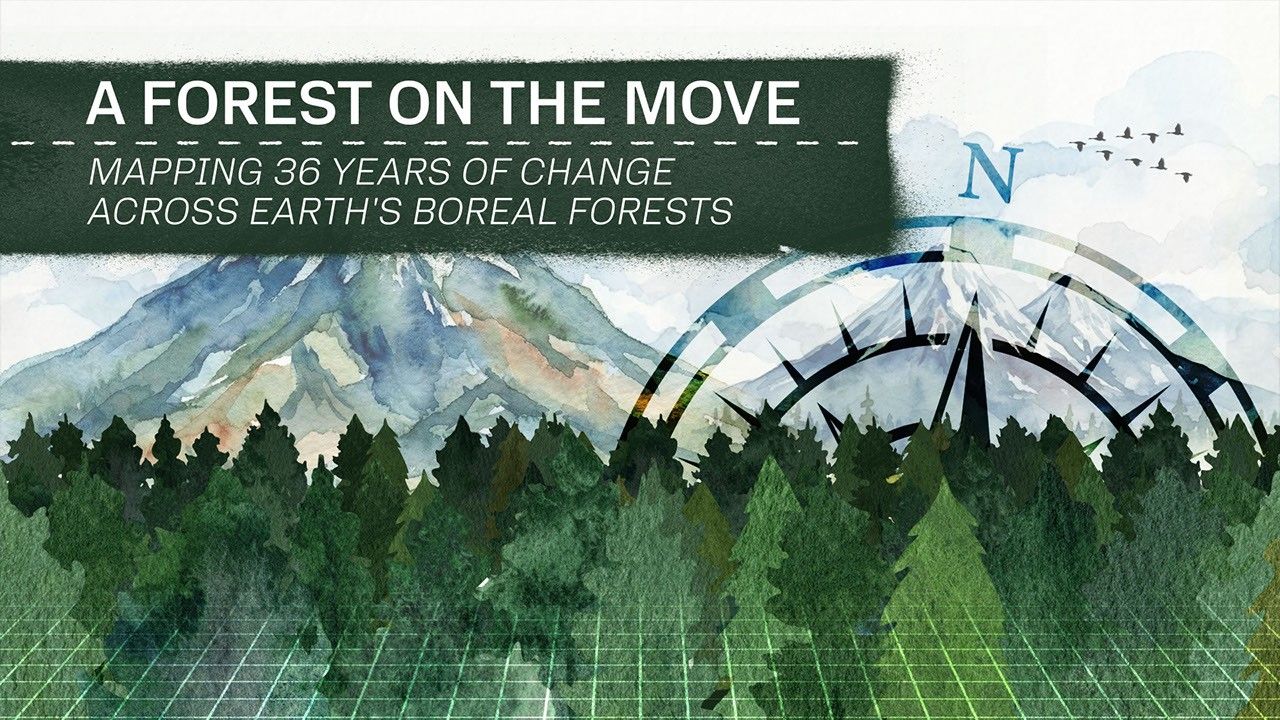
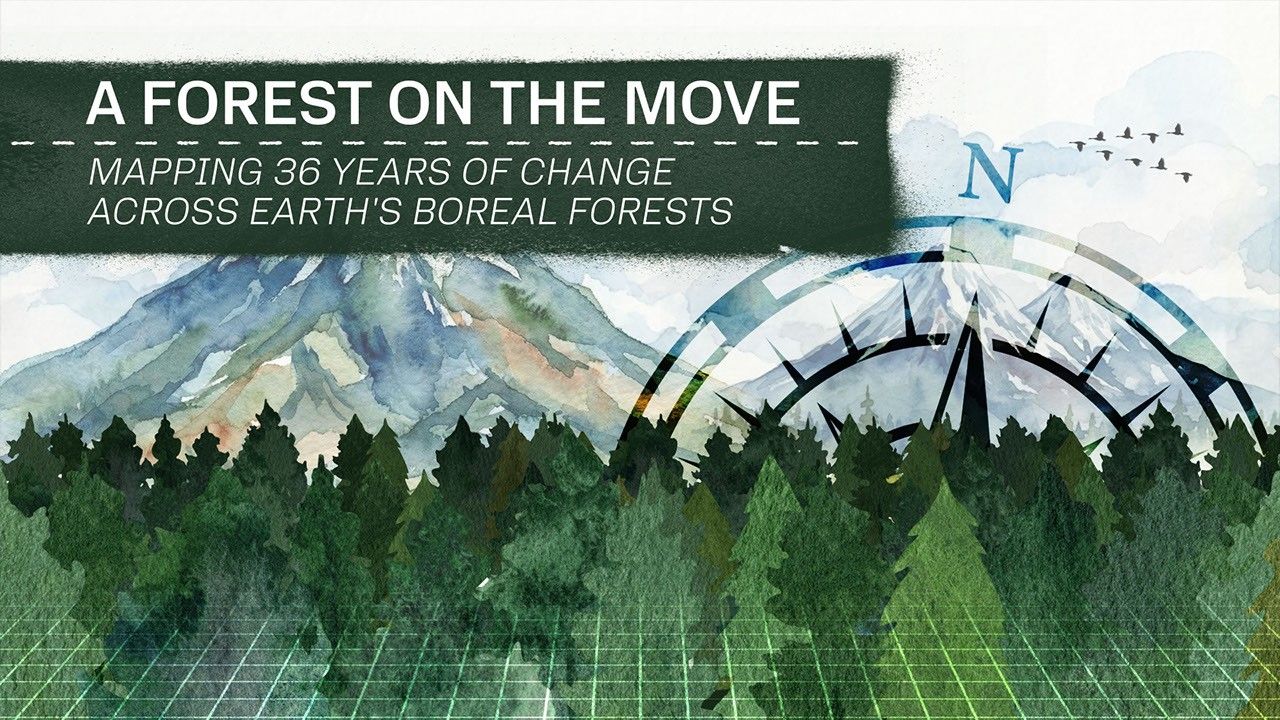
For the first time, researchers have been able to confirm that our planet’s boreal forests are on the move. NASA’s Goddard Space Flight Center/Chris Burns The boreal forest—the world’s largest terrestrial biome—is warming faster than any other forest type. To understand the changing dynamics of boreal forests, Feng et al., 2026 analyzed the biome from 1985 to 2020, leveraging the longest and highest-resolution satellite record of calibrated tree cover to date. The study, published in February in Biogeosciences with four co-authors from NASA Goddard Space Flight Center, confirms a northward shift in boreal forest cover over the past four decades. Landsat imagery played a central role in this study: the researchers applied machine learning to process 224,026 scenes collected by Landsats 4, 5, 7, and 8 to create annual, 30-meter resolution maps of tree cover across the entire boreal biome. They downscaled and extended calibrated MODIS Vegetation Continuous Fields data to 30-meter resolution, creating a 36-year time series (1984-2020) that provided unprecedented spatial detail for tracking forest changes.
The analysis revealed that boreal forests both grew in size and moved northward. The forests expanded by 0.844 million km² (a 12% increase) and shifted northward by 0.29° mean latitude, with gains concentrated between 64-68°N. Their work also showcased the capacity of new growth to act as a carbon sink. Young boreal forests (up to 36 years) hold an estimated 1.1-5.9 petagrams of carbon (Pg C) with potential to sequester an additional 2.3-3.8 Pg C if allowed to mature. Landsat’s long time series of highly calibrated data allows researchers to study how ecosystems shift over decades, a crucial insight into our changing world.
Explore More
Boreal Forests Are Shifting North
2 min read The boreal forest—the world’s largest terrestrial biome—is warming faster than any other forest type. New research uses Landsat data to…
Article 
4 min read About 2,900 Olympic athletes have converged on northern Italy to sort out who is the GOAT—or perhaps the stoat.
Article 
Tracking Glacial Change with Landsat and Radar
5 min read NASA Scientist Alex Gardner highlights how Landsat made his research into the dynamics of glacial flow possible.