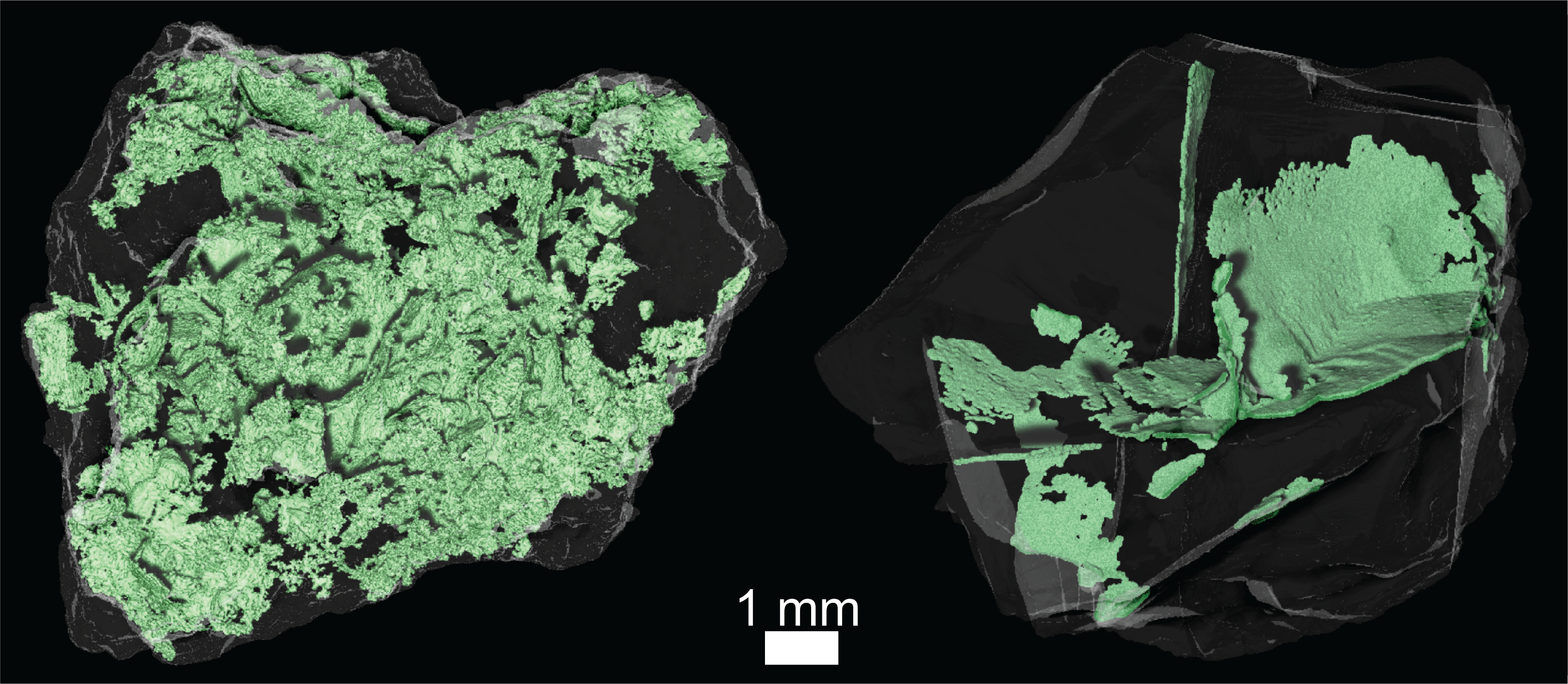
5 Min Read Asteroid Bennu’s Rugged Surface Baffled NASA, We Finally Know Why These are X-ray computed tomography (XCT) scans of particles from asteroid Bennu. They show the most common types of crack networks observed in Bennu samples. Credits:
NASA/Scott Eckley In one of the biggest surprises of NASA’s OSIRIS-REx mission, its target asteroid, Bennu, turned out to be a jagged, rugged world covered in large boulders, with few of the smooth patches that earlier observations from Earth-based instruments had indicated.
“When OSIRIS-REx got to Bennu in 2018, we were surprised by what we saw,” said Andrew Ryan, a scientist with the University of Arizona’s Lunar and Planetary Laboratory in Tucson, who led the mission’s sample physical and thermal analysis working group. “We expected some boulders, but we anticipated at least some large regions with smoother, finer regolith that would be easy to collect. Instead, it looked like it was all boulders, and we were scratching our heads for a while.”
Particularly puzzling were observations made in 2007 by NASA’s Spitzer Space Telescope, which measured low thermal inertia, indicative of an asteroid whose surface heats up and cools down rapidly as it rotates into and out of sunlight, like a sandy beach on Earth. This was at odds with the many large boulders that OSIRIS-REx found upon arrival, which should act more like blocks of concrete, shedding heat long after the Sun has set.
Data collected by the OSIRIS-REx spacecraft during its survey campaign at the asteroid suggested a possible explanation: the boulders could be much more porous than expected. Once the samples were delivered to Earth, researchers were able to investigate this further.
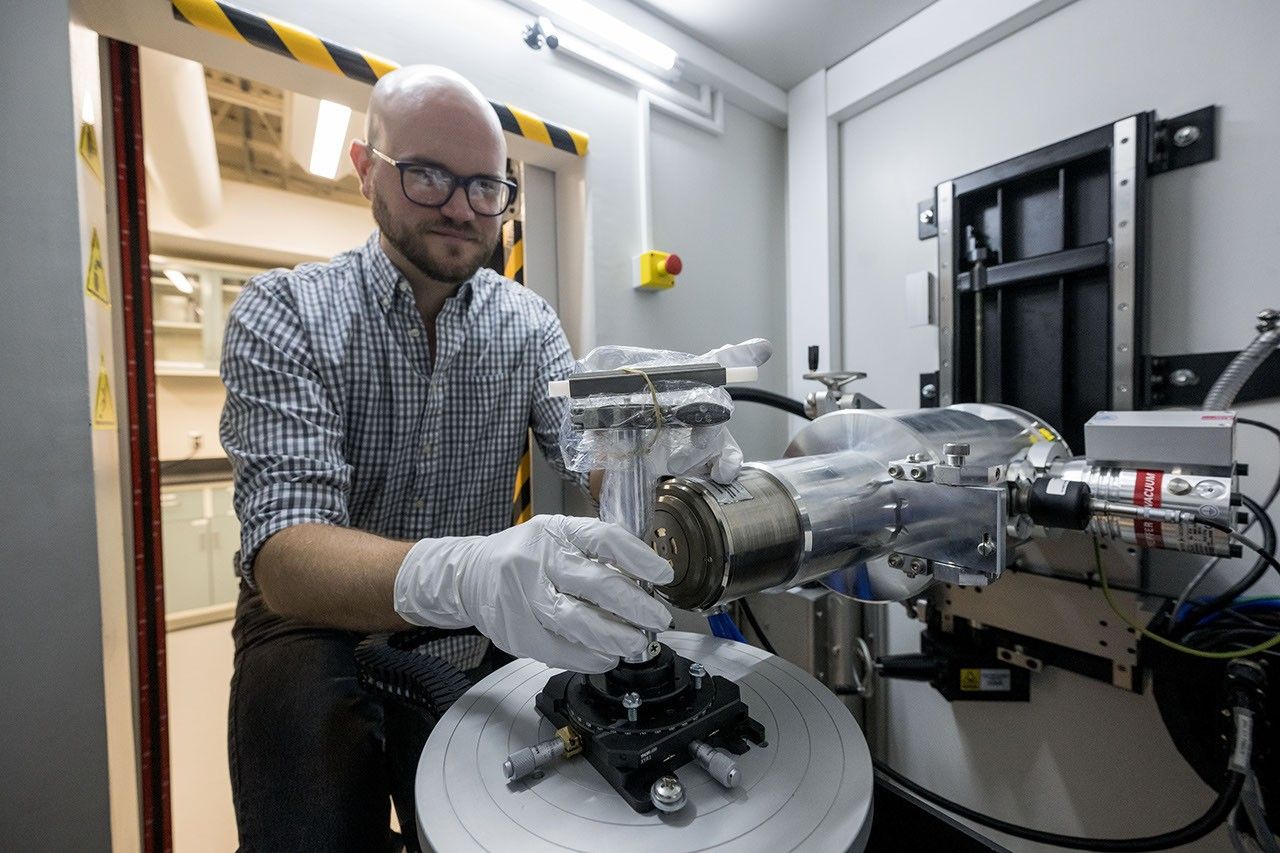
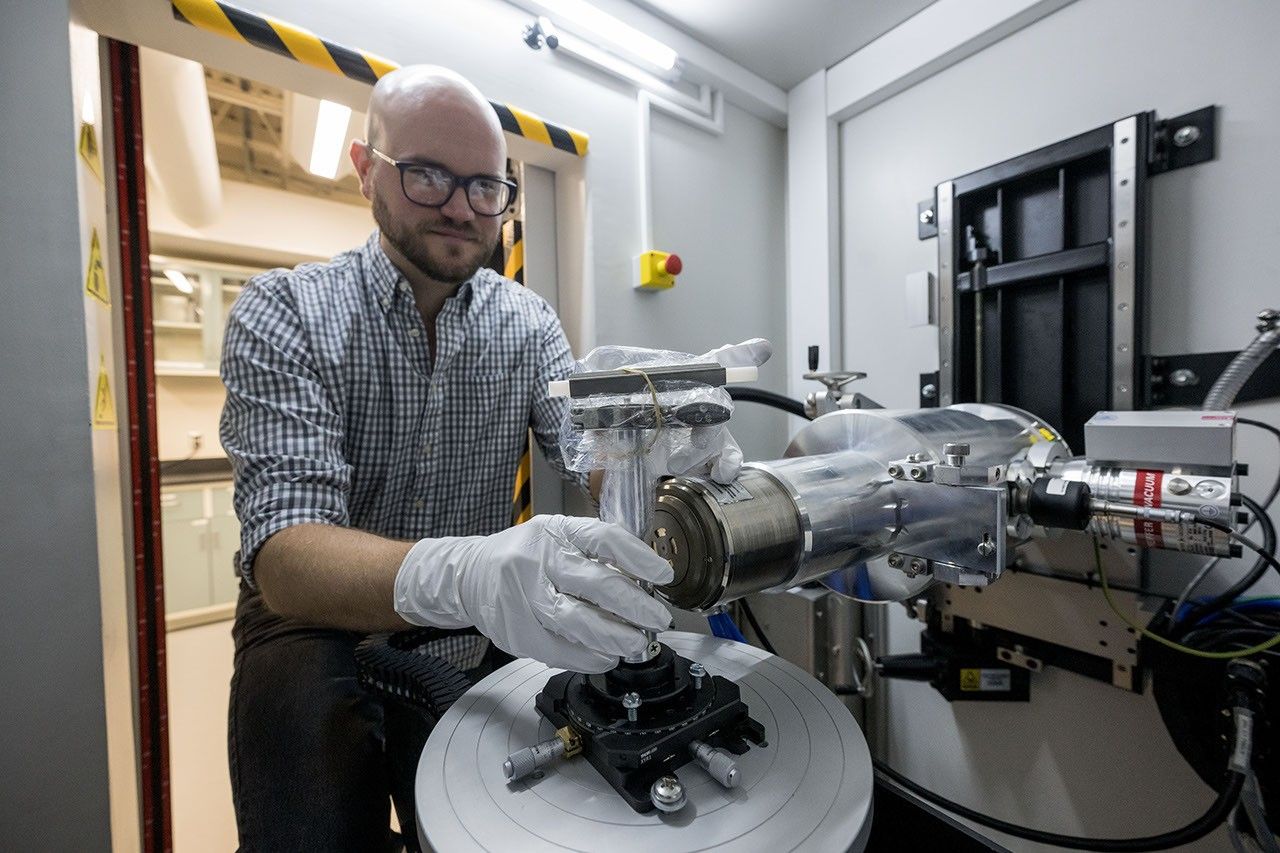
 Scott Eckley, X-ray scientist within NASA Johnson Space Center’s Astromaterials Research and Exploration Science (ARES), demonstrates the process for placing a container holding a piece of asteroid material in an X-ray Computed Tomography (XCT) machine. XCT scans let researchers image particles through airtight containers and visualize a rock’s shape and internal structure without damaging the sample. Credits: NASA/Robert Markowitz Ryan’s team scrutinized rock particles collected from Bennu’s surface using a variety of laboratory analysis techniques. In a study published in Nature Communications the authors reported that the boulders are indeed porous enough to account for some of the observed heat loss, but not all of it. Rather, many of the rocks turned out to be riddled with extensive networks of cracks.
To test whether the cracks could be the reason for the asteroid’s surface losing heat, a team at Nagoya University in Japan analyzed Bennu sample material using lock-in thermography. This laser-based technique allows researchers to hit a tiny spot on the surface of the sample and measure how the heat diffuses through it, similar to how ripples move across a pond.
“That’s when things became really interesting,” Ryan said. “The thermal inertia measured in the lab samples turned out to be much higher than what the spacecraft’s instruments had recorded, echoing similar findings obtained by the team of OSIRIS-REx’s partner mission, JAXA’s (Japan Aerospace Exploration Agency) Hayabusa-2.”
To make meaningful predictions about how the material would behave in the large boulders on the asteroid, the team had to find a way to scale up the measurements obtained with the small sample particles.
Using a glove box, team members at NASA’s Johnson Space Center in Houston sealed sample particles in air-tight containers under a protective nitrogen atmosphere, then transferred them to a lab where they could perform X-ray computed tomography, or XCT scans. Once a particle was scanned, it went back into the glove box.
Exterior Interior
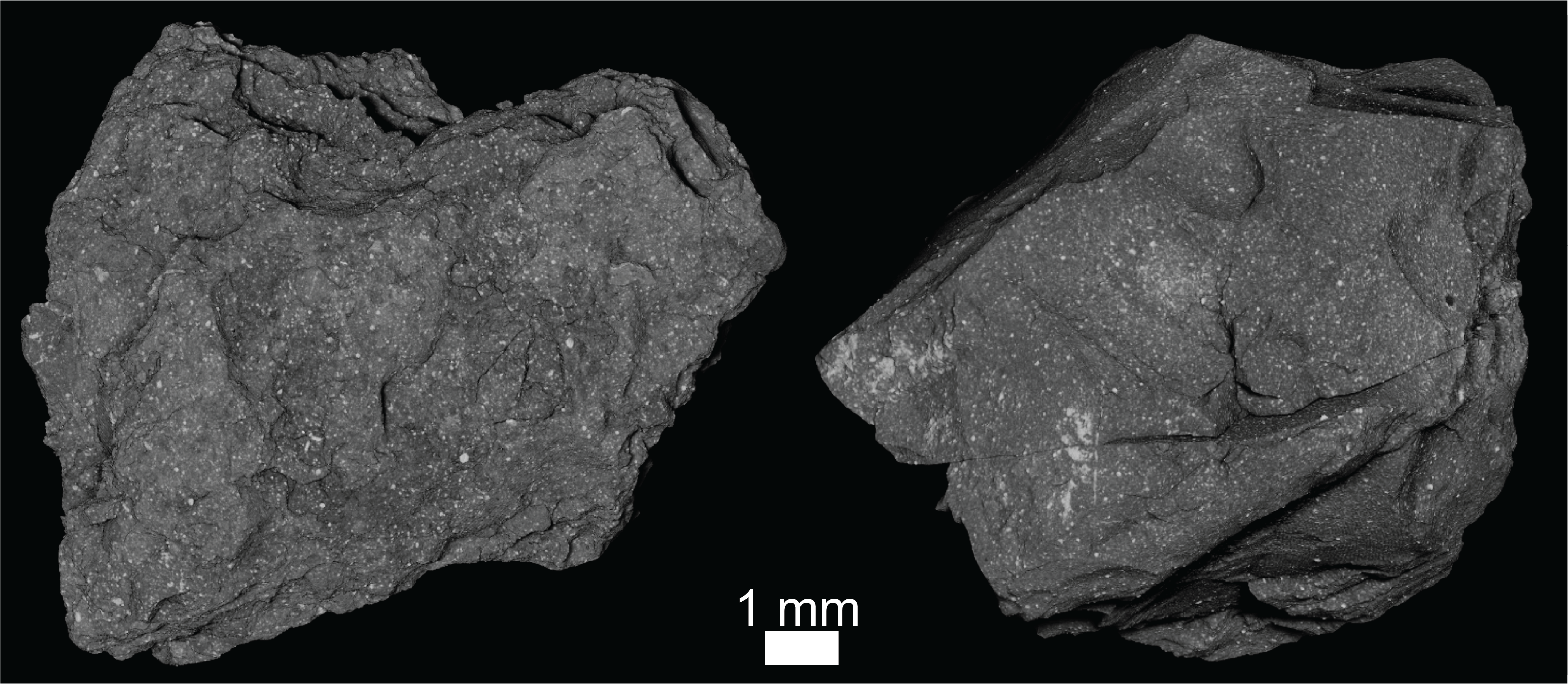
 These are X-ray computed tomography (XCT) scans of particles from asteroid Bennu. They show the most common types of crack networks observed in Bennu samples. One has an extensive and connect framework of curved cracks, whereas the other has sparse, straight, and flat fractures.
 These are X-ray computed tomography (XCT) scans of particles from asteroid Bennu. They show the most common types of crack networks observed in Bennu samples. One has an extensive and connect framework of curved cracks, whereas the other has sparse, straight, and flat fractures. ExteriorInterior
These are X-ray computed tomography (XCT) scans of particles from asteroid Bennu. They show the most common types of crack networks observed in Bennu samples. One has an extensive and connect framework of curved cracks, whereas the other has sparse, straight, and flat fractures. These are X-ray computed tomography (XCT) scans of particles from asteroid Bennu. They show the most common types of crack networks observed in Bennu samples. One has an extensive and connect framework of curved cracks, whereas the other has sparse, straight, and flat fractures.
Exterior
Interior
exteriod and interior
X-ray Computed Tomography (XCT) scans of two asteroid Bennu particles
CurtainToggle2-Up
Image Details
These are X-ray computed tomography (XCT) scans of particles from asteroid Bennu. They show the most common types of crack networks observed in Bennu samples. One has an extensive and connect framework of curved cracks, whereas the other has sparse, straight, and flat fractures.
“The sample goes into its own ‘spacesuit,’ gets a CT scan, and then comes back to its pristine environment, all without having any exposure to the terrestrial environment,” said Nicole Lunning, lead OSIRIS-REx sample curator within the Astromaterials Research and Exploration Science division at NASA Johnson and one of the study’s co-authors. “We can image right through these airtight containers to visualize the shape and internal structure of the rock that’s inside.”
“X-ray computed tomography allows us to look at the inside of an object in three dimensions, without damaging it,” said study co-author and NASA Johnson X-ray scientist Scott Eckley.
It turns out that they’re really cracked too, and that was the missing piece of the puzzle.”  Andrew Ryan
Scientist at University of Arizona’s Lunar and Planetary Laboratory
Once mapped in this way, a permanent 3-dimensional digital archive of a sample particle’s shape and interior is created, and the data are entered into a public database. Ryan’s team used the X-ray CT scan data for computer simulations modeling heat flow and thermal inertia. When scaled up to boulder size, the thermal inertia results fell into agreement with what the spacecraft had measured at the asteroid.
Where scientists once expected the boulders of Bennu to be extremely porous and fluffy, perhaps even spongy, the sample analysis revealed something unexpected.
“It turns out that they’re really cracked too, and that was the missing piece of the puzzle,” Ryan said.
Ron Ballouz, a scientist with the Johns Hopkins University Applied Physics Laboratory in Laurel, Maryland, and the paper’s second author, said this work transforms how scientists interpret the structure of an asteroid based on its thermal properties seen from Earth.
“We can finally ground our understanding of telescope observations of the thermal properties of an asteroid through analyzing these samples from that very same asteroid,” Ballouz said.
NASA’s Goddard Space Flight Center provided overall mission management, systems engineering, and the safety and mission assurance for OSIRIS-REx. Dante Lauretta of the University of Arizona, Tucson, is the principal investigator. The university leads the science team and the mission’s science observation planning and data processing. Lockheed Martin Space in Littleton, Colorado, built the spacecraft and provided flight operations. Goddard and KinetX Aerospace were responsible for navigating the OSIRIS-REx spacecraft. Curation for OSIRIS-REx takes place at NASA’s Johnson Space Center in Houston. International partnerships on this mission include the OSIRIS-REx Laser Altimeter instrument from CSA (Canadian Space Agency) and asteroid sample science collaboration with JAXA’s (Japan Aerospace Exploration Agency’s) Hayabusa2 mission. OSIRIS-REx is the third mission in NASA’s New Frontiers Program, managed by NASA’s Marshall Space Flight Center in Huntsville, Alabama, for the agency’s Science Mission Directorate in Washington.
By Daniel Stolte
University of Arizona
For more information on the OSIRIS-REx mission, visit:
https://www.nasa.gov/osiris-rex
Karen Fox / Molly Wasser
Headquarters, Washington
202-285-5155 / 240-419-1732
karen.c.fox@nasa.gov / molly.l.wasser@nasa.gov
Victoria Segovia
Johnson Space Center, Houston
281-483-5111
victoria.segovia@nasa.gov
About the Author  NASA Science Editorial Team
Details Last Updated Mar 17, 2026 Related Terms OSIRIS-REx (Origins, Spectral Interpretation, Resource Identification, Security-Regolith Explorer) Asteroids Astromaterials Bennu Johnson Space Center Planetary Science Planetary Science Division
 4 min read A Most Unusual Lake Lake Unter-See in Antarctica, sealed beneath thick ice, contains unusually high levels of dissolved oxygen…
Article
6 days ago
 6 min read Resurrecting Ancient Enzymes in NASA’s Search for Life Beyond Earth
Article
2 months ago
 4 min read NASA Finds Lunar Regolith Limits Meteorites as Source of Earth’s Water
Article
2 months ago
Keep Exploring Discover More Topics From NASA Missions