
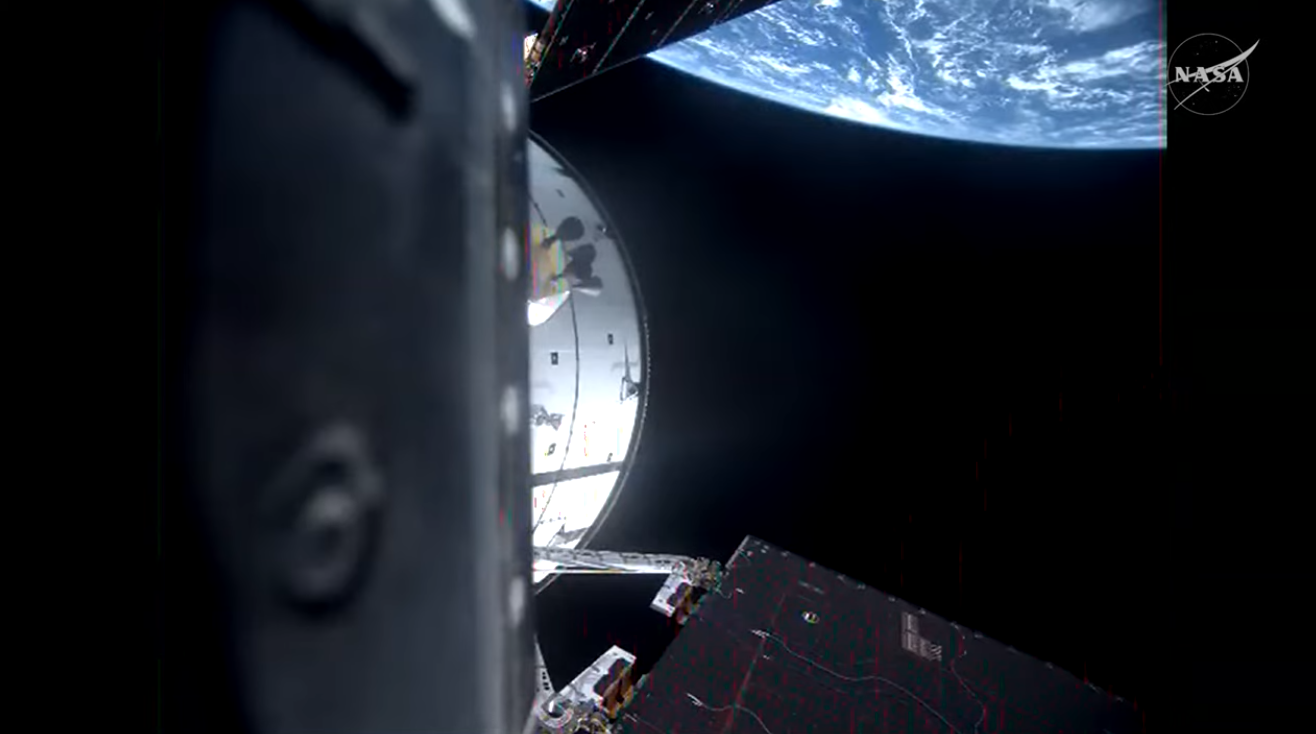
The apogee raise burn was successfully completed, continuing to fine tune the Orion spacecraft’s orbit around Earth. The ICPS (interim cryogenic propulsion stage) ignited its RL10 engine for a precisely timed burn that increased the highest point of the spacecraft’s orbit.
Ahead of the burn, the Artemis II crew began setting their spacecraft up for life in space. Among the tasks is a checkout of the toilet. During this operation, the crew called down to report a blinking fault light. The team on the ground is looking into what might be causing that issue and will be working with the crew to resolve it.
Proximity Operations Demonstration
The Artemis II crew will now begin preparations for the proximity operations demonstration. This demonstration will test the Orion spacecraft’s ability to manually maneuver relative to another spacecraft, the ICPS, after separation, using its onboard navigation sensors and reaction control thrusters. Before the demonstration, Orion will have planned communications handover from NASA’s Near Space Network to the Deep Space Network. These two networks work in tandem to support Orion from the launch pad, around the Moon, and back to Earth.
During the approximately 70-minute proximity operations demonstration, the crew will command the Orion spacecraft, named Integrity, through a series of moves using the detached upper stage of the SLS (Space Launch System) rocket as a mark. The ICPS includes an approximately two-foot target that will be used to evaluate how Orion flies with astronauts at the controls.
As the spacecraft and its crew move away, the spacecraft will perform an automated backflip to turn around and face the stage. At approximately 300 feet away, Orion will stop its relative motion. The crew will take control and use the translational and rotational hand controllers and display system to make very small movements to ensure the spacecraft is responding as expected.
About 30 feet from the stage, Orion will stop, and the crew will check out the spacecraft’s fine handling qualities to evaluate how it performs near another spacecraft. Small maneuvers performed very close to the ICPS will be done using the reaction control system thrusters on the spacecraft’s European Service Module.
At the end of the demonstration, the spacecraft will perform an automated departure burn to move away from the ICPS before the stage then fires to re-enter Earth’s atmosphere over a remote location in the Pacific Ocean. During Orion’s departure burn, engineers will use the spacecraft’s docking camera to gather precise positioning measurements, which will help inform navigation during rendezvous activities on future missions in the lunar environment, where there is no GPS system.
The spacecraft’s solar array wings are generating power, thermal conditions remain within predicted ranges, and flight controllers have verified that the crew is safely configured for the next phase of the mission.