
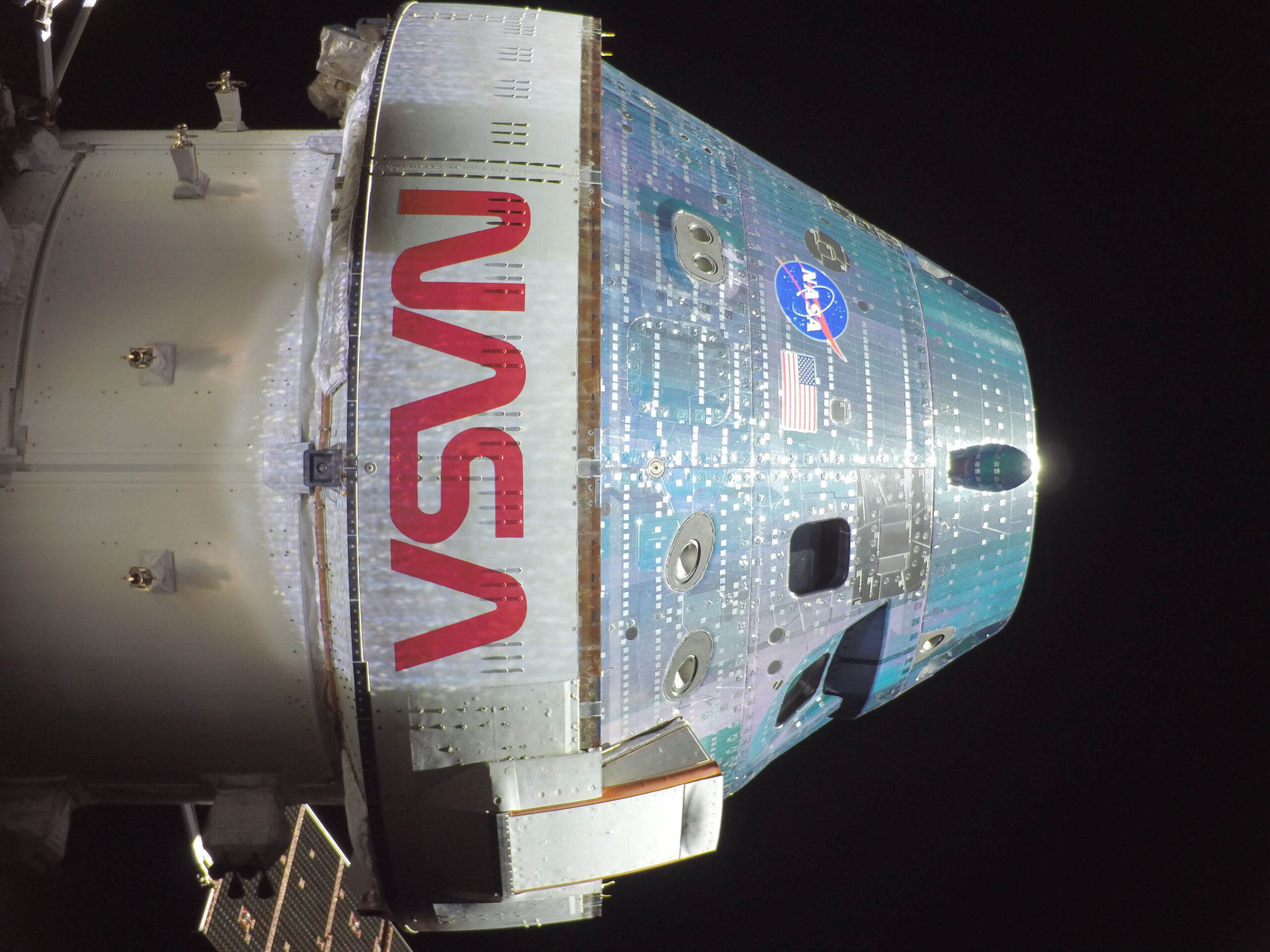
As the Orion spacecraft continues its path toward the Moon, the Artemis II crew will spend their fourth flight day preparing for their lunar flyby on Monday, April 6.
The crew of NASA astronauts Reid Wiseman, Victor Glover, Christina Koch, and CSA (Canadia Space Agency) astronaut Jeremy Hansen, began their day in space to the tune of Chappell Roan’s “Pink Pony Club,” before transitioning into their daily activities.
At wakeup, the spacecraft and its crew were approximately 169,000 miles from Earth and approaching the Moon at 110,700 miles.
View the updated mission schedule for the lunar flyby here.
Taking control of Orion in deep space
Later Saturday, Glover will take manual control of the spacecraft to test its performance in deep space to provide more data about the spacecraft’s handling qualities across different movements. The demonstration is scheduled for 9:10 p.m.
A 24-hour acoustics test also will occur to help engineers characterize the sound environment in the spacecraft.
Crew prepares to study lunar surface
After the piloting demonstration, the crew will review a list of the surface features the NASA science team has asked them to analyze and photograph during their six-hour flyby on Monday, April 6. The flyby period begins at 2:45 p.m., when Orion’s main cabin windows will be pointed toward the Moon and the Artemis II crew will be close enough to make scientific observations.
The crew will see the Moon from a unique vantage point compared with the Apollo missions, which flew about 70 miles above the surface. Orion will fly 4,066 miles away at closest approach at approximately 7:02 p.m. From that distance, the crew will see the entire disk of the Moon at once, including regions near the north and south poles.
The angle of the Sun’s illumination of the Moon will change throughout the period based on the shifting positions of the Sun, Moon, and spacecraft — revealing both familiar nearside terrain and portions of the far side not visible from Earth. This visualization, compressed from seven hours to one minute, includes Earthrise and Earthset, and a solar eclipse, which will be visible to the crew at the end of the flyby window, when the Sun will glide behind the Moon for nearly an hour from the perspective of Orion.
As they pass the Moon, the crew will apply geology skills learned in the classroom and in Moon-like environments on Earth to photograph and describe features including impact craters, ancient lava flows, and surface cracks and ridges formed as the Moon slowly changed over time. They will note differences in color, brightness, and texture, which provide clues that help scientists understand what the surface is made of and how it formed.
Toward the end of the flyby, the crew will observe a solar eclipse from space as Orion, the Moon, and the Sun align in such a way that the astronauts will see our star disappear behind the Moon for about an hour. During this period, the crew will see a mostly dark Moon. They will use the opportunity to analyze the solar corona — the Sun’s outermost atmosphere — as it peeks out from the edge of the Moon. The crew also will look for flashes of light from meteoroids if they strike the surface to gather insight on potential surface hazards.
In addition to the flyby, the spacecraft is expected to surpass the Apollo 13 distance record by 4,102 miles and will reach its maximum distance from Earth at 7:05 p.m., a total of 252,757 miles from the planet. Apollo 13’s trajectory around the Moon carried its crew 248,655 miles from Earth.
Far side communications
When Orion passes behind the Moon, the mission will experience a planned communications blackout beginning at approximately 5:47 p.m. and lasting 40 minutes. During this time, the Moon blocks the radio signals between the Deep Space Network (DSN) and the spacecraft.
Similar blackouts occurred during the Artemis I and Apollo missions and are expected when using an Earth-based communications infrastructure. Once Orion reemerges from behind the Moon, the DSN quickly reacquires its signal and restores contact with mission control.
Characterizing deep space environment and life
In addition to preparing for the lunar flyby, Artemis II includes several payloads and activities designed to help NASA understand how spacecraft systems, the crew, and biological samples respond to the deep space environment.
The AVATAR payload is carrying bone marrow cells derived from crew blood samples and will help researchers study how the human immune system reacts to deep space. The payload is operating as expected. The immune biomarkers activity will provide further insights, and the crew is scheduled to collect saliva samples today. Additionally, the German Space Agency (DLR) provided multiple M-42 radiation sensors that are installed inside Orion. The sensors, along with NASA’s own radiation measurements, are helping characterize radiation levels throughout the spacecraft. Finally, the crew is wearing actigraphy devices — small, watchlike sensors that gather health-related data — and answering periodic questions about conditions aboard Orion. These Standard Measures, combined with the actigraphy data (ARCHER), will help NASA improve crew efficiency on future missions.
Clearing vent line
Flight controllers in the Mission Control Center at NASA’s Johnson Space Center in Houston again have cancelled another planned outbound trajectory correction (OTC) burn, as Orion’s trajectory remains on track. The team will instead adjust the spacecraft’s attitude to point the vent toward the Sun to help clear a wastewater vent line. This change in the OTC burn schedule does not impact the current trajectory of the Orion spacecraft.
Overnight, controllers vented wastewater overboard to free up space in Orion’s waste management system tank, but the activity ended earlier than expected. Engineers have been using the vent heaters to melt any potential ice that may be clogging the line and orienting the vent toward the Sun to help mitigate the issue. Teams also are reviewing other potential causes. The wastewater tank is not full and the toilet is operational; however, the crew was instructed to use backup collection devices overnight if needed.
Optical communications demo surpasses 100 GB
Just after 12 p.m. EDT, the Orion Artemis II Optical Communications System surpassed 100 gigabytes of data downlinked during the mission, including high resolution images. The terminal, mounted on the outside of the Orion capsule, uses laser communications — infrared light — to transmit more data than traditional radiofrequency systems. Demonstrations like this highlight the potential of laser communications for missions to the Moon as operations become more complex and future crewed missions to Mars and beyond.
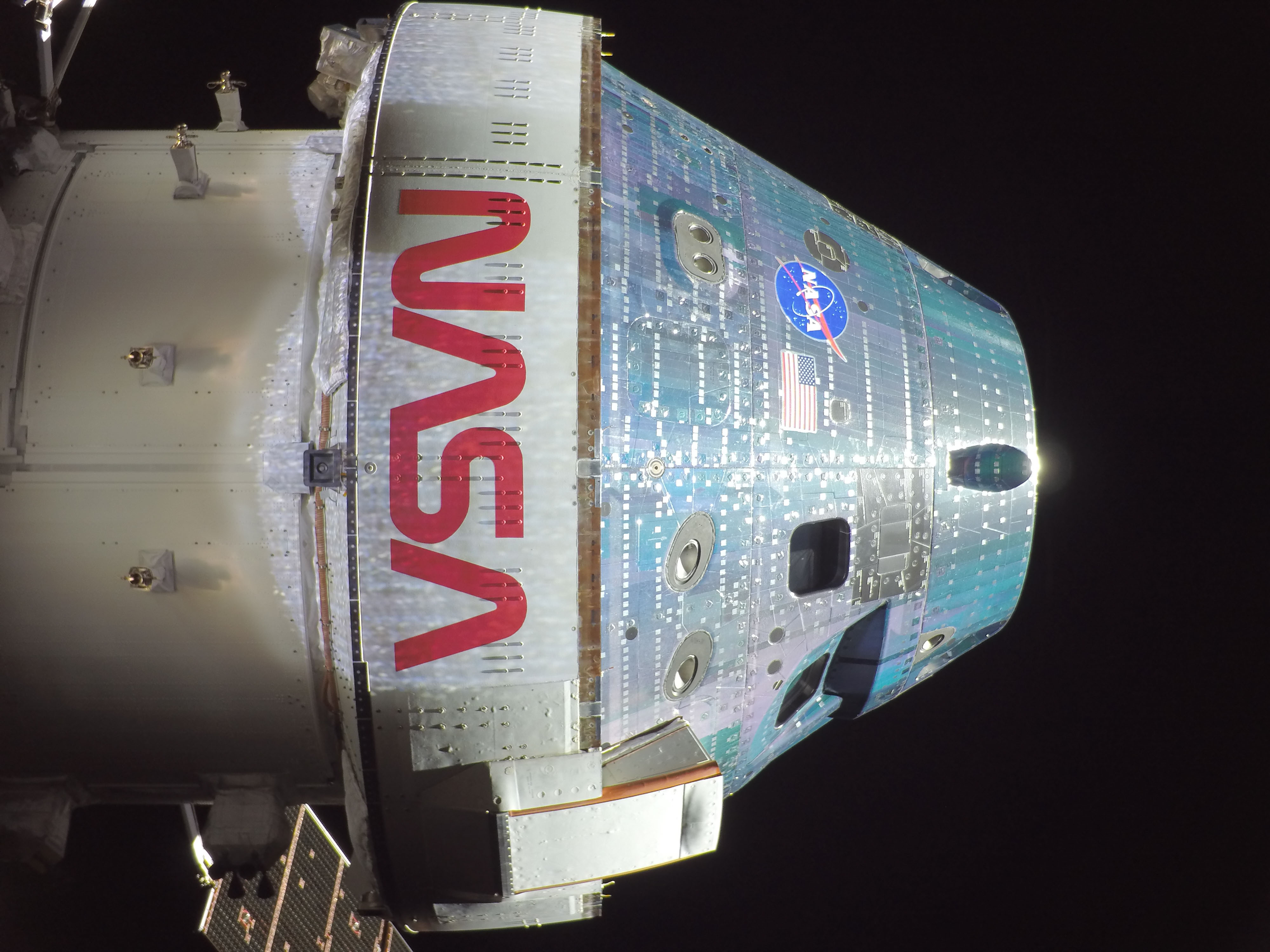
View the latest imagery from the Artemis II mission on our Artemis II Multimedia Resource Page. Please follow @NASAArtemis on X, Facebook, and Instagram for real-time updates. Live coverage of the mission is available on NASA’s YouTube channel.