
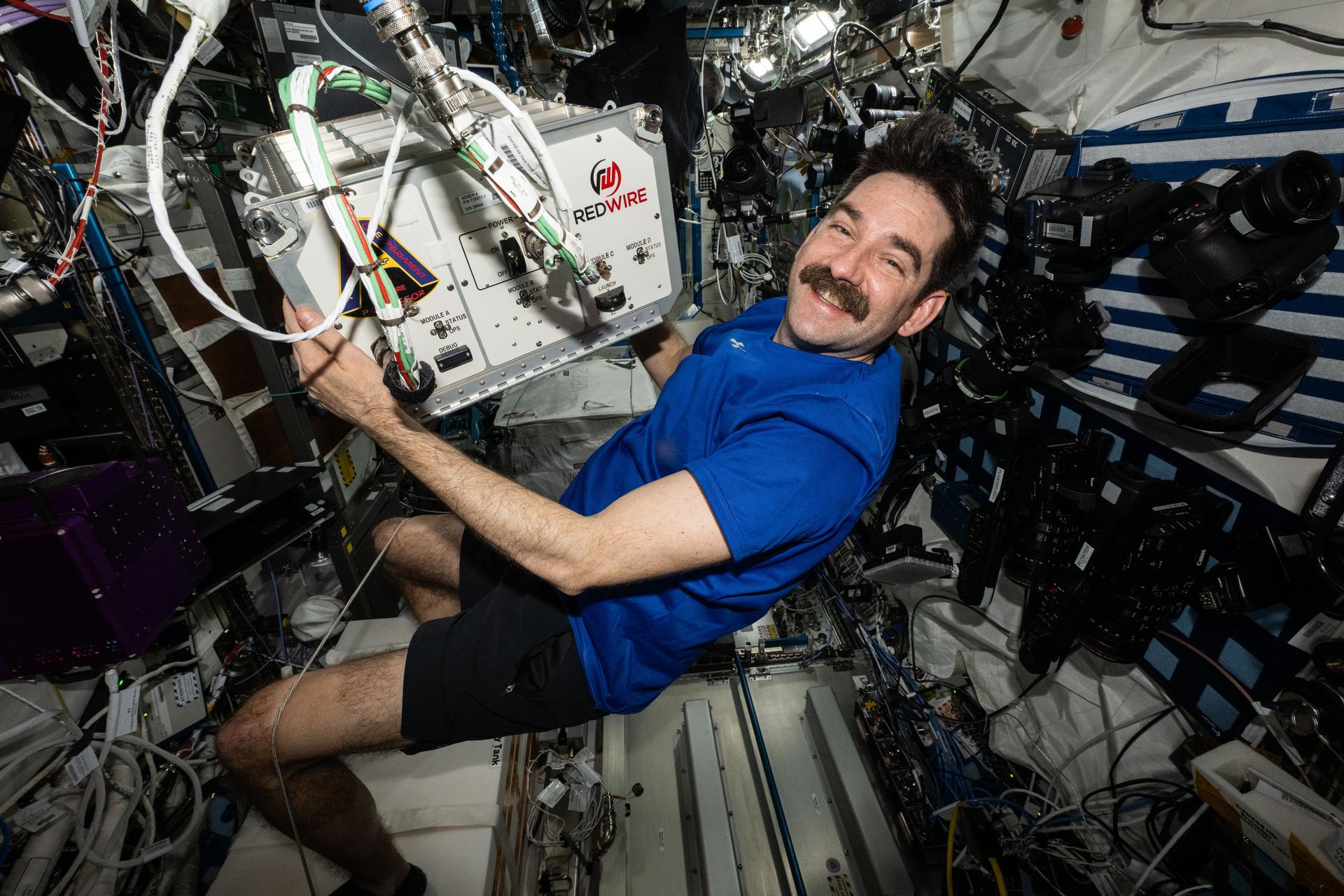
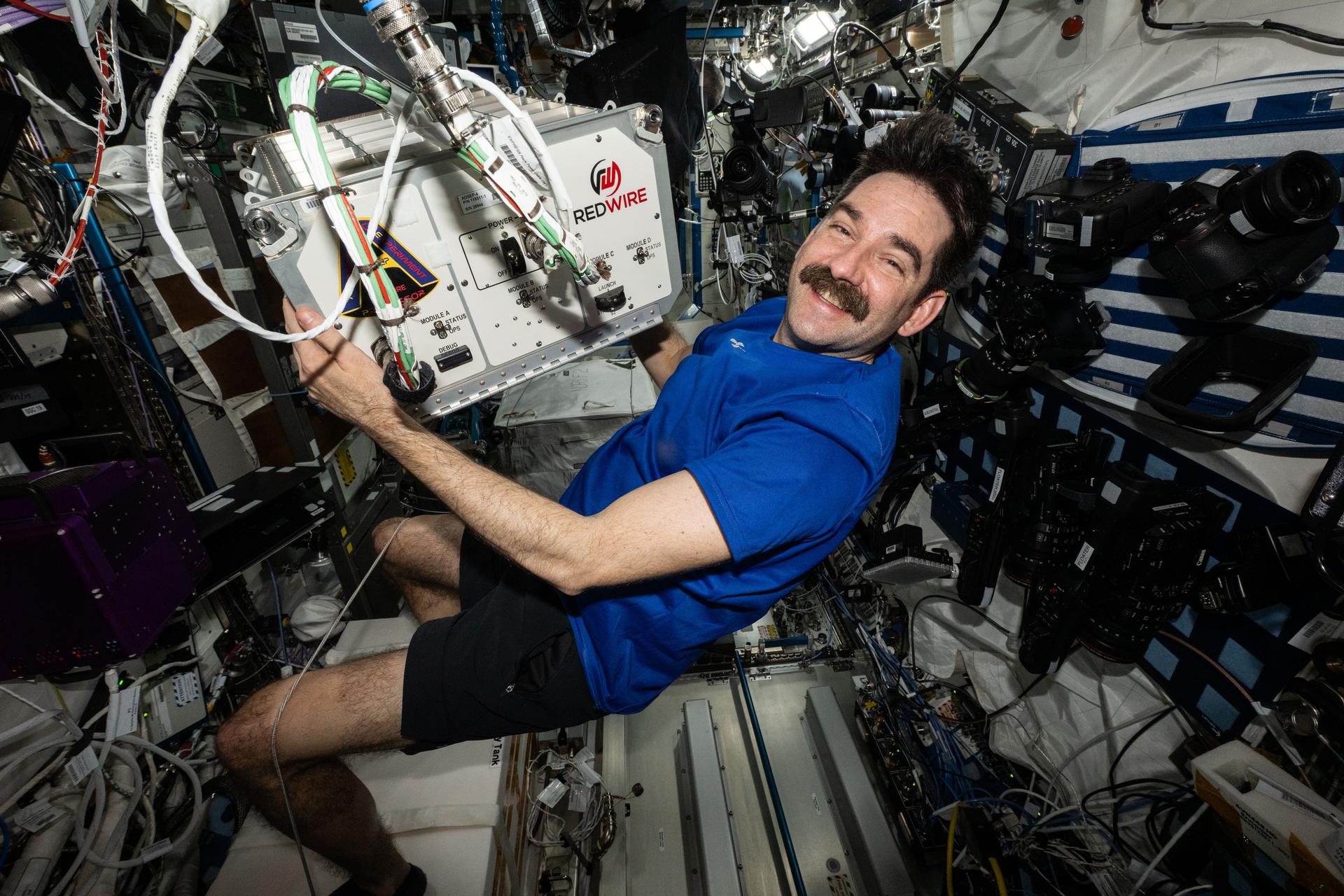
Advanced health research, including ultrasound scans, blood tests, and exercise studies, using the latest technology in microgravity was on Thursday’s schedule for the Expedition 75 crew. The orbital residents also continued their ongoing cargo operations and maintenance tasks aboard the International Space Station.
Station commander Jessica Meir conducted the EchoFinder-2 space health study for a second day, this time with NASA flight engineer Jack Hathaway. The duo took turns inside the Columbus laboratory module scanning each other’s organs with the Echo ultrasound hardware as a technician on the ground monitored in real time. The investigation uses a computer tablet and a combination of augmented reality and artificial intelligence to correctly position the probe then detect and visualize the organs. Results may enable future crews to use medical monitoring tools without guidance from doctors on the ground as they travel farther away from Earth.
An immune system study was under way for a third day inside the Harmony module as NASA flight engineer Anil Menon processed blood samples after a 24-hour incubation period. Menon first retrieved tubes, specially designed for use in microgravity, containing blood samples from the Kubik incubator. Next, he spun the sample tubes in a centrifuge separating the blood into red and white blood cells, platelets, and plasma. At the completion of the experiment, he placed the sample tubes in a science freezer for preservation and later analysis. The samples will be analyzed aboard the orbital complex to learn how living in space affects an astronaut’s ability to fight infections and disease.
Flight engineer Sophie Adenot of ESA (European Space Agency) strapped on the sensor-packed Bio-Monitor vest and headband then pedaled for an hour on the Destiny laboratory module’s exercise cycle. The wearable sensors comfortably monitored Adenot’s blood pressure, heart rate, and breathing rate during her workout. Afterward, she prepared her biomedical data for downloading to give doctors insight into space-influenced physiological changes and how lunar and planetary gravity environments may affect crew health.
Adenot later took turns with Menon and transferred cargo in and out of the Cygnus XL cargo spacecraft from Northrop Grumman. Cygnus XL launched on April 14 carrying over 11,000 pounds of science and supplies for the crew. It arrived at the station two days later for a capture with the Canadarm2 robotic arm and installation to the Unity module’s Earth-facing port.
The Progress 96 cargo spacecraft, which arrived with nearly three tons of food, fuel, and supplies on Sept. 19, is still being unloaded by Roscosmos flight engineers Pyotr Dubrov, Anna Kikina, and Andrey Fedyaev. The three cosmonauts also split their Thursday shift jogging on a treadmill for a fitness assessment, replacing power system components inside the Zvezda service module, and synchronizing neutron radiation detection hardware with mission controllers on Earth.
Learn more about station activities by following the space station blog, @space_station on X, as well as the ISS Facebook and ISS Instagram accounts.
Get the latest from NASA delivered every week. Subscribe here.