
Experiments exploring cancer treatments and cartilage repair topped the Expedition 74 crew’s research schedule on Friday. Two cosmonauts are also gearing up for a spacewalk in less than a week.
Doctors are taking advantage of the International Space Station’s weightless environment to develop and test advanced cancer treatments. Two experiments taking place aboard the orbital outpost on Friday are looking at different therapies and exploring how microgravity impacts their effectiveness.
NASA flight engineer Chris Williams continued the Space Cancer Therapeutics investigation by processing samples of fruit flies engineered with a pancreatic‑cancer genetic profile and treated with an anti‑cancer drug. Williams exposed one group of flies to artificial gravity and a second group to microgravity. Both sets will be frozen for preservation and returned to Earth aboard a SpaceX Dragon cargo spacecraft. Researchers will analyze the samples to assess the therapy’s effectiveness, understand its underlying molecular mechanisms, and determine microgravity’s influence on cancer development. Fruit flies are ideal for this research because their physiology is well understood, allowing scientists to track how cancer‑related processes change in different spaceflight conditions.
NASA flight engineer Jack Hathaway worked in the Harmony module observing DNA-mimicking materials for their ability to form stable structures in microgravity and potentially fight cancer. Hathaway pointed a light-measuring device at the manufactured nanoparticles that resemble the natural building blocks of DNA to evaluate the quality of the samples. The biotechnology study is testing the tiny, engineered materials—loaded with a cancer‑fighting drug—for their ability to reach target cancer cells and prevent unwanted side effects possibly leading to the development of a new type of cancer treatment.
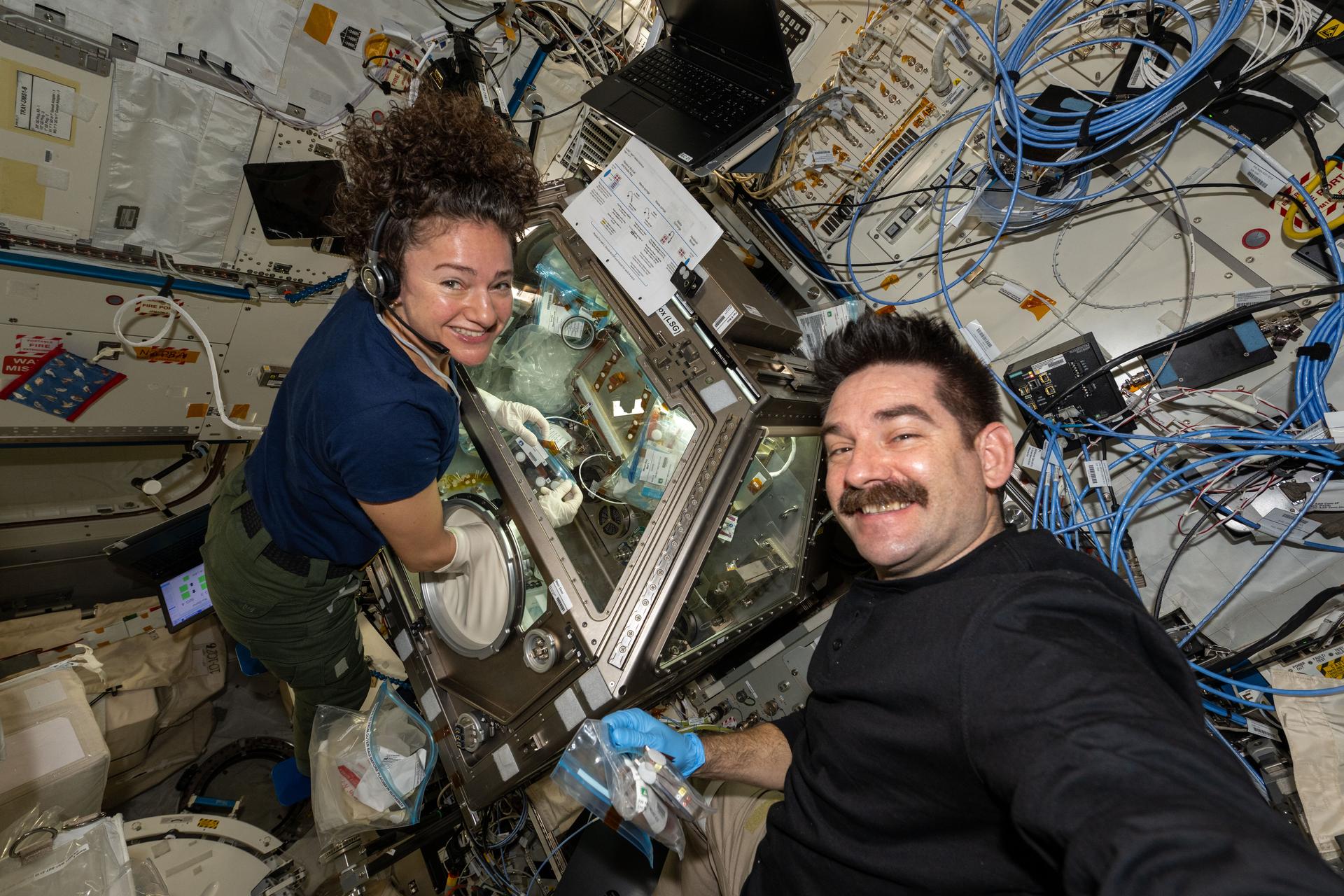
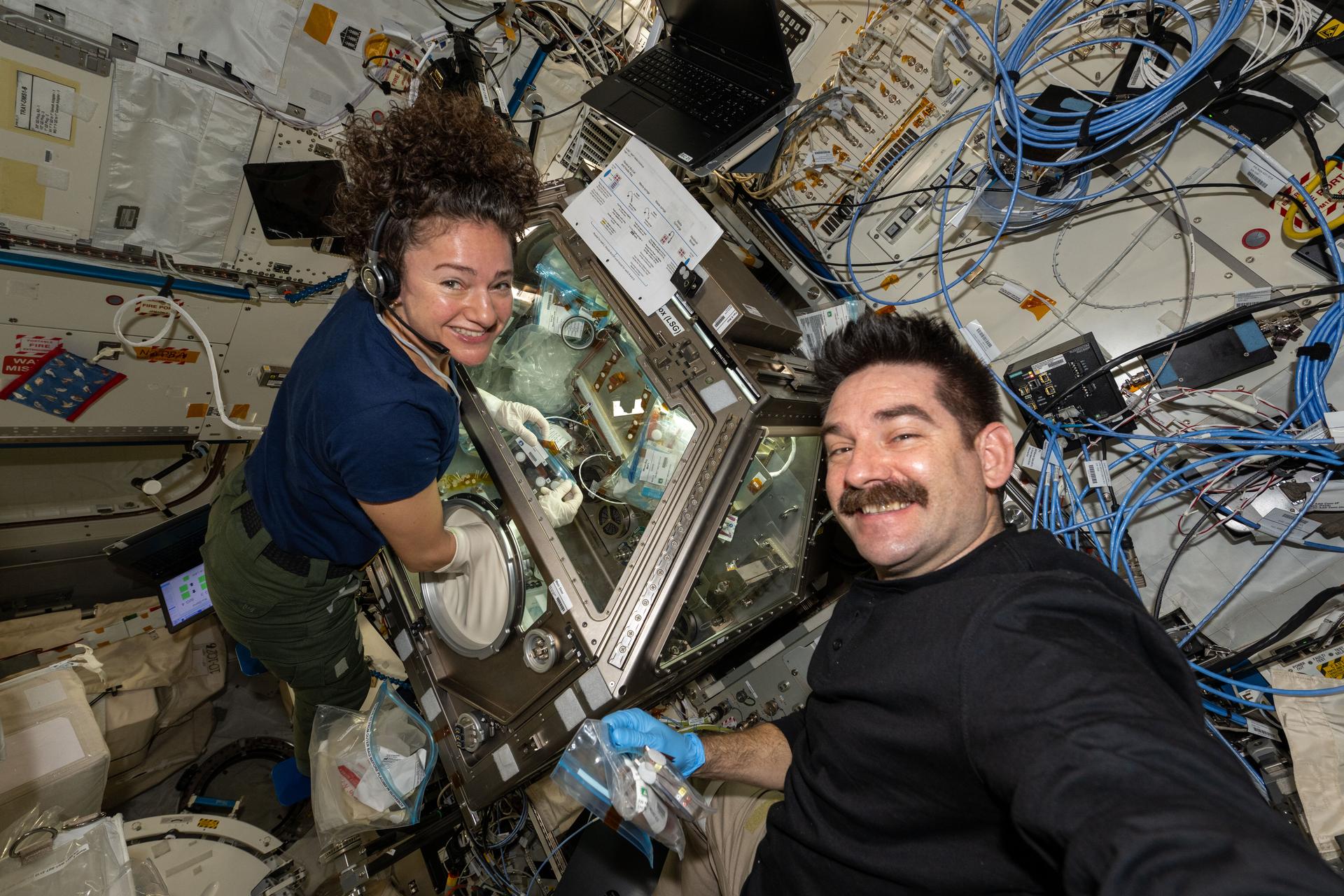
NASA flight engineer Jessica Meir spent her shift treating samples of cartilage cells inside the Kibo laboratory module’s Life Science Glovebox to learn how human cartilage builds and repairs itself when gravity is removed. Doctors will use the insights from the biotechnology experiment to learn how to create replacement cartilage, treat arthritis and joint damage, and understand the effects of weightlessness on an astronaut’s joint health.
Flight engineer Sophie Adenot of ESA (European Space Agency) spent her day reorganizing and transferring cargo in and out of the SpaceX Dragon cargo spacecraft docked to the Harmony module’s forward port. Adenot adjusted a variety of science freezers to access cargo pallets and other research hardware installed inside Dragon for stowage aboard the space station.
Roscosmos cosmonauts Sergey Kud-Sverchkov and Sergey Mikaev, station commander and flight engineer respectively, tested a pair of Orlan spacesuits in the Poisk module’s airlock checking the suits for pressure leaks, functionality, and mobility. Flight engineer Andrey Fedyaev assisted the duo with the suit checks then moved on and checked components that support the Elektron oxygen generator in the Roscosmos segment of the orbital outpost.
Learn more about station activities by following the space station blog, @space_stationon X, as well as the ISS Facebook and ISS Instagram accounts.
Get the latest from NASA delivered every week. Subscribe here.