
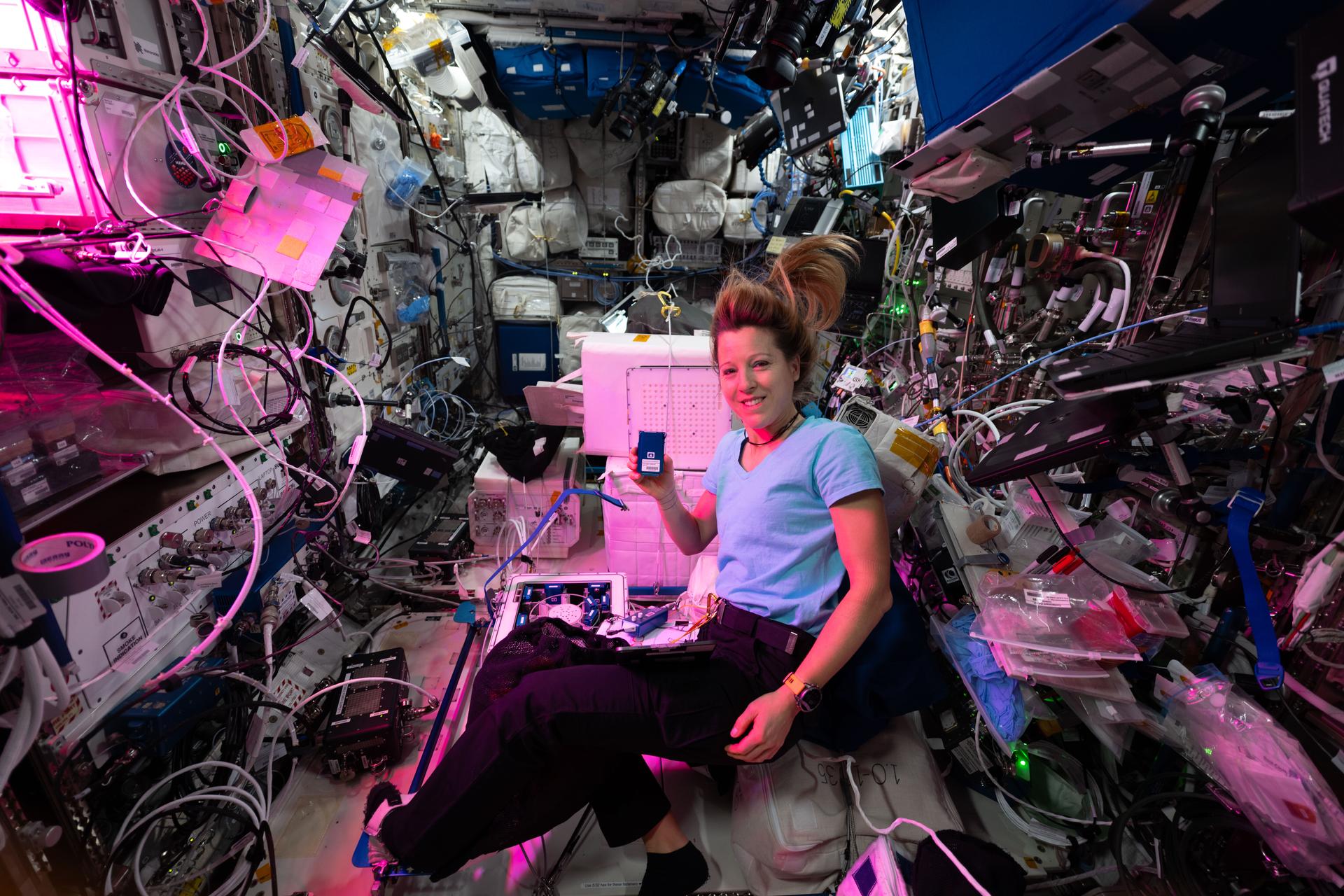
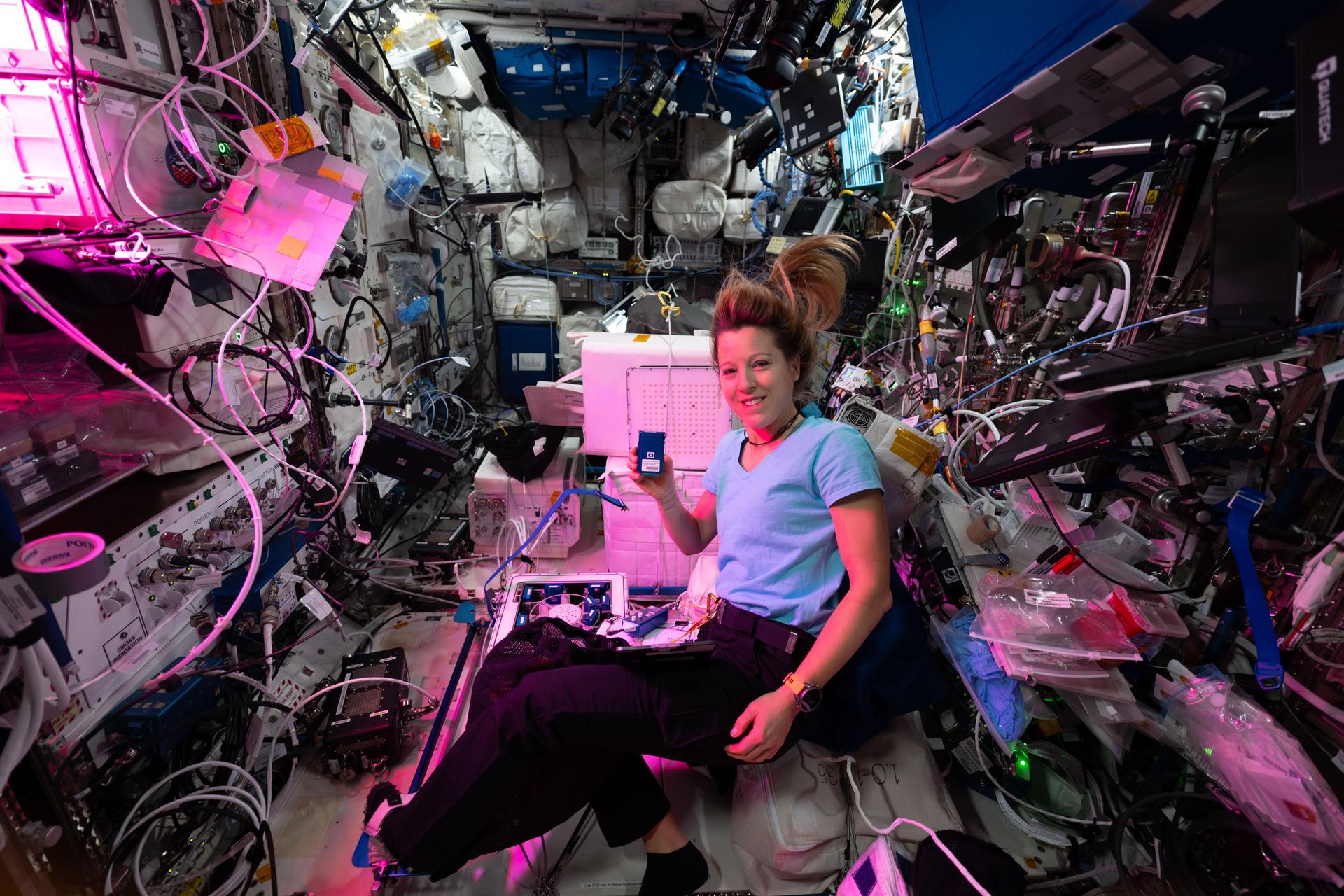
Four Expedition 74 astronauts had a light duty day with an array of advanced research still scheduled for Thursday. The three cosmonauts aboard the International Space Station focused on ongoing spacewalk preparations and robotics training.
NASA flight engineers Jessica Meir, Jack Hathaway, and Chris Williams, and ESA (European Space Agency) flight engineer Sophie Adenot had a busy week of unloading and activating critical new science experiments delivered aboard a SpaceX Dragon on Sunday, May 17. The quartet relaxed half of the day Thursday after an intense few days that saw the crew kicking off advanced investigations into cancer treatments, growing blood-clotting platelets, and engineering cartilage tissue, all seeking to benefit health on and off the Earth.
When Meir was back on shift Thursday, she photographed microgreens growing to help botanists learn how to provide a healthy diet for astronauts aboard a spacecraft. Next, she nourished stem cell samples inside Kibo’s Life Science Glovebox being incubated to learn how to manufacture space-designed therapies to treat cancer and blood conditions.
Hathaway assisted Meir with the sample nourishing by first setting up the Life Science Glovebox, and retrieving the stem cell samples from a science freezer for thawing, then handing them over to Meir for processing. He also installed lights, batteries, and video cameras on a pair of Orlan spacesuits two cosmonauts will wear on an upcoming spacewalk.
Williams loaded materials research carriers onto a platform that will be placed inside the Kibo laboratory module’s airlock for retrieval. The Japanese robotic arm will grapple the hardware and install it on an external platform where the materials will be exposed to the microgravity environment for analysis. The long-running physics study seeks to assist engineers designing equipment, hardware, fabrics, and more to better withstand the harsh environment of outer space.
Adenot spent most of her on-duty time installing combustion research hardware in one of Kibo’s multi-purpose small payload racks to study how solid materials ignite, burn, propagate flame, and self-extinguish in microgravity.
Station commander Sergey Kud-Sverchkov and flight engineer Sergei Mikaev, both from Roscosmos, partnered with Hathaway installing electronic and video components on the Orlan spacesuits. The cosmonaut pair later studied the tasks and the associated maneuvers, displayed digitally on a computer screen, planned for an upcoming spacewalk next week.
Roscosmos flight engineer Andrey Fedyaev familiarized himself with the operation of the European robotic arm and the job it will perform in support of next week’s spacewalk. Kud-Sverchkov and Mikaev joined Fedyaev for the robotic reviews then later regrouped for the spacewalk computer training.
Learn more about station activities by following the space station blog, @space_stationon X, as well as the ISS Facebookand ISS Instagram accounts.
Get the latest from NASA delivered every week. Subscribe here.