Explore Hubble Hubble Home Overview About Hubble The History of Hubble Hubble Timeline Why Have a Telescope in Space? Hubble by the Numbers At the Museum FAQs Impact & Benefits Hubble’s Impact & Benefits Science Impacts Cultural Impact Technology Benefits Impact on Human Spaceflight Astro Community Impacts Science Hubble Science Science Themes Science Highlights Science Behind Discoveries Universe Uncovered Hubble’s Partners in Science Hubble & Citizen Science AI & Hubble Science Explore the Night Sky Observatory Hubble Observatory Hubble Design Mission Operations Science Operations Astronaut Missions to Hubble Hubble vs Webb Team Hubble Team Career Aspirations Hubble Astronauts Multimedia Images Videos Online Activities e-Books Sonifications Podcasts 3D Hubble Models Lithographs Fact Sheets Posters Hubble on the NASA App Glossary News Hubble News Social Media Media Resources 35th Anniversary More Online Activities 3 min read
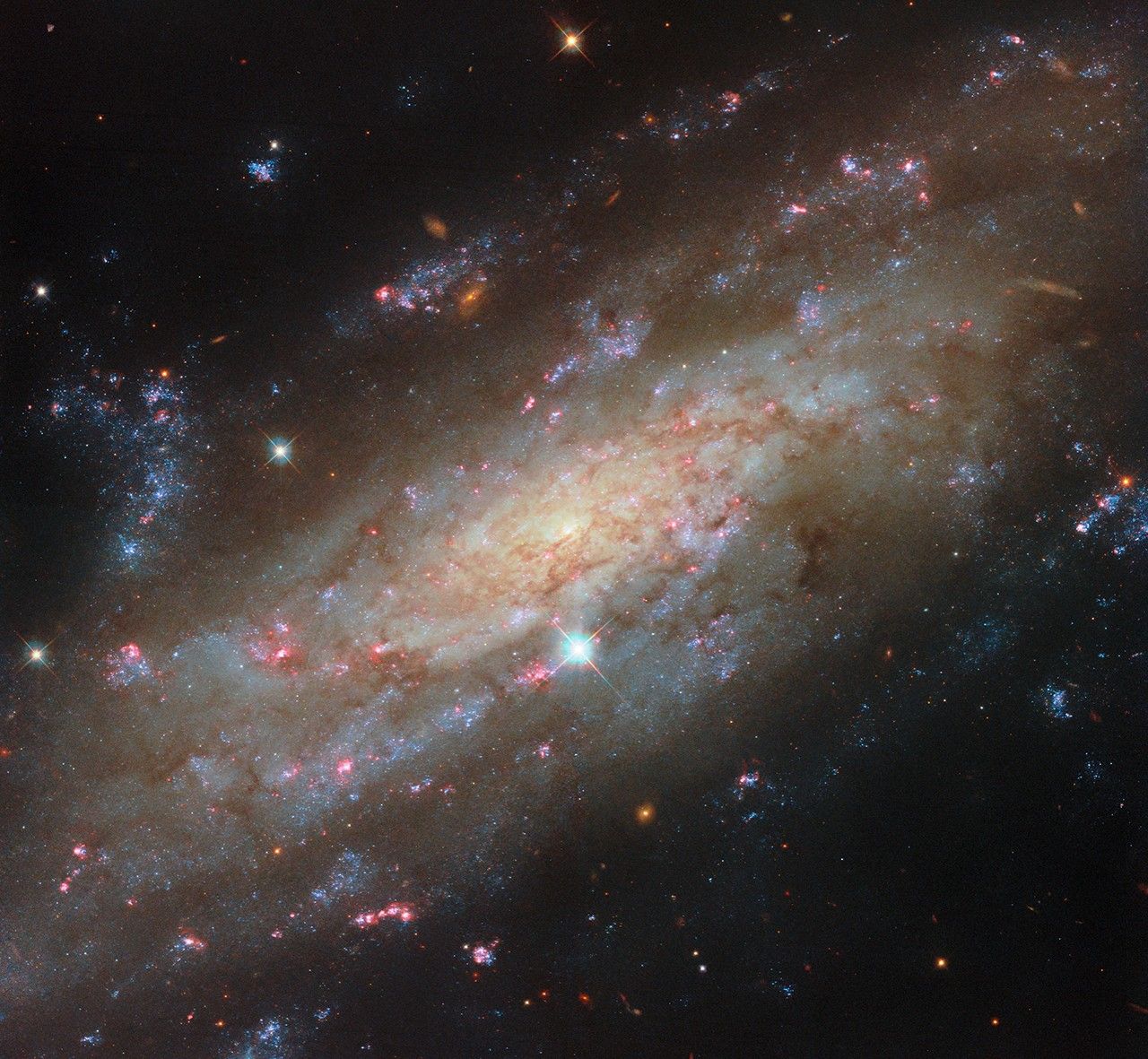
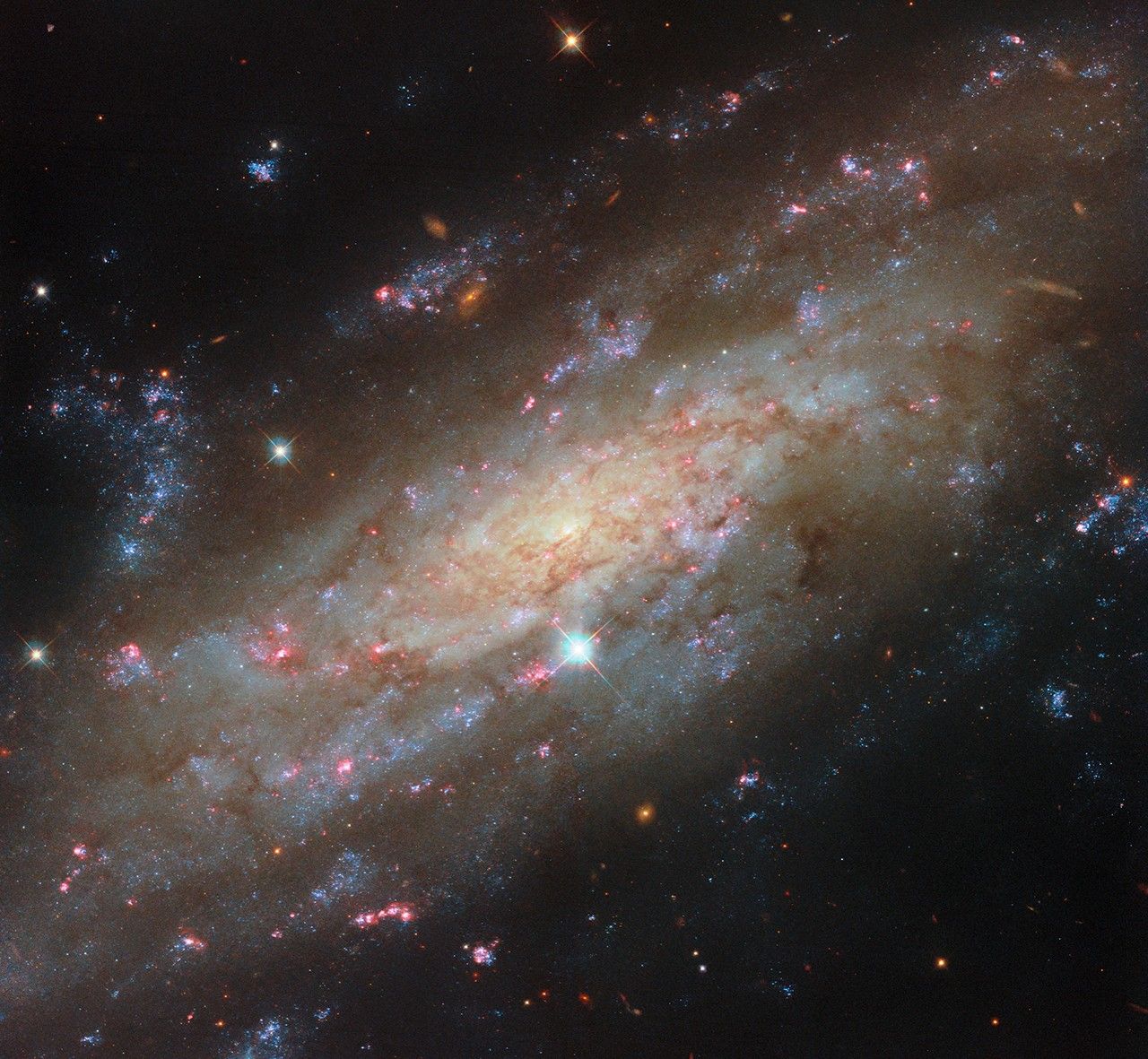
Hubble Spots a Starry Spiral  This NASA Hubble Space Telescope image features the glittering spiral galaxy NGC 3137, located 53 million light-years away in the constellation Antlia (the Air Pump). ESA/Hubble & NASA, D. Thilker and the PHANGS-HST Team In this new picture from NASA’s Hubble Space Telescope, a spiral galaxy glittering with star clusters is the center of attention. NGC 3137 is located 53 million light-years away in the constellation Antlia (the Air Pump). As a nearby spiral galaxy, this target offers astronomers an excellent opportunity to study the cycle of stellar birth and death, as well as giving researchers a glimpse of a galactic system similar to our own.
NGC 3137 is of particular interest to astronomers because it travels through space with a group of galaxies that is thought to be similar to the Local Group, the galaxy group that contains our Milky Way. Similar to the Local Group, the NGC 3175 group contains two large spiral galaxies: NGC 3137 and NGC 3175, which Hubble has also observed. In the Local Group, the largest members are the Milky Way galaxy and Andromeda, another spiral galaxy. In addition to two large spiral galaxies, both groups also contain a number of smaller dwarf galaxies, although it’s not yet known how many of these tiny companions the NGC 3175 group has; researchers have found more than 500 dwarf galaxy candidates. By studying this nearby galaxy group, astronomers can learn about the dynamics of our own galactic home.
NGC 3137 is revealed in fantastic detail by Hubble. This image is crafted from observations in six different color bands, creating a view that highlights several facets of this beautiful spiral. The galaxy’s center, which is encircled by a network of fine, dusty clouds, hosts a black hole estimated to be 60 million times more massive than the Sun. NGC 3137 is highly inclined from our point of view, giving a unique perspective on its loose, feathery spiral structure. A couple of photobombing Milky Way stars and a smattering of far more distant background galaxies complete the image.
As stunning as each of these features may be, it’s the galaxy’s brilliant star clusters that steal the show. The galaxy is peppered with dense clusters of bright blue stars and glowing red gas clouds, which signal the presence of hot, young stars still encased in their birth nebulae.
Unsurprisingly, these star clusters are exactly what has drawn Hubble’s keen eye. Researchers are using Hubble to carry out an observing program (#17502; PI: D. Thilker) focusing on star clusters in 55 nearby galaxies. The data collected will help astronomers identify star clusters and the glowing nebulae that surround them, providing a way to measure the ages of stars in galaxies like NGC 3137. These observations give an in-depth view of stellar life in spiral galaxies, from the young stars still in the process of forming to the ancient stellar populations that grew up in the early years of their galactic hosts.
The PHANGS (Physics at High Angular Resolution in Nearby Galaxies)-HST program for which these observations were taken is part of a larger effort by some of the most powerful observatories on (and around) Earth. Hubble contributes greatly to this massive undertaking, which combines Hubble data with observations from the NASA/ESA/CSA James Webb Space Telescope and the Atacama Large Millimeter/submillimeter Array (ALMA). Together, Hubble’s powerful optical and ultraviolet capabilities, Webb’s sensitive infrared eyes, and ALMA’s broad network of radio dishes bring us an unmatched view of star formation in the local universe.
Text credit: ESA/Hubble
Facebook logo @NASAHubble @NASAHubble Instagram logo @NASAHubble Media Contact:
Claire Andreoli
NASA’s Goddard Space Flight Center, Greenbelt, MD
claire.andreoli@nasa.gov
Details Last Updated May 01, 2026 Editor Andrea Gianopoulos Location NASA Goddard Space Flight Center Related Terms Hubble Space Telescope Astrophysics Astrophysics Division Galaxies Goddard Space Flight Center Spiral Galaxies The Universe
Keep Exploring Discover More Topics From Hubble Hubble Space Telescope
Since its 1990 launch, the Hubble Space Telescope has changed our fundamental understanding of the universe.