
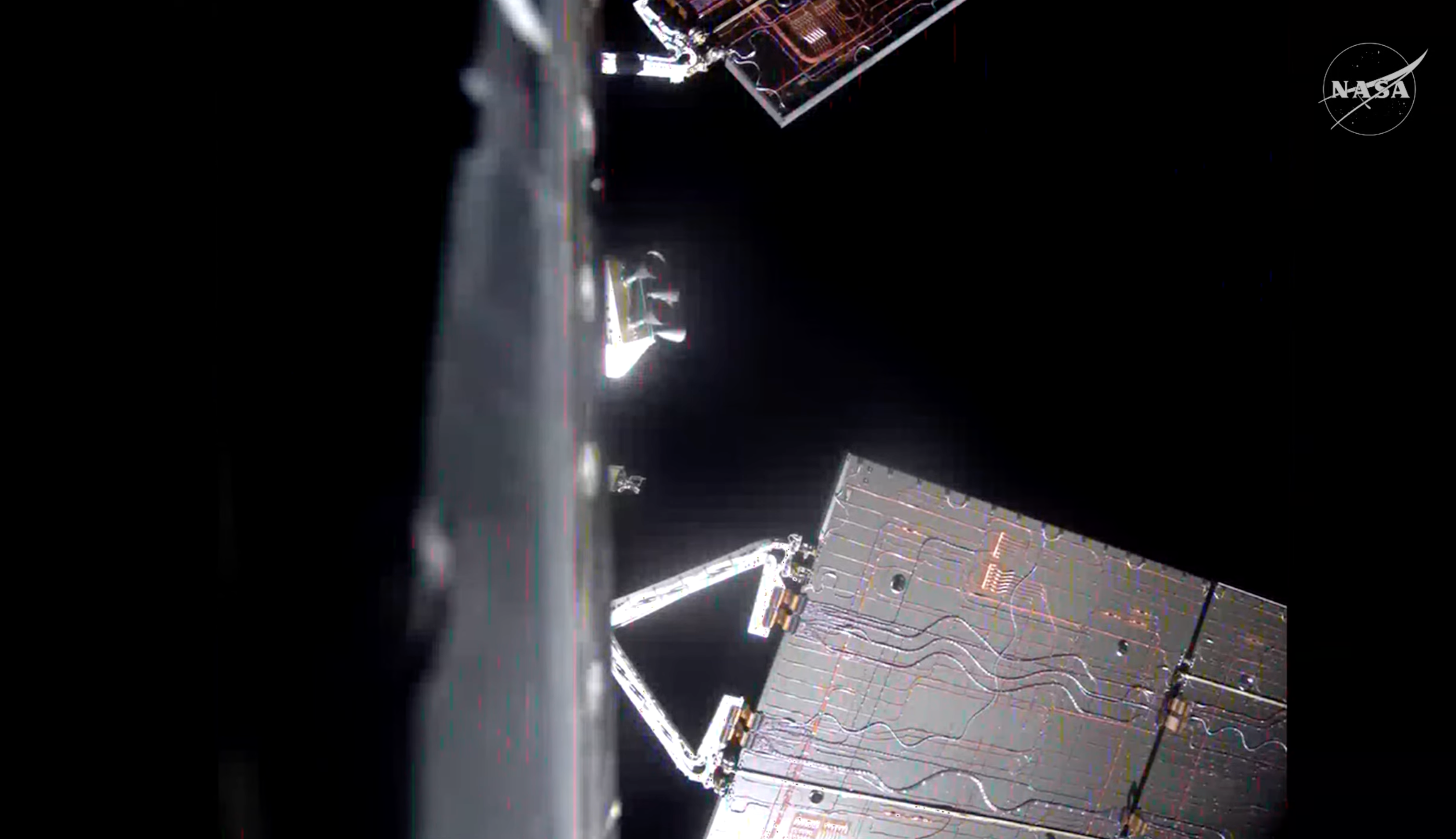

Mission control teams in Houston and the Artemis II crew completed an outbound correction burn to refine the Orion spacecraft’s trajectory to the Moon. The burn began at 11:03 p.m. EDT and lasted 17.5 seconds.
NASA astronauts Reid Wiseman, Victor Glover, and Christina Koch, along with CSA (Canadian Space Agency) astronaut Jeremy Hansen, continue on a precise path to flyby the Moon on Monday, April 6.
Early in their workday, the crew completed a key test objective of the mission: the Orion Crew Survival System (OCSS) suit.
All four crew members conducted a full sequence of tests, including putting on and pressurizing the suit, performing leak checks, simulating seat entry, and assessing mobility and their ability to eat and drink. The suit protects astronauts during dynamic phases of flight and provides life support in the event of cabin depressurization and survival operations after splashdown.
Wrapping up the day, the crew will enter the Moon’s sphere of influence at 12:41 a.m. Monday, April 6, when the Moon’s gravity becomes the dominant force controlling Orion’s trajectory.
That milestone sets the stage for the main event of flight day 6: the crew’s flight around the far side of the Moon.
Watch live coverage of the Artemis II lunar flyby on NASA+, Amazon Prime, Apple TV, Hulu, Netflix, HBO Max and Roku beginning at 1 p.m., alongside the agency’s 24/7 coverage on its YouTube channel. Learn how to stream NASA content through a variety of online platforms, including social media.
Key lunar flyby times, milestones (all times Eastern subject to change based on real-time operations):
- 1 p.m.: NASA+ coverage of lunar flyby begins.
- 1:56 p.m.: The crew will surpass the record for humans’ farthest distance from Earth, previously set by Apollo 13 (248,655 miles) in 1970.
- 2:10 p.m.: Crew remarks on breaking Apollo 13 distance record (audio only)
- 2:15 p.m.: Crew configures Orion’s cabin for flyby operations
- 2:45 p.m.: Lunar flyby begins
- 6:44 p.m.: Predicted loss of communications as crew heads behind the Moon (approximately 40 minutes)
- 7:02 p.m. Orion closest approach to the Moon
- 7:07 p.m.: Orion reaches maximum distance from Earth (252,757 miles)
- 7:25 p.m.: Predicted acquisition of communications as crew reemerges from behind the Moon
- 8:35 p.m.: Orion enters solar eclipse
- 9:20 p.m.: Lunar flyby concludes
- 9:32 p.m.: Solar eclipse concludes
The crew is scheduled to begin their sleep period for the day at 2:20 a.m., and will receive their wake up call to begin flight day 6 at 10:50 a.m. on Monday, April 6.
View the latest imagery from the Artemis II mission on our Artemis II Multimedia Resource Page. Please follow @NASAArtemis on X, Facebook, and Instagram for real-time updates. Live mission coverage is available on NASA’s YouTube channel.