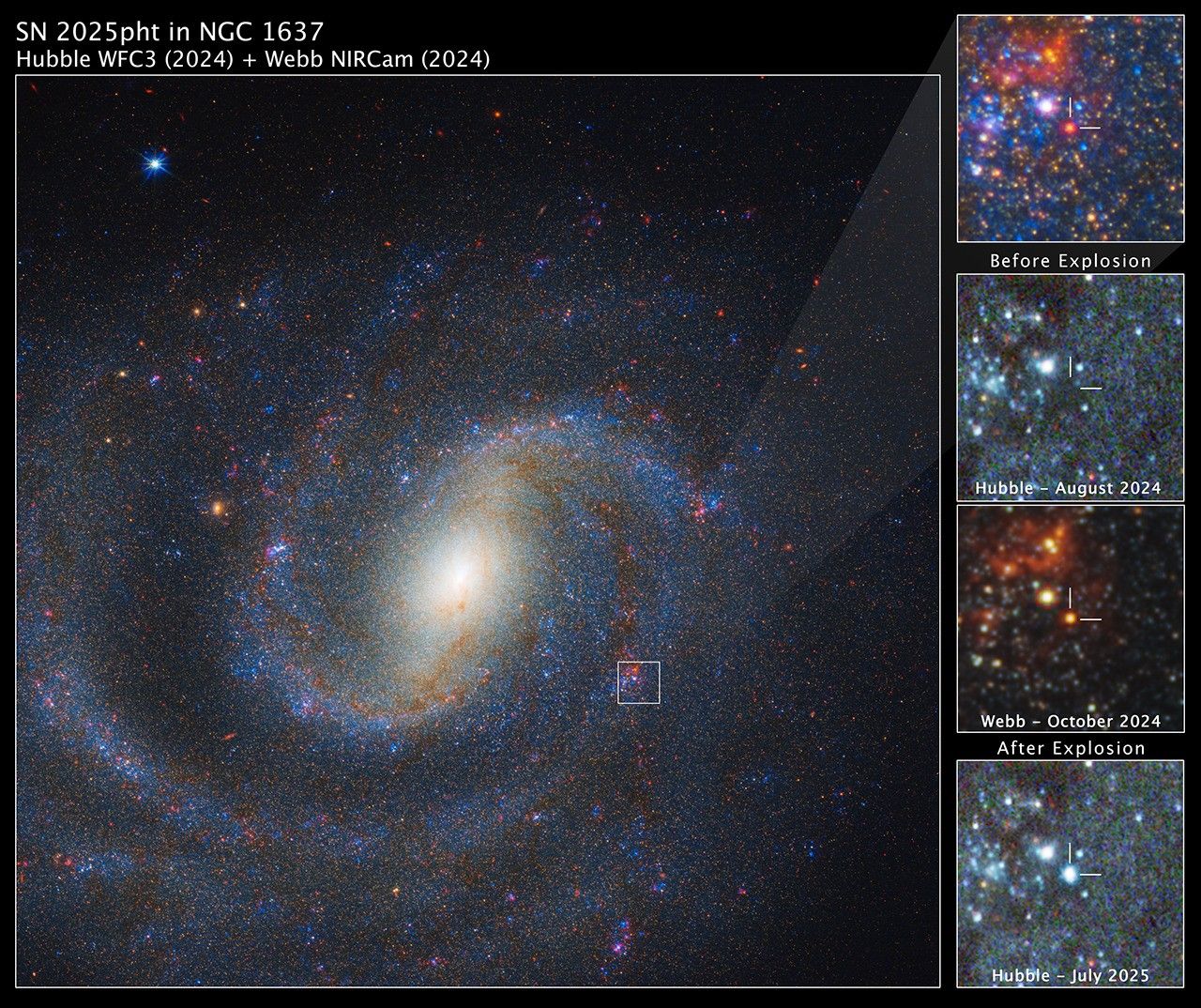
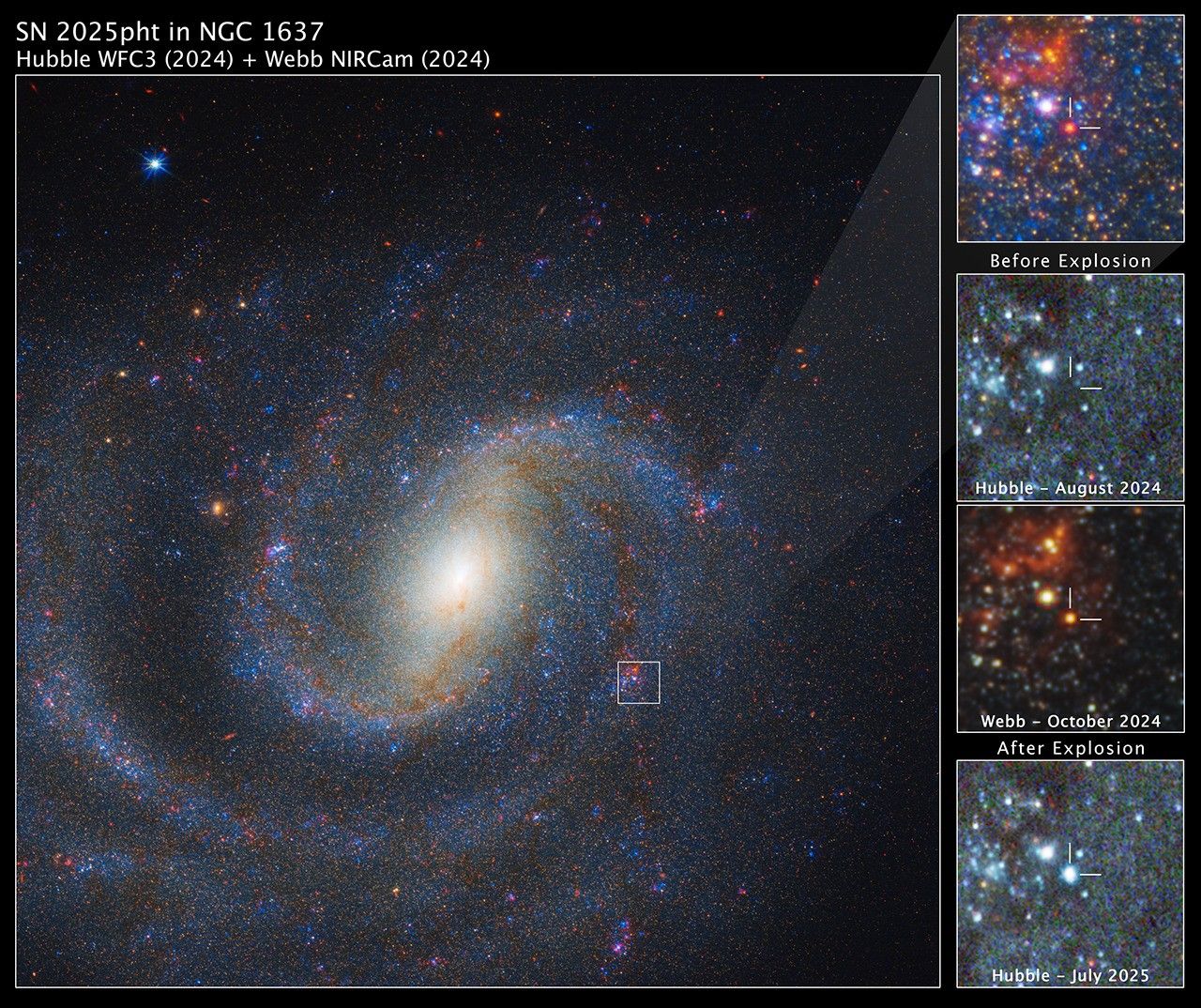
Explore Webb Science James Webb Space Telescope (JWST) NASA’s Webb Telescope… Webb News Latest News Latest Images Webb’s Blog Awards X (offsite – login reqd) Instagram (offsite – login reqd) Facebook (offsite- login reqd) Youtube (offsite) Overview About Who is James Webb? Fact Sheet Impacts+Benefits FAQ Webb Timeline Science Overview and Goals Early Universe Galaxies Over Time Star Lifecycle Other Worlds Science/Engineering Explainers Observatory Overview Launch Deployment Orbit Mirrors Sunshield Instruments & ISIM Module Instrument: NIRCam Instrument: MIRI Instrument: NIRSpec Instrument: FGS/NIRISS Optical Telescope Element Backplane Spacecraft Bus Multimedia About Webb Images Images Videos What is Webb Observing? 3d Webb in 3d Solar System Podcasts Webb Image Sonifications Webb’s First Images Team International Team People Of Webb More For the Media For Scientists For Educators For Fun/Learning 4 Min Read NASA’s Webb Telescope Locates Former Star That Exploded as Supernova 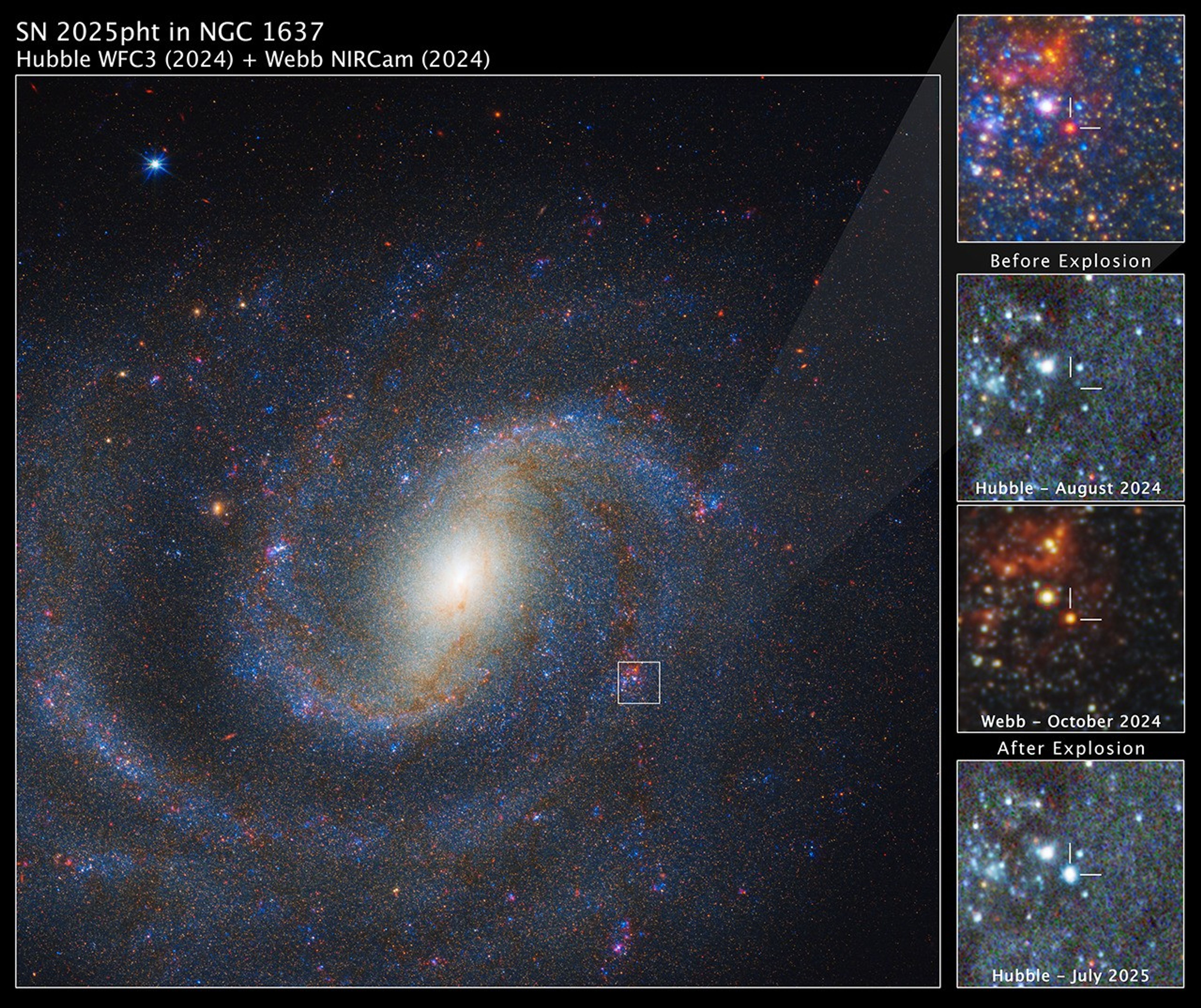 The main image at left shows a combined Webb and Hubble view of spiral galaxy NGC 1637. Panels at right show a detailed view of a red supergiant star before and after it exploded. Before exploding, it is not visible to Hubble, only to Webb. Hubble shows the glowing aftermath. Credits:
Image: NASA, ESA, CSA, STScI, Charles Kilpatrick (Northwestern), Aswin Suresh (Northwestern); Image Processing: Joseph DePasquale (STScI) Forty million years ago, a star in a nearby galaxy exploded, spewing material across space and generating a brilliant beacon of light. That light traveled across the cosmos, reaching Earth June 29, 2025, where it was detected by the All-Sky Automated Survey for Supernovae. Astronomers immediately turned their resources to this new supernova, designated 2025pht, to learn more about it. But one team of scientists instead turned to archives, seeking to use pre-supernova images to identify exactly which star among many had exploded. And they succeeded.
Images of galaxy NGC 1637 taken by NASA’s James Webb Space Telescope showed a single red supergiant star located exactly where the supernova now shines. This represents the first published detection of a supernova progenitor by Webb. The results were published in the Astrophysical Journal Letters.
“We’ve been waiting for this to happen – for a supernova to explode in a galaxy that Webb had already observed. We combined Hubble and Webb data sets to completely characterize this star for the first time,” said lead author Charlie Kilpatrick of Northwestern University.
Image: SN 2025pht in NGC 1637 The main image at left shows a combined Webb and Hubble view of spiral galaxy NGC 1637. Panels at right show a detailed view of a red supergiant star before and after it exploded. Before exploding, it is not visible to Hubble, only to Webb. Hubble shows the glowing aftermath. Image: NASA, ESA, CSA, STScI, Charles Kilpatrick (Northwestern), Aswin Suresh (Northwestern); Image Processing: Joseph DePasquale (STScI) Case of missing red supergiants By carefully aligning Hubble and Webb images taken of NGC 1637, the team was able to identify the progenitor star in images taken by Webb’s MIRI (Mid-Infrared Instrument) and NIRCam (Near-Infrared Camera) in 2024. They found that the star appeared surprisingly red – an indication that it was surrounded by dust that blocked shorter, bluer wavelengths of light.
“It’s the reddest, most dusty red supergiant that we’ve seen explode as a supernova,” said graduate student and co-author Aswin Suresh of Northwestern University.
This excess of dust could help explain a long-standing problem in astronomy that could be described as the case of the missing red supergiants. Astronomers expect the most massive stars that explode as supernovas to also be the brightest and most luminous. So, they should be easy to identify in pre-supernova images. However, that hasn’t been the case.
One potential explanation is that the most massive aging stars are also the dustiest. If they’re surrounded by large quantities of dust, their light could be dimmed to the point of undetectability. The Webb observations of supernova 2025pht support that hypothesis.
“I’ve been arguing in favor of that interpretation, but even I didn’t expect to see it as extreme as it was for supernova 2025pht. It would explain why these more massive supergiants are missing because they tend to be more dusty,” said Kilpatrick.
Carbon “burps” The team was not only surprised by the amount of dust, but also by its composition. Applying computer models to the Webb observations indicated that the dust is likely carbon-rich, when astronomers would have expected it to be more silicate-rich. The team speculates that this carbon might have been dredged up from the star’s interior shortly before it exploded.
“Having observations in the mid-infrared was key to constraining what kind of dust we were seeing,” said Suresh.
The team now is working to look for similar red supergiants that may explode as supernovas in the future. Observations by NASA’s upcoming Nancy Grace Roman Space Telescope may help this search. Roman will have the resolution, sensitivity, and infrared wavelength coverage to not only see these stars, but also potentially witness their variability as they “burp” out large quantities of dust near the end of their lives.
The James Webb Space Telescope is the world’s premier space science observatory. Webb is solving mysteries in our solar system, looking beyond to distant worlds around other stars, and probing the mysterious structures and origins of our universe and our place in it. Webb is an international program led by NASA with its partners, ESA (European Space Agency) and CSA (Canadian Space Agency).
To learn more about Webb, visit:
Downloads & Related Information The following sections contain links to download this article’s images and videos in all available resolutions followed by related information links, media contacts, and if available, research paper and Spanish translation links.
Related Images & Videos SN 2025pht in NGC 1637 The main image at left shows a combined Webb and Hubble view of spiral galaxy NGC 1637. Panels at right show a detailed view of a red supergiant star before and after it exploded. Before exploding, it is not visible to Hubble, only to Webb. Hubble shows the glowing aftermath.
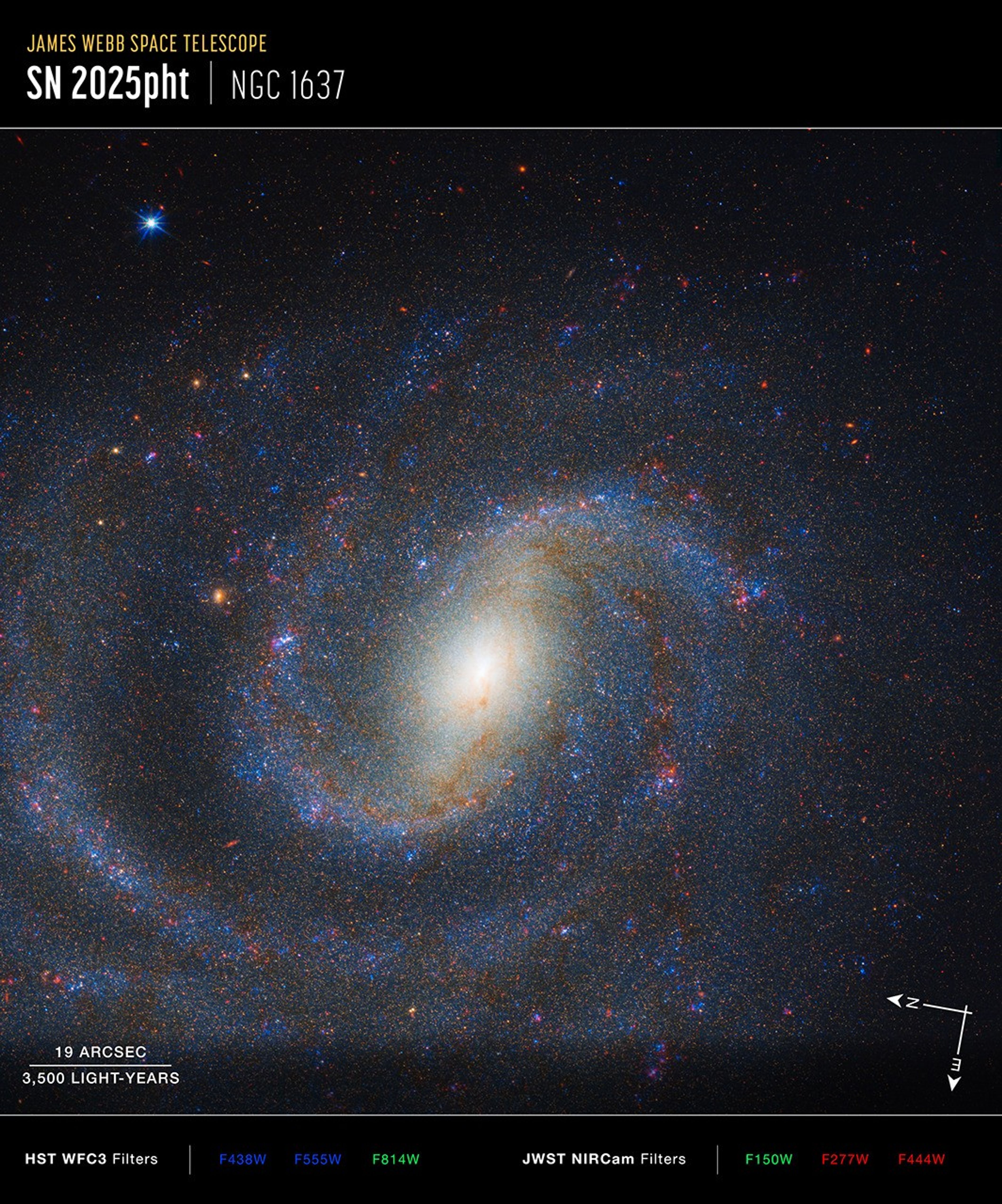 NGC 1637 Compass Image Image of galaxy NGC 1637 captured by Hubble’s WFC3 and Webb’s NIRCam, with compass arrows, scale bar, and color key for reference.
Related Links Read more: NASA’s Webb Opens New Window on Supernova Science
Explore more: ViewSpace Star Death: Crab Nebula
Explore more: ViewSpace Take a Tour of Cassiopeia A
Explore more: Massive Stars: Engines of Creation
Read more: NASA’s Webb Identifies Earliest Supernova to Date, Shows Host Galaxy
Details Last Updated Feb 23, 2026 Location NASA Goddard Space Flight Center Contact Media Laura Betz
NASA’s Goddard Space Flight Center
Greenbelt, Maryland
laura.e.betz@nasa.gov
Christine Pulliam
Space Telescope Science Institute
Baltimore, Maryland
Related Terms James Webb Space Telescope (JWST) Astrophysics Goddard Space Flight Center Science & Research Spiral Galaxies Stars Supernovae The Universe
Related Links and Documents The science paper by C. Kilpatrick et al.
Keep Exploring Related Topics James Webb Space Telescope
Webb is the premier observatory of the next decade, serving thousands of astronomers worldwide. It studies every phase in the…