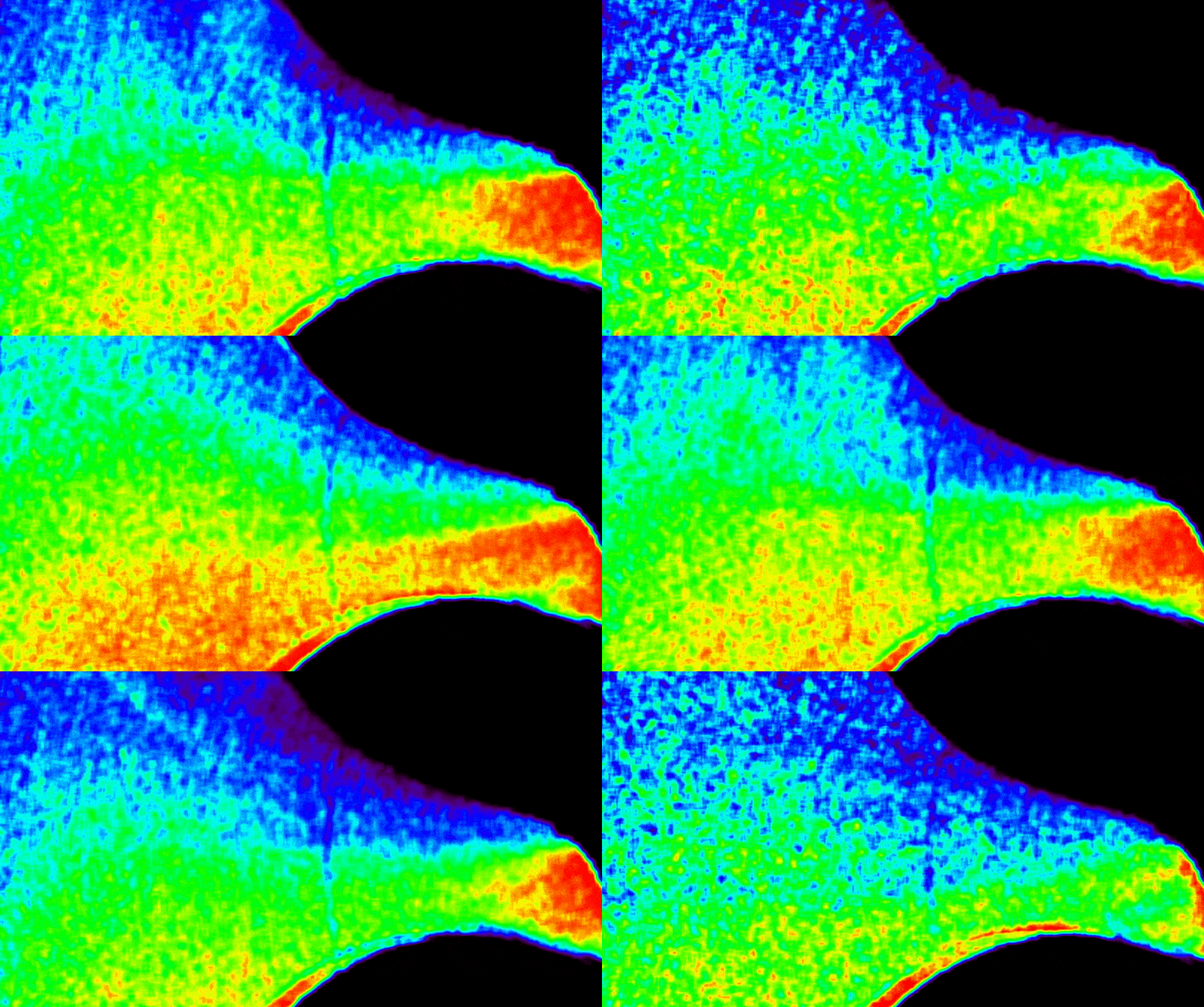
 For the first time, scientists can observe temperature changes in the Sun’s outer atmosphere thanks to new technology introduced by NASA’s CODEX instrument. This animated, color-coded heat map shows temperature changes over the course of a couple days, where red indicates hotter regions and purple indicates cooler ones. NASA/KASI/INAF/CODEX Key Points: NASA’s CODEX investigation captured images of the Sun’s outer atmosphere, the corona, showcasing new aspects of its gusty, uneven flow. The CODEX instrument, located on the International Space Station, is a coronagraph — a scientific tool that creates an artificial eclipse with physical disks — that measures the speed and temperature of solar wind using special filters. These first-of-their-kind measurements will help scientists improve models of space weather and better understand the Sun’s impact on Earth. Scientists analyzing data from NASA’s CODEX (Coronal Diagnostic Experiment) investigation have successfully evaluated the instrument’s first images, revealing the speed and temperature of material flowing out from the Sun. These images, shared at a press event Tuesday at the American Astronomical Society meeting in Anchorage, Alaska, illustrate the Sun’s outer atmosphere, or corona, is not a homogenous, steady flow of material, but an area with sputtering gusts of hot plasma. These images will help scientists improve their understanding of how the Sun impacts Earth and our technology in space.
“We really never had the ability to do this kind of science before,” said Jeffrey Newmark, a heliophysicist at NASA’s Goddard Space Flight Center in Greenbelt, Maryland, and the principal investigator for CODEX. “The right kind of filters, the right size instrumentation — all the right things fell into place. These are brand new observations that have never been seen before, and we think there’s a lot of really interesting science to be done with it.”
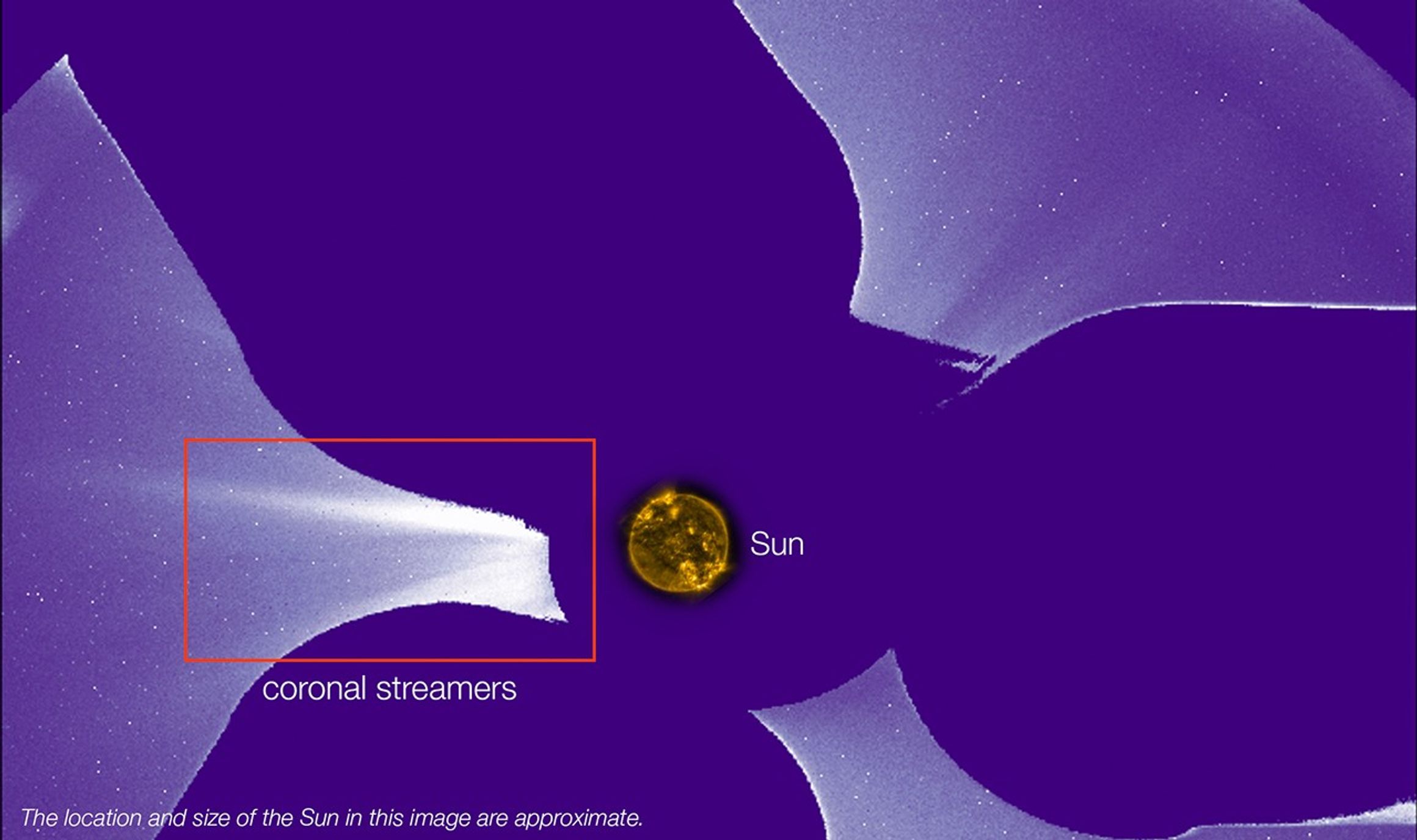 The Sun continuously radiates material in the form of the solar wind. The Sun’s magnetic field shapes this material, sometimes creating flowing, ray-like formations called coronal streamers. In this view from NASA’s CODEX instrument, large dark spots block much of the bright light from the Sun. Blocking this light allows the instrument’s sensitive equipment to capture the faint light of the Sun’s outer atmosphere. NASA/KASI/INAF/CODEX NASA’s CODEX is a solar coronagraph, an instrument often employed to study the Sun’s faint corona, or outer atmosphere, by blocking the bright face of the Sun. The instrument, which is installed on the International Space Station, creates artificial eclipses using a series of circular pieces of material called occulting disks at the end of a long telescope-like tube. The occulting disks are about the size of a tennis ball and are held in place by three metal arms.
Scientists often use coronagraphs to study visible light from the corona, revealing dynamic features, such as solar storms, that shape the weather in space, potentially impacting Earth and beyond.
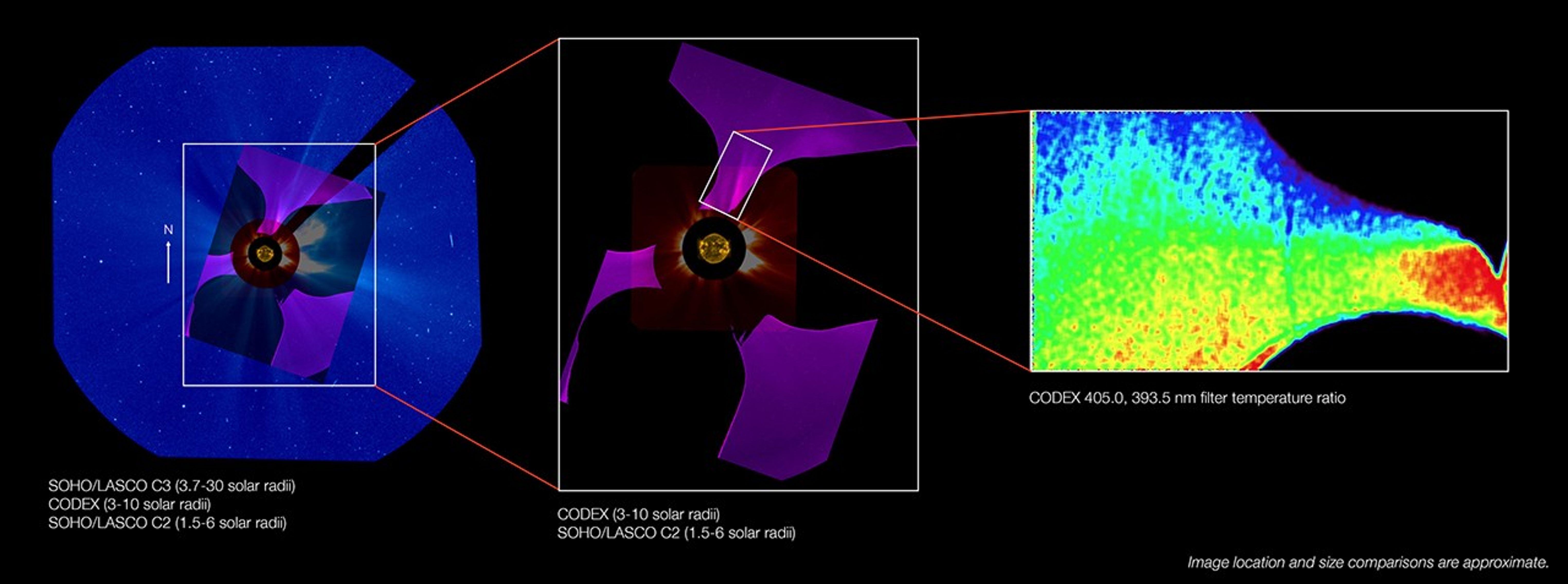 NASA missions use coronagraphs to study the Sun in various ways, but that doesn’t mean they all see the same thing. Coronagraphs on the joint NASA-ESA Solar and Heliospheric Observatory (SOHO) mission look at visible light from the solar corona with both a wide field of view and a smaller one. The CODEX instrument’s field of view is somewhere in the middle, but looks at blue light to understand temperature and speed variations in the background solar wind.
In this composite image of overlapping solar observations, the center and left panels show the field-of-view coverage of the different coronagraphs with overlays and are labeled with observation ranges in solar radii. The third panel shows a zoomed-in, color-coded portion of the larger CODEX image. It highlights the temperature ratios in that portion of the solar corona using CODEX 405.0 and 393.5 nm filters. NASA/ESA/SOHO/KASI/INAF/CODEX “The CODEX instrument is doing something new,” said Newmark. “Previous coronagraph experiments have measured the density of material in the corona, but CODEX is measuring the temperature and speed of material in the slowly varying solar wind flowing out from the Sun.”
These new measurements allow scientists to better characterize the energy at the source of the solar wind.
The CODEX instrument uses four narrow-band filters — two for temperature and two for speed — to capture solar wind data. “By comparing the brightness of the images in each of these filters, we can tell the temperature and speed of the coronal solar wind,” said Newmark.
Understanding the speed and temperature of the solar wind helps scientists build a more accurate picture of the Sun, which is necessary for modeling and predicting the Sun’s behaviors.
“The CODEX instrument will impact space weather modeling by providing constraints for modelers to use in the future,” said Newmark. “We’re excited for what’s to come.”
by NASA Science Editorial Team
NASA’s Goddard Space Flight Center, Greenbelt, Md
CODEX is a collaboration between NASA Goddard Space Flight Center and the Korea Astronomy and Space Science Institute (KASI) with additional contribution from Italy’s National Institute for Astrophysics (INAF).
Details Last Updated Jun 10, 2025 Related Terms Heliophysics Coronagraph Coronal Diagnostic Experiment (CODEX) Goddard Space Flight Center Heliophysics Division Space Weather The Sun The Sun & Solar Physics